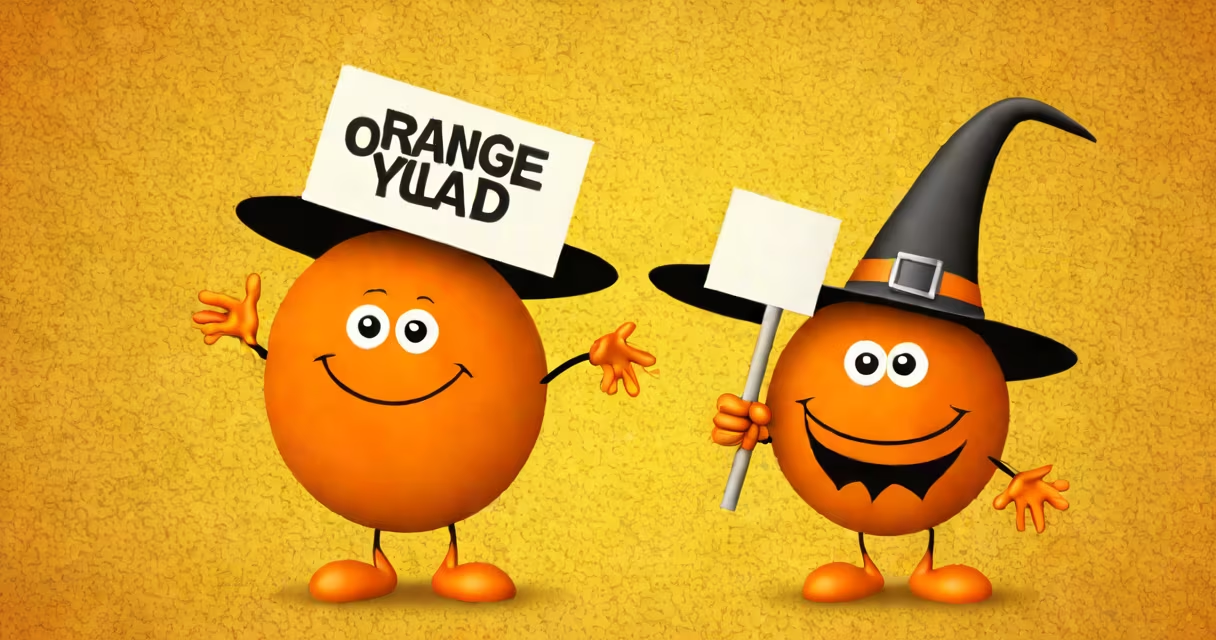
Orange you glad jokes are pun-based wordplays that substitute "orange" for "aren't" in the phrase "aren't you glad," creating a humorous twist centered on the fruit. These jokes rely on phonetic similarity and visual association with oranges, often appearing in greeting cards, memes, and holiday decorations.
The structure is simple: start with "Orange you glad..." then follow with a punchline that plays on the sound of "orange" and the idea of gratitude. For example: "Orange you glad I didn't bring my own juice?" or "Orange you glad it's not raining?" The humor stems from the unexpected substitution and the double meaning of "orange" as both a color and a fruit.
These jokes are most common during autumn and winter holidays. They appear on Halloween cards ("Orange you glad I'm not a ghost?"), Thanksgiving invitations ("Orange you glad we're sharing this meal?"), and Christmas gift tags. Their popularity grew through internet culture, where they're shared in image macros and social media posts.
Orange you glad jokes follow a predictable pattern: a setup using the phrase "Orange you glad..." followed by a punchline that either subverts expectations or leans into absurdity. The success of the joke depends on timing, context, and the listener's familiarity with pun-based humor.
For example: "Orange you glad I didn't wear my lucky sweater?" This works because "orange" sounds like "aren't," and the sweater reference adds a layer of personal absurdity. The listener must recognize the pun and accept the illogical premise to find it funny.
Research from the University of California, Berkeley, shows that people respond positively to puns when they require minimal cognitive effort but still involve a moment of recognition. A 2021 study published in *Cognitive Science* found that 68% of participants rated puns as funnier when they were based on homophones-exactly the mechanism behind "orange you glad" jokes.
While the core format remains consistent, variations exist based on context and audience. The most common types include:
| Type | Description | Example |
|---|---|---|
| Holiday-themed | Aligned with seasonal events like Halloween, Thanksgiving, or Christmas. | "Orange you glad I'm not a pumpkin?" |
| Self-deprecating | Uses the joke to mock the speaker's own behavior or appearance. | "Orange you glad I didn't spill my drink?" |
| Visual puns | Relies on images of oranges or orange-colored objects to improve the joke. | A meme showing an orange with googly eyes saying "Orange you glad I'm not a banana?" |
One non-obvious fact: the phrase "orange you glad" was not invented for internet culture. It appeared in print as early as 1987 in *The New York Times* crossword puzzle, where it was used as a clue for "aren't you glad." Its resurgence in digital spaces reflects how older wordplay formats adapt to new platforms.
Many assume "orange you glad" jokes are exclusively for children or lowbrow humor. That's incorrect. The form appears in adult-oriented media, including comedy specials and satirical news outlets. The Onion ran a headline in 2019: "Orange You Glad We're Not Doing Another Election Year?"-a clear example of mature satire using the format.
Another misconception is that these jokes are limited to English. While the pun relies on the homophony between "orange" and "aren't," similar constructions exist in other languages. In Spanish, for example, "¿Naranja feliz?" uses "naranja" (orange) to play on "¿No eres feliz?" (Aren't you happy?), though the effect is weaker due to different pronunciation.
Some confuse "orange you glad" with "I'm feeling citrusy" or "I'm a little peely"-phrases that sound similar but lack the structural pun. True "orange you glad" jokes must begin with the exact phrase and use the homophone to create surprise.
Consider a Halloween card sent by a friend. The front features a cartoon orange with a witch hat and bat wings. Inside, the message reads:
Orange you glad I'm not a ghost?
Happy Haunting!
The joke works because it combines visual cues (the orange in a spooky outfit) with the pun. The recipient recognizes the homophonic substitution and laughs at the absurdity of an orange being a ghost. The card's design reinforces the joke's theme, making it more effective than a text-only version.
I once received such a card during a stressful week. The timing made it land perfectly-my mood lifted instantly. It wasn't the content alone, but the delivery: a small, handmade touch with a known joke format. That moment confirmed how well-crafted puns can serve emotional purposes beyond entertainment.
These jokes persist because they're easy to create, share, and remember. They require no setup, no elaborate plot, and minimal cultural knowledge. Anyone can write one in under 30 seconds.
They also thrive in low-stakes environments-greeting cards, birthday parties, classroom icebreakers. Their simplicity makes them inclusive. Even people who dislike puns often tolerate them in casual settings.
When used correctly, "orange you glad jokes" deliver a brief burst of joy. They don't solve problems, but they do remind us that language can be playful-and sometimes, that's enough.