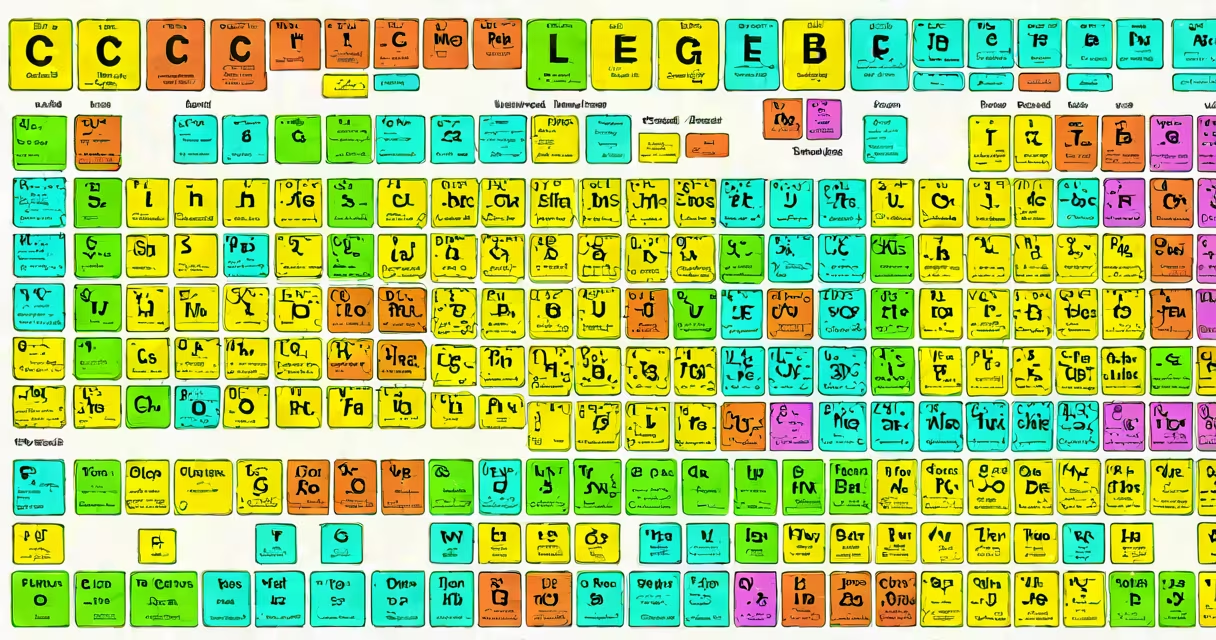
The periodic table arranges elements by increasing atomic number, which equals the number of protons in the nucleus. Each element's position reveals its proton count and electron configuration, defining its chemical identity and reactivity.
Elements are ordered left to right and top to bottom based on atomic number-the number of protons in the atom's nucleus. This number is unique to each element and determines its place on the table. For example, hydrogen has 1 proton and occupies the first position. Iron has 26 protons and appears in period 4, group 8. The atomic number is written above the element symbol in standard notation.
Electrons orbit the nucleus in energy levels called shells. The number of electrons in a neutral atom equals the number of protons. So hydrogen has 1 electron, carbon has 6, and uranium has 92. These electrons fill shells in a predictable pattern: the first shell holds up to 2 electrons, the second up to 8, the third up to 18, and so on. The outermost shell determines how an element bonds with others.
Each row (period) corresponds to a new electron shell being filled. Period 1 contains elements with electrons in only the first shell. Period 2 adds the second shell. As you move across a period, electrons fill subshells in the order s, p, d, f. Group numbers indicate valence electrons-those involved in bonding. Elements in group 1 have one valence electron; group 18 have eight (except helium, which has two).
For example, sodium (Na) has atomic number 11. Its electron configuration is 1s² 2s² 2p⁶ 3s¹. That's 2 electrons in the first shell, 8 in the second, and 1 in the third. The single electron in the third shell makes sodium highly reactive-it readily donates that electron to form Na⁺ ions. Chlorine (Cl), atomic number 17, has configuration 1s² 2s² 2p⁶ 3s² 3p⁵-seven valence electrons. It gains one electron to complete its outer shell, forming Cl⁻.
Transition metals in groups 3-12 have electrons filling inner d-orbitals. Iron (Fe, atomic number 26) has configuration [Ar] 4s² 3d⁶. The 3d electrons influence magnetic properties and oxidation states. This complexity explains why iron forms multiple stable ions like Fe²⁺ and Fe³⁺.
Standard periodic tables display several key values:
| Element | Atomic Number (Protons) | Electron Count (Neutral Atom) | Valence Electrons | Group |
|---|---|---|---|---|
| Carbon (C) | 6 | 6 | 4 | 14 |
| Oxygen (O) | 8 | 8 | 6 | 16 |
| Sodium (Na) | 11 | 11 | 1 | 1 |
| Chlorine (Cl) | 17 | 17 | 7 | 17 |
These values are consistent across all versions of the periodic table. The atomic number is always the whole number listed above the symbol. Electron count matches the atomic number in neutral atoms. Valence electrons are determined by group number for main-group elements (groups 1, 2, 13-18).
Some tables include electron configurations below the symbol. Others show oxidation states or electronegativity. But the core layout remains focused on proton count and electron shell structure.
People often assume that the periodic table shows mass number or neutron count. It does not. Mass number varies by isotope. Carbon-12 has 6 neutrons; carbon-14 has 8. Both are carbon because they share 6 protons. The table reflects only proton count and electron arrangement.
Another misconception is that all elements in a group behave identically. While they share similar valence structures, size and shielding effects cause differences. Lithium (Li) reacts violently with water. Sodium (Na) does too-but less violently. Potassium (K) explodes. The trend arises from increasing atomic radius and decreasing ionization energy down the group.
A non-obvious fact: the periodic table's layout was designed to reflect electron shell filling patterns. Mendeleev left gaps for undiscovered elements based on missing positions. He predicted eka-silicon (germanium) with properties close to silicon. When germanium was discovered in 1886, its atomic weight and density matched Mendeleev's predictions within 1%. This confirmed the table's predictive power based on electron configuration.
Chemists use the periodic table to predict compound formation. For example, magnesium (Mg, atomic number 12) has electron configuration 1s² 2s² 2p⁶ 3s². It loses two electrons to form Mg²⁺. Oxygen (O, atomic number 8) gains two electrons to form O²⁻. Together, they form MgO-magnesium oxide-a stable ionic compound used in refractory materials.
In materials science, the table guides alloy design. Titanium (Ti, atomic number 22) has four valence electrons. Its ability to form strong covalent bonds makes it ideal for aerospace components. Chromium (Cr, atomic number 24) adds corrosion resistance when alloyed with iron. Stainless steel combines iron, chromium, and nickel-elements chosen for their electron configurations and bonding stability.
I once used the periodic table to troubleshoot a failed solder joint in a circuit board. The joint was brittle. Checking the table revealed that tin (Sn, atomic number 50) and lead (Pb, atomic number 82) form a eutectic alloy at 183°C. But lead-free solder uses tin and silver. Silver has a different electron configuration and higher melting point. Adjusting the ratio based on electron shell compatibility improved joint strength.
Understanding periodic table electrons and protons unlocks the logic behind elemental behavior. Each element's position is not arbitrary-it reflects a precise balance of protons and electrons that shapes chemistry, materials, and life itself.