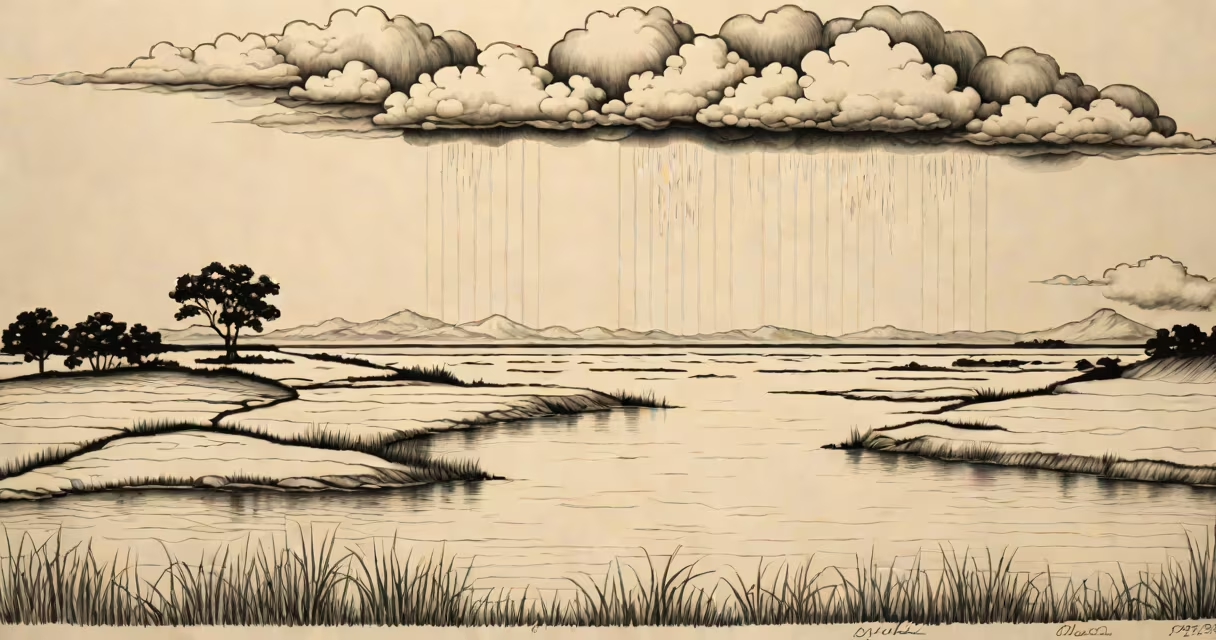
Research about water cycle investigates the continuous movement of water through Earth's atmosphere, land, and oceans via evaporation, condensation, precipitation, and collection. This process sustains ecosystems, shapes climates, and supports human water use.
The water cycle, also known as the hydrological cycle, describes how water evaporates from surfaces like oceans and lakes, rises into the atmosphere, cools, condenses into clouds, and returns to Earth as precipitation. It then flows over land or infiltrates soil, eventually returning to oceans or lakes through runoff and groundwater flow. This cycle operates continuously across global scales and local environments.
Scientists use satellite data, ground sensors, and climate models to track water movement. For example, NASA's GRACE satellites measure changes in Earth's gravity caused by shifts in water mass, revealing groundwater depletion in regions like California's Central Valley. Research about water cycle helps predict droughts, floods, and long-term climate impacts.
Water begins its process when solar energy heats surface water, causing evaporation. Over oceans, this accounts for 86% of global evaporation. Water vapor rises, cools, and condenses into tiny droplets around dust particles, forming clouds. When droplets grow too heavy, they fall as precipitation-rain, snow, sleet, or hail.
Once on land, precipitation follows several paths. Some runs off into rivers and lakes. Some seeps into soil, becoming groundwater. Plants absorb water through roots and release it through leaves in a process called transpiration. All these processes feed back into the cycle.
A single drop of water may travel through multiple phases. A raindrop falling on a forest in the Amazon might evaporate from tree leaves, rise to form a cloud, drift over the Andes, fall as snow, melt, flow into a river, and reach the Atlantic Ocean-all within weeks. This illustrates the interconnectedness of the system.
Researchers categorize water cycle processes into four core stages: evaporation, condensation, precipitation, and collection. Each stage involves measurable physical and chemical interactions.
| Stage | Description | Measurement Method |
|---|---|---|
| Evaporation | Water turns from liquid to vapor at surface | Satellite infrared sensors, eddy covariance towers |
| Condensation | Vapor cools and forms liquid droplets in clouds | Radar, lidar, weather balloons |
| Precipitation | Water falls from clouds as rain, snow, etc. | Weather radar, rain gauges, satellite microwave sensors |
| Collection | Water gathers in oceans, lakes, glaciers, or soil | GRACE satellites, streamflow gauges, soil moisture probes |
Climate scientists analyze long-term trends in the water cycle using data from the Global Precipitation Measurement (GPM) mission. GPM data shows that tropical regions have seen a 5% increase in rainfall intensity since 2000, while arid zones face declining recharge rates. These findings inform water resource planning and disaster preparedness.
Research about water cycle also includes modeling. The Community Land Model (CLM), used by the National Center for Atmospheric Research, simulates how vegetation and soil affect evapotranspiration. Simulations show that deforestation in the Congo Basin reduces regional rainfall by up to 15%, altering local agriculture and biodiversity.
Many assume the water cycle is closed and balanced at all times. But research shows it is changing and sensitive to temperature and land use. For example, a 2°C rise in global average temperature increases evaporation rates by 7% per degree, according to the Intergovernmental Panel on Climate Change (IPCC) Sixth Assessment Report.
Another misconception is that all precipitation becomes runoff. In reality, only 30% of rainfall ends up in streams in temperate forests. The rest is absorbed by soil, taken up by plants, or evaporated directly from leaf surfaces. This is why urban areas with impermeable surfaces experience flash flooding during storms-their drainage systems cannot handle rapid runoff.
Some confuse the water cycle with the carbon cycle. While both involve exchanges between atmosphere and biosphere, the water cycle moves water molecules through phase changes driven by heat. The carbon cycle involves biochemical reactions that store carbon in living tissue and fossil fuels. They interact-plants use water and CO₂-but their mechanisms differ.
In 2019, researchers at the University of California, Davis, used research about water cycle to model groundwater depletion in the Central Valley. By combining satellite data with field measurements, they identified that over-pumping for almond farming reduced aquifer levels by 1.5 meters between 2003 and 2015. Their findings led to revised irrigation policies and water allocation rules.
Another example: the 2022 Pakistan floods were linked to a stalled monsoon system. Research about water cycle helped meteorologists understand how unusually warm Arabian Sea waters increased moisture transport into the region. The resulting rainfall totaled 300 mm in 48 hours-over 10 times the monthly average. Early warnings based on water cycle modeling saved thousands of lives.
I once observed a classroom experiment where students tracked water movement through a terrarium. After 72 hours, 82% of the initial water had condensed on the glass and returned as droplets. This hands-on demonstration confirmed that evaporation and condensation occur rapidly under controlled conditions-a principle applied in industrial cooling towers and desert fog harvesters.
Research about water cycle remains essential for managing freshwater resources, adapting to climate change, and supporting food production. It combines physics, biology, and environmental science to explain one of Earth's most important systems.