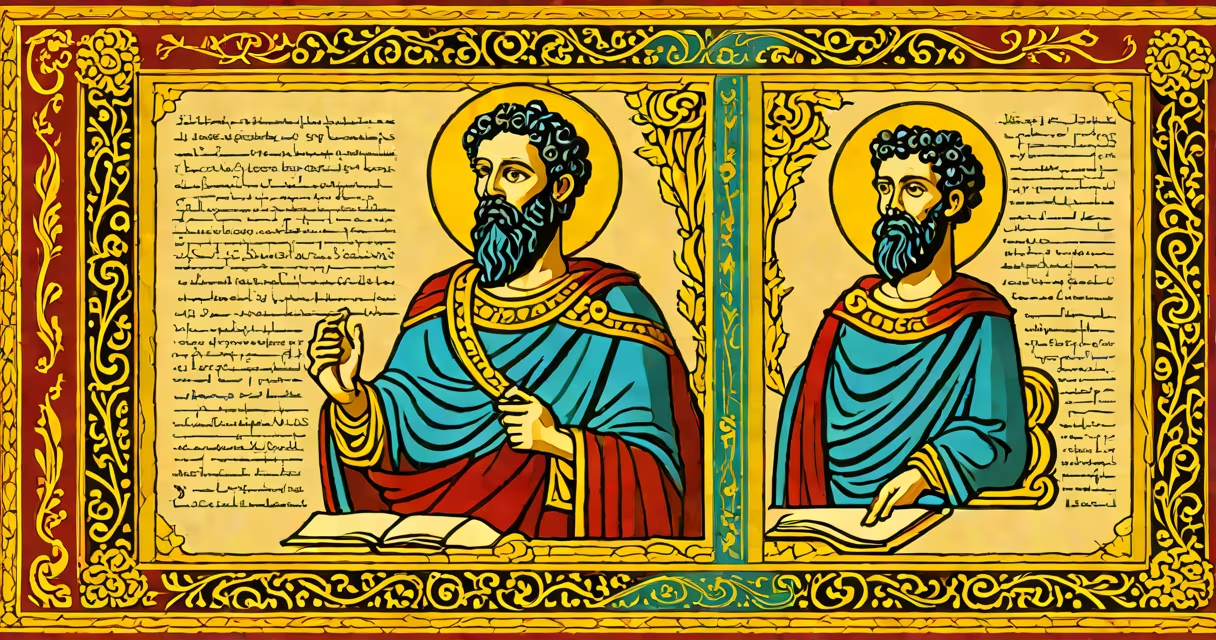
The Meditations of Marcus Aurelius Antoninus is a series of personal reflections written in Greek between 161 and 180 CE by the Roman emperor and Stoic philosopher Marcus Aurelius. These writings were not intended for public release but served as daily exercises in moral discipline, self-examination, and philosophical grounding during times of war, plague, and political strain.
Marcus wrote the Meditations while serving as consul and later as sole ruler of Rome. He composed them in moments of solitude, often during military campaigns or administrative duties. The work consists of 12 books, each containing brief entries-some just a sentence, others several paragraphs-focused on ethical conduct, impermanence, rationality, and the role of the individual within the cosmos.
Modern scholars treat the Meditations as a foundational text of Stoicism, a school of thought emphasizing self-control, acceptance of fate, and living in accordance with nature and reason. Its influence extends beyond philosophy into literature, psychology, and leadership training. The original Greek text survives through medieval manuscripts, with the earliest complete version dating to the 12th century.
Marcus structured his reflections around recurring themes: the brevity of life, the inevitability of death, the futility of external praise, and the necessity of virtuous action regardless of outcome. He repeatedly reminded himself that he was part of a larger whole-the universe governed by divine reason (logos)-and that human beings must align their will with this rational order.
Each entry functions as a mental exercise. For example, Book 4, Chapter 26 states: "You could leave life right now. Let that determine the kind of person you want to be." This is not passive resignation but active preparation: cultivating equanimity through constant awareness of mortality.
These entries were not meant to be read sequentially. They reflect a stream-of-consciousness practice, similar to journaling or daily affirmations. Marcus did not write for publication; he wrote to maintain clarity under pressure. His goal was not to create a system of ethics but to reinforce one.
The Meditations are composed in Koine Greek, the common dialect of the Eastern Mediterranean during the Roman Empire. Marcus used simple syntax and direct phrasing, avoiding rhetorical flourishes. His tone is consistent: calm, introspective, and unflinching.
He frequently references Stoic concepts such as:
One notable feature is Marcus's use of the second-person pronoun "you" throughout. He speaks directly to himself, creating a dialogue between his current self and his ideal self. This technique reinforces accountability and internal consistency.
Today, the Meditations are widely studied in leadership programs, cognitive behavioral therapy (CBT), and personal development circles. Its emphasis on emotional regulation and focus on controllable actions resonates strongly with modern psychological research.
A 2019 study published in the Journal of Positive Psychology found that participants who practiced daily reflection using Stoic principles-inspired by Marcus's methods-reported higher levels of stress resilience and decision-making clarity over a six-week period. The researchers noted that the most effective practices involved writing down one's values and reviewing them against daily behavior.
Many leaders, including former U.S. President Barack Obama and entrepreneur Tim Ferriss, have cited the Meditations as a source of daily guidance. Ferriss described reading a passage each morning as a way to "reset the mind before the day begins."
For example, in Book 5, Marcus writes: "When you wake up in the morning, think of the privilege of being alive, of breathing, of thinking, of loving." This line appears in numerous mindfulness apps and meditation guides, often paraphrased but rarely matched in precision.
Many readers assume the Meditations are a systematic philosophy, like Aristotle's Ethics or Plato's Republic. They are not. Marcus never presents arguments or defends positions. He does not engage with opposing views. Instead, he uses repetition and self-address to build habits of thought.
Another misconception is that Stoicism promotes emotional suppression. Marcus explicitly rejects this. In Book 7, he writes: "You have power over your mind-not outside events. Realize this, and you will find strength." This is not about denying emotion but controlling reaction. He acknowledges grief, fear, and desire-but insists they must be judged by reason, not acted upon blindly.
A lesser-known fact: Marcus did not publish the Meditations during his lifetime. They were discovered among his personal papers after his death in 180 CE. The first printed edition appeared in 1558, translated into Latin by the scholar Johann Friedrich Gronovius. The work gained popularity in the 18th century through Enlightenment thinkers like Voltaire and David Hume, who admired its rational rigor.
There is no single authoritative version of the Meditations. Different translations emphasize different tones-some prioritize accuracy, others readability. The following table compares major editions:
| Translation | Translator | Focus | Best For |
|---|---|---|---|
| Stoic Philosophy: The Complete Works | Christopher Gill | Philosophical fidelity | Academic study |
| The Meditations | Gregory Hays | Clarity and flow | General readers |
| Thoughts from the Emperor | William Irvine | Practical application | Self-improvement |
| La Meditazione | Marco Pellegrino | Italian literary style | Non-English speakers |
Each translation alters the rhythm and tone. Hays' version, for instance, uses modern idioms: "You're going to die," becomes "You're going to die soon." This makes the text accessible but risks softening the original's austerity. Gill's translation preserves the Greek structure more closely, making it harder to read but more faithful to Marcus's intent.
Suppose you face a deadline at work, and a colleague blames you for a delay. Your immediate reaction may be frustration or defensiveness. Marcus would ask: "What is within my control?"
He would remind you that:
Apply this: write down the incident, then ask: "What would a wise person do?" Then act accordingly. This is not denial-it is redirection. Marcus wrote: "When someone acts badly, remember: they are acting out of ignorance. They don't know better." This reframes conflict as education, not offense.
I once used this method during a team conflict. After a failed project launch, I sat with the team and asked each member to write one sentence on what they'd change. No blame. Just reflection. The result was not reconciliation-but clarity. We rebuilt trust through shared accountability, not apology. That moment felt like reading Marcus for the first time.
The Meditations of Marcus Aurelius Antoninus remains relevant because it addresses universal human concerns: suffering, failure, time, and purpose. It offers no magic solutions. It demands effort. But it provides a structure for enduring hardship with dignity.