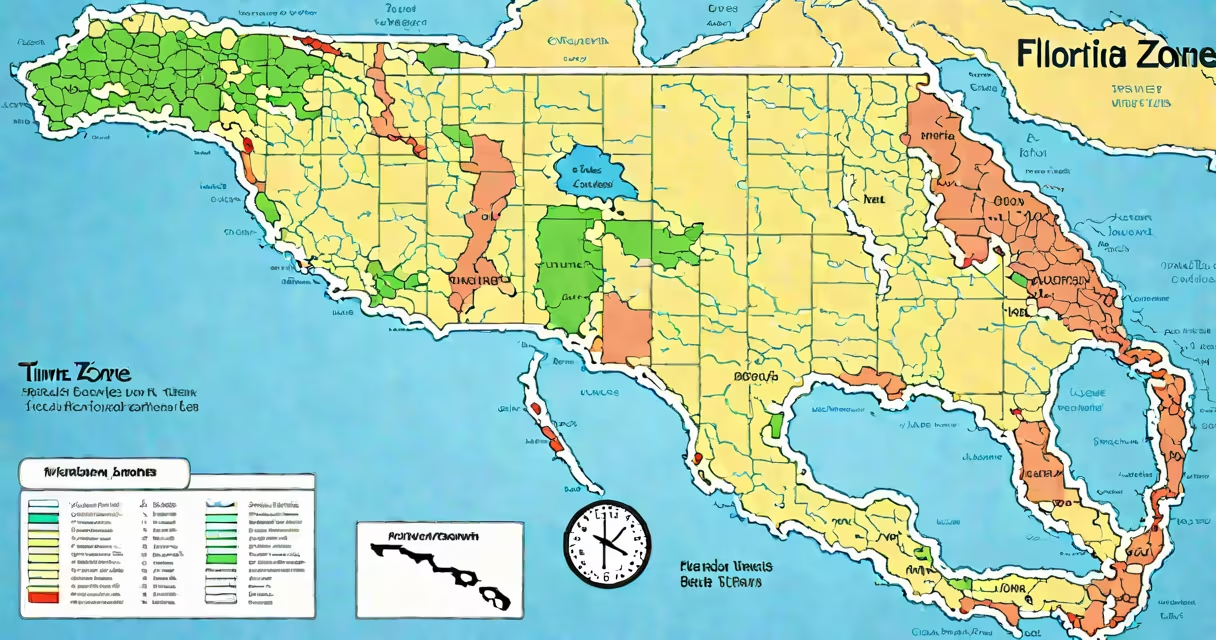
Florida operates primarily in the Eastern Time Zone, observing Central Daylight Time during standard time and switching to Eastern Daylight Time in summer. The state spans two main time zones in practice: Eastern Time (UTC−5) and Central Time (UTC−6), though most of Florida uses Eastern Time.
Florida lies entirely within the contiguous United States' eastern half, placing it in the Eastern Time Zone (ET) for most of the year. This zone includes states like New York, Georgia, and North Carolina. During standard time, Florida observes Eastern Standard Time (EST), which is UTC−5. From March to November, the state switches to Eastern Daylight Time (EDT), UTC−4, advancing clocks by one hour.
The state's western panhandle-counties such as Walton, Okaloosa, and Santa Rosa-follow Central Time (CT), UTC−6, during standard time and Central Daylight Time (CDT), UTC−5, during daylight saving. This division exists due to historical and geographic alignment with neighboring Alabama and Mississippi. The boundary between the two zones runs roughly along the 87th meridian west, dividing the state into eastern and western regions.
Daylight saving time begins on the second Sunday in March and ends on the first Sunday in November. During this period, clocks move forward one hour at 2:00 AM local time. For example, in Miami, clocks go from 1:59 AM to 3:00 AM, skipping the 2:00-3:00 hour. On the last Sunday in October, clocks fall back one hour, repeating the 1:00-2:00 AM window.
These shifts affect daily routines, business hours, and travel schedules. For instance, a 9:00 AM meeting in Orlando during daylight saving time is at 8:00 AM Eastern Time in winter. A call scheduled at 10:00 AM EST in December becomes 11:00 AM EDT in June. This change impacts coordination across U.S. regions, especially in industries like broadcasting, logistics, and healthcare.
Time zone boundaries are not always aligned with political borders. Florida's western panhandle lies in the Central Time Zone despite being part of the southeastern U.S. region. This creates a small but noticeable difference: a person in Pensacola (Central Time) is one hour behind someone in Jacksonville (Eastern Time) during standard time.
Florida uses two primary time zones, each with distinct observance patterns:
| Region | Time Zone (Standard) | Time Zone (Daylight) | Examples |
|---|---|---|---|
| Most of Florida (eastern half) | Eastern Standard Time (EST), UTC−5 | Eastern Daylight Time (EDT), UTC−4 | Miami, Orlando, Tallahassee, Tampa |
| Western Panhandle (e.g., Gulf Coast) | Central Standard Time (CST), UTC−6 | Central Daylight Time (CDT), UTC−5 | Pensacola, Panama City, Fort Walton Beach |
Despite the dual system, the majority of Florida's population lives in the Eastern Time Zone. Over 90% of residents, including those in major metropolitan areas, follow Eastern Time. The western panhandle accounts for less than 10% of the state's population but maintains Central Time due to long-standing economic ties with the Midwest.
A non-obvious distinction: Florida does not observe "permanent daylight saving time." Unlike some states considering legislation to make daylight saving permanent, Florida still reverts to standard time in November. The Uniform Time Act of 1966, enforced by the U.S. Department of Transportation, mandates this cycle nationwide. Even if a state passes a bill to stay on daylight time year-round, federal approval is required.
Many assume Florida is uniformly in one time zone. This is incorrect. The state straddles both Eastern and Central Time Zones. A common error is scheduling events based on a single time zone without checking the location. For example, a concert in Miami at 7:00 PM EDT is at 6:00 PM CST in Pensacola, even though both cities are in Florida.
Another misconception is that Florida's time zone changes annually. It does not. The start and end dates for daylight saving are consistent: second Sunday in March and first Sunday in November. These dates are set by the U.S. Congress and apply across all states using daylight saving.
Some travelers confuse Florida's time with adjacent regions. For instance, the Bahamas, located just south of Florida, uses Atlantic Standard Time (AST), UTC−4, year-round. This means that during daylight saving time, Florida (EDT, UTC−4) and the Bahamas are in sync. But during standard time, Florida (EST, UTC−5) is one hour behind the Bahamas.
Consider a university with campuses in Tallahassee (Eastern Time) and Pensacola (Central Time). A virtual faculty meeting scheduled for 10:00 AM Eastern Time on a Tuesday occurs at 9:00 AM Central Time. If the meeting were held at 10:00 AM in Pensacola, it would be at 11:00 AM in Tallahassee. Time zone awareness prevents missed meetings and scheduling conflicts.
When planning travel, time zone differences affect flight arrival times. A flight from Miami (EST) to Pensacola (CST) departing at 6:00 PM EST arrives at 5:00 PM CST-same clock time, but one hour earlier in the day. Travelers often overlook this, leading to confusion about arrival timing.
I once coordinated a statewide nonprofit event involving teams from Miami, Orlando, and Pensacola. We used a shared calendar with time zone labels. Without this, we'd have had multiple team members show up an hour off schedule. Using tools like Google Calendar's time zone detection helped prevent errors.
Florida's time zone structure reflects decades of geographic and administrative decisions. While the eastern half follows Eastern Time, the western panhandle remains in Central Time-a legacy of rail lines and early trade routes. The split persists because changing it would require significant coordination among local governments, utilities, and emergency services.
Always verify the time zone for your specific location in Florida. Use official sources like the National Institute of Standards and Technology (NIST) or the U.S. Time Zone Map from the U.S. Department of Transportation. These provide accurate, up-to-date references for public and private use.
The time zone for Florida is not uniform. Most of the state uses Eastern Time, but the western panhandle follows Central Time. Both zones observe daylight saving time, shifting clocks forward and backward annually. Awareness of these differences ensures accurate scheduling, travel planning, and communication across the state.