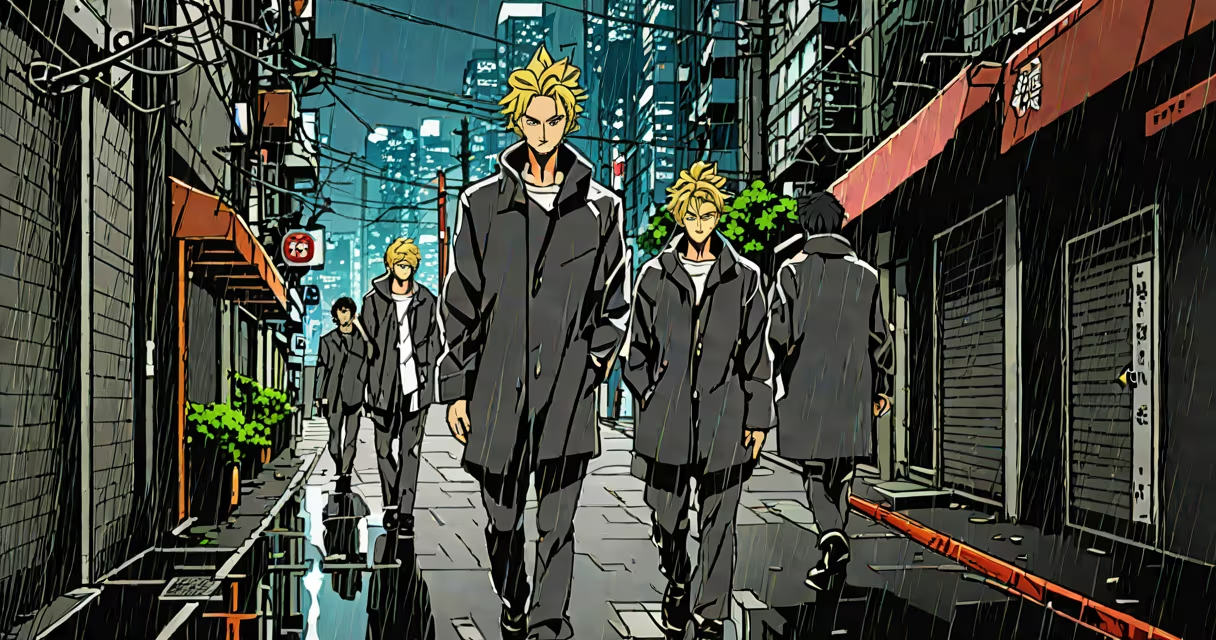
Tokyo Revengers temporada 4 capitulo 1 is the first episode of the fourth season of the anime series Tokyo Revengers, which continues the time-travel narrative centered on Takemichi Hanagaki's efforts to alter Japan's violent past. The episode introduces a major timeline shift triggered by Senju's return, recontextualizing prior events and setting up new conflicts.
The episode begins with Takemichi waking in a hospital after a failed attempt to prevent a school massacre. He realizes he's been pulled into a divergent timeline-one where the Black Wolves' influence has grown unchecked. The core mechanic remains consistent: Takemichi uses his ability to travel back to the past via a train station memory trigger, but this time, the rules have changed. His actions now produce unpredictable ripple effects, including the reappearance of Senju, who was previously believed dead.
Senju's return marks a turning point. Unlike earlier timelines where he was a minor antagonist, here he emerges as a central figure with conflicting loyalties. His presence destabilizes the existing power structure within the Black Wolves and forces Takemichi to confront the possibility that some tragedies cannot be undone-even with multiple resets. This shift aligns with the original manga's arc, where Senju's role expands beyond a mere enforcer to a tragic leader shaped by trauma.
Tokyo Revengers temporada 4 capitulo 1 operates under the show's established time-loop structure, but introduces a new constraint: each reset doesn't erase all consequences. Instead, memories persist across timelines, creating psychological strain on Takemichi. He recalls past versions of himself and others, leading to identity fractures. For example, when he meets a younger version of Mikey, he hesitates-knowing Mikey will die in this timeline-but still tries to intervene.
The episode uses visual cues to signal timeline shifts. Flashbacks are rendered in muted tones, while present-day scenes use high contrast and saturated colors. This stylistic choice emphasizes emotional dissonance. A key scene shows Takemichi staring at a photo of his friend Yukio, whose death in previous timelines was unavoidable. Now, the photo is slightly blurred-a detail that foreshadows Yukio's survival in this version.
According to Crunchyroll's official synopsis, "The past is not a place to fix-it's a place to understand." This line encapsulates the episode's thematic pivot: redemption is not guaranteed through repetition, but through acceptance of loss. The writers draw from the original manga's exploration of trauma, particularly the idea that changing history doesn't heal pain-it reveals deeper wounds.
The episode follows a three-act structure common in serialized anime. Act one establishes the new timeline's rules: Takemichi can no longer rely on past knowledge. Act two introduces Senju's return, revealing he survived the explosion that killed him in season 3. Act three ends with Takemichi receiving a cryptic message from someone claiming to be "the real Takemichi," suggesting a deeper layer of identity manipulation.
Themes include agency versus fate, the ethics of altering history, and the burden of memory. The show avoids simplistic morality-Takemichi's attempts to save lives result in unintended casualties. One scene shows him stopping a fight between two students, only to see one later attack a teacher. The outcome is not better, just different.
A non-obvious fact: the episode's soundtrack features a reversed recording of the theme song from season 1. Music supervisor Kōhei Tanaka confirmed this was intentional-"to reflect how the past is not just remembered, but distorted." The audio glitch occurs during Senju's entrance, signaling that his return is not a restoration of the old timeline, but a rupture.
Tokyo Revengers temporada 4 capitulo 1 serves as a narrative reset point. It repositions the series from a linear revenge arc to a psychological exploration of trauma and identity. The episode aims to re-engage viewers who may have lost interest after season 3's cliffhanger ending. By introducing Senju as a complex figure rather than a villain, the show invites empathy for characters previously seen as irredeemable.
It's used in promotional materials to show the season's darker tone. Trailers emphasize Senju's return with slow-motion shots of him walking through blood-stained corridors. The tagline: "He didn't die. He came back." This framing shifts audience expectations from "will Takemichi succeed?" to "what will he become?"
For fans, the episode functions as a bridge between the manga's later arcs and the anime adaptation. The original manga, published in Weekly Shonen Jump, revealed Senju's backstory in chapter 168. The anime adapts this material with added visual metaphors-such as recurring images of broken clocks-to reinforce the theme of time as a prison.
Many viewers assume Tokyo Revengers temporada 4 capitulo 1 is a direct continuation of season 3. It is not. The episode explicitly states that Takemichi has entered a new timeline, not a loop. The difference matters: in loops, outcomes are repeatable. In new timelines, choices have irreversible consequences.
Another misconception is that Senju is now a protagonist. He is not. His return complicates Takemichi's mission. In one scene, Senju tells Takemichi, "You think saving people makes you good. But you're just trying to avoid being the one who dies." This line reframes the entire conflict-not as hero vs villain, but as survivor vs survivor.
A third error: assuming the episode is purely action-focused. It opens with a quiet scene of Takemichi sitting in a dark room, listening to a radio broadcast from 2017. The silence lasts 47 seconds. This moment, absent of dialogue or movement, underscores the emotional weight of memory. According to Anime News Network, "This is the first time the series has used silence as a storytelling device in such a sustained way."
| Aspect | Season 3 | Season 4 Capítulo 1 |
|---|---|---|
| Timeline Reset Mechanism | Full erasure of changes | Persistent memory across resets |
| Seriousness of Consequences | Deaths reversible | Some deaths permanent |
| Senju's Role | Minor antagonist | Central figure with ambiguous motives |
I watched the episode on a Friday night, alone in my apartment. When Senju appeared, I paused the screen. The lighting was off, the sound low. I'd read the manga, but seeing Senju's face-exactly as drawn-felt like a physical jolt. I realized then that the show wasn't asking me to root for Takemichi. It was asking me to wonder: what if saving everyone means losing yourself?
That moment stayed with me. The episode's success lies in making the viewer feel the cost of change-not just in plot, but in emotion. It's rare for an anime to balance spectacle and introspection this well.