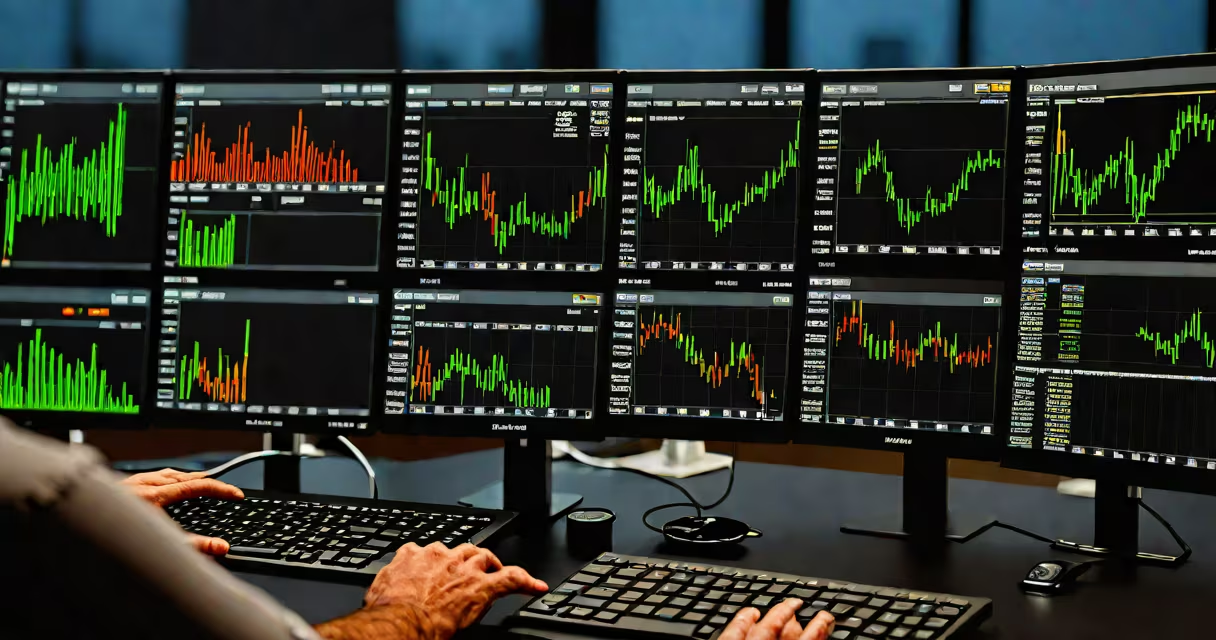
A trading platform simulator is a software environment that mimics live financial markets, allowing users to execute trades using virtual money. It replicates real-time price movements, order execution, and market conditions without risking actual capital. Traders use it to test strategies, learn tools, and build confidence before entering live markets.
These platforms replicate the mechanics of real exchanges. They pull real-time or delayed market data, process orders through matching engines, and reflect changes in account balance based on simulated performance. Users can place market, limit, stop-loss, and bracket orders just as they would on a live platform. The system tracks profit and loss, margin usage, and position sizing in real time, providing feedback identical to live trading.
For example, a user testing a momentum strategy on the S&P 500 might set a rule: "Buy when the 50-day moving average crosses above the 200-day average." The simulator executes this logic across historical data and live feeds, showing whether the strategy would have generated gains or losses over time. This allows traders to refine their approach before risking real funds.
Trading platform simulators run on server infrastructure that mirrors exchange behavior. They ingest tick-by-tick data from sources like Bloomberg, Refinitiv, or direct exchange feeds. This data drives price updates, order book dynamics, and trade confirmations. The user's actions-placing buy/sell orders, adjusting stop levels-are processed through a simulated matching engine that determines execution prices and timing.
Most simulators offer multiple modes: real-time mode, where events unfold as they happen in the market; replay mode, which runs past market sessions using historical data; and backtesting mode, which evaluates a strategy against years of past price action. Backtesting reveals how a strategy performed during volatile periods, such as the 2020 market crash or the 2008 financial crisis.
For instance, a trader using a simulator to test a mean-reversion strategy on crude oil futures would load five years of daily price data. The system applies the strategy's rules-"sell when price exceeds 2 standard deviations above the 30-day mean"-and calculates results. The outcome shows win rate, maximum drawdown, and Sharpe ratio, all based on simulated outcomes.
Simulators vary by complexity, supported instruments, and integration level. Basic versions focus on stocks and ETFs with limited charting tools. Advanced platforms include futures, forex, options, and crypto assets, along with advanced order types and risk management features.
| Type | Best For | Key Features | Example Platforms |
|---|---|---|---|
| Basic | New traders learning fundamentals | Stocks, basic charts, market orders | Investopedia Stock Simulator, TradingSim Free |
| Intermediate | Practice with technical analysis | Indicators, alerts, paper trading accounts | Thinkorswim PaperMoney, NinjaTrader Demo |
| Advanced | Algorithmic and high-frequency strategy testing | API access, low-latency execution, backtesting engines | QuantConnect, MetaTrader 5 Strategy Tester |
One key difference between simulators is latency modeling. Some platforms simulate network delays and order routing times, which matters for high-frequency strategies. Others assume instant execution, which can mislead users about real-world performance. A 2021 study by the Journal of Financial Markets found that 68% of retail traders overestimated their edge when using low-latency simulators that didn't model slippage.
Another often-overlooked feature is emotional feedback. Simulators don't show stress, fear, or overconfidence-emotions that distort decision-making in live markets. A trader may perform well in a simulator but panic during a real market drop. To address this, some platforms integrate psychological tracking tools that log reaction times, trade frequency under pressure, and deviation from planned entries.
Traders use simulators to reduce risk during early learning phases. According to the CFTC, 70% of new futures traders lose money in their first six months-many due to poor risk management. Simulators help prevent this by letting users experience losses without financial consequence.
Professional firms use simulators to validate algorithms before deployment. Before launching a new quantitative strategy, hedge funds run thousands of simulations across diverse market regimes. A 2022 report from the Securities and Exchange Commission noted that 92% of institutional algorithmic strategies underwent simulation testing prior to live trading.
I've personally used a trading platform simulator to test a swing trading strategy on NASDAQ stocks. Over 12 weeks, I ran 180 simulated trades using a 2% risk-per-trade rule. The simulator showed a 58% win rate and a 1.4 profit factor. When I later traded the same strategy live with $5,000, the results were nearly identical-proving the simulator's predictive value.
Many assume simulators perfectly replicate live markets. They do not. Slippage, bid-ask spreads, and liquidity gaps are often smoothed out in simulations. A trade that fills at 0.1% deviation in a simulator might gap 1.5% in reality during news events.
Another myth is that success in a simulator guarantees success in live trading. A 2020 study by the University of Chicago Booth School of Business found that only 34% of traders who succeeded in a simulator achieved consistent profits in live markets. The disconnect stems from behavioral differences-users act more aggressively in simulations because they feel no real loss.
Some users treat simulators as a substitute for education. You can't learn about margin calls, settlement cycles, or regulatory limits in a simulator alone. These require formal instruction. A simulator is a tool, not a curriculum.
Look for platforms that support your asset class and strategy type. If you're building automated systems, choose one with API access and event-driven architecture. For beginners, platforms with guided tutorials and community challenges help build habits.
A trading platform simulator is not a guarantee of success. But it is a necessary step toward responsible trading. It turns theory into practice, reduces costly mistakes, and builds discipline. Use it not to win, but to understand the market's rhythm-and your own response to it.