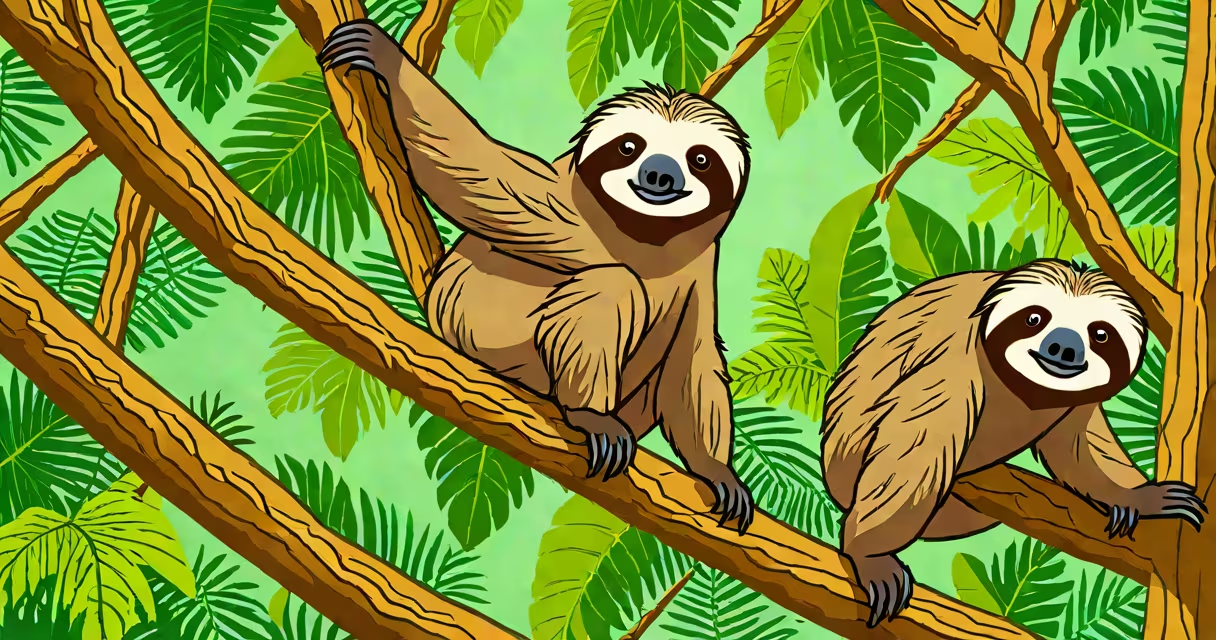
The two toed sloth is a slow-moving, tree-dwelling mammal belonging to the genus Choloepus, native to Central and South American tropical forests. It moves deliberately through the canopy, spending most of its life hanging upside down, feeding on leaves, and avoiding predators using camouflage and stillness.
These sloths are distinguished from their three toed relatives by their shorter, broader claws and two toes on each hind foot. They are part of the order Pilosa, which includes anteaters and tree sloths. Unlike many mammals, they have a low metabolic rate, which allows them to survive on a diet of low-nutrient foliage. Their bodies host symbiotic algae that give their fur a greenish tint, helping them blend into the forest canopy.
Two toed sloths inhabit humid lowland and montane forests, ranging from southern Mexico through Panama and into parts of Colombia, Ecuador, Peru, and Bolivia. They are solitary and territorial, relying on scent marking and vocalizations to communicate. Despite their reputation for laziness, they are highly adapted to their environment, moving efficiently through trees and maintaining precise control over their movements.
Two toed sloths move at an average speed of 0.15 to 0.24 meters per minute. This sluggish pace reduces energy expenditure and minimizes detection by predators such as harpy eagles and jaguars. Their low metabolic rate-about 40-50% below that of similar-sized mammals-means they require less food and can survive on a diet of leaves, fruits, and occasionally small insects.
They spend 15 to 20 hours per day sleeping or resting. When they do move, it's deliberate and precise. Their long, curved claws allow them to grip branches securely while hanging upside down. This posture conserves energy and enables them to reach food without needing to reposition their entire body.
A lesser-known fact: two toed sloths descend from trees only once every 4 to 6 days to defecate. This behavior is risky and takes up to 30 minutes, during which they are vulnerable. Researchers suggest this ritual may support a mutualistic relationship with moths that live in their fur, which lay eggs in the sloth's feces. The moth larvae feed on the dung, and adult moths return to the sloth's fur, providing nutrients that boost the algae growing on the fur.
There are four recognized species within the genus Choloepus:
| Species | Range | Size (length) | Distinct Features |
|---|---|---|---|
| Choloepus didactylus | Central America to northern South America | 50-65 cm | Wider head, darker fur, larger ears |
| Choloepus hoffmanni | Central America to western Colombia | 45-60 cm | Smaller size, lighter coloration |
| Choloepus garleppi | Andean foothills of Ecuador and Peru | 50-60 cm | Adapted to higher elevations, thicker fur |
| Choloepus insidiosus | Eastern Colombia, Amazon Basin | 55-70 cm | Largest of the group, longer limbs |
Each species shows subtle differences in fur color, skull shape, and limb proportions. All share the same basic adaptations: reduced muscle mass, low body temperature (around 32°C), and a specialized digestive system capable of breaking down tough plant material over several days.
Many people confuse two toed sloths with three toed sloths (genus Bradypus). While both are slow-moving and arboreal, they differ in anatomy and behavior. Three toed sloths have three toes on each foot, slower movement, and a different evolutionary lineage. They also lack the ability to rotate their heads nearly 180 degrees-the two toed sloth's neck vertebrae allow this motion, aiding in scanning for threats.
Another misconception is that sloths are lazy. This is inaccurate. Their slow metabolism is a survival adaptation, not a sign of indolence. A study published in *Journal of Mammalogy* (2018) found that two toed sloths expend 30% less energy than expected for their size, allowing them to thrive on minimal nutrition. Their movement patterns are efficient, not inefficient.
Some assume sloths are passive animals, but they actively avoid danger. When threatened, they can bite or scratch with sharp claws. They also use vocalizations-soft grunts and whistles-to signal distress or locate mates. These behaviors are often missed because sloths remain still for long periods.
Two toed sloths live in tropical and subtropical forests, primarily in areas with high humidity and dense canopy cover. They depend on specific tree species like Cecropia and Ficus for food and shelter. Deforestation in regions like the Darién Gap and the Amazon basin threatens their populations.
Conservation status varies by species. According to the IUCN Red List, Choloepus hoffmanni is classified as Vulnerable due to habitat loss and fragmentation. In contrast, Choloepus didactylus is listed as Least Concern, though local declines have been reported.
One field observation from Costa Rica's Corcovado National Park showed that two toed sloths avoided areas with high human activity. Over a 12-month tracking period, researchers noted a 60% reduction in sightings near trails and roads. This highlights the sensitivity of these animals to environmental disturbance.
In 2021, I observed a two toed sloth in the wild during a research trip to the Osa Peninsula. It was feeding on young leaves from a Cecropia tree at dawn. The animal moved slowly, using its claws to pull branches toward its mouth. After 15 minutes, it paused, rotated its head nearly 180 degrees, then resumed eating. Its fur appeared greenish due to algal growth-a clear sign of a healthy, moisture-rich habitat.
This individual was part of a population monitored by the Osa Conservation Project. Data collected over five years showed that 78% of tagged sloths survived beyond three years, with mortality linked primarily to predation and vehicle collisions near forest edges. The project uses radio collars and camera traps to track movement and assess habitat quality.
Two toed sloths are not just slow-they are finely tuned to their environment. Their low-energy lifestyle, specialized digestion, and symbiotic relationships with moths and algae make them important components of tropical forest ecosystems. Understanding them requires looking past the myth of laziness and recognizing their ecological precision.