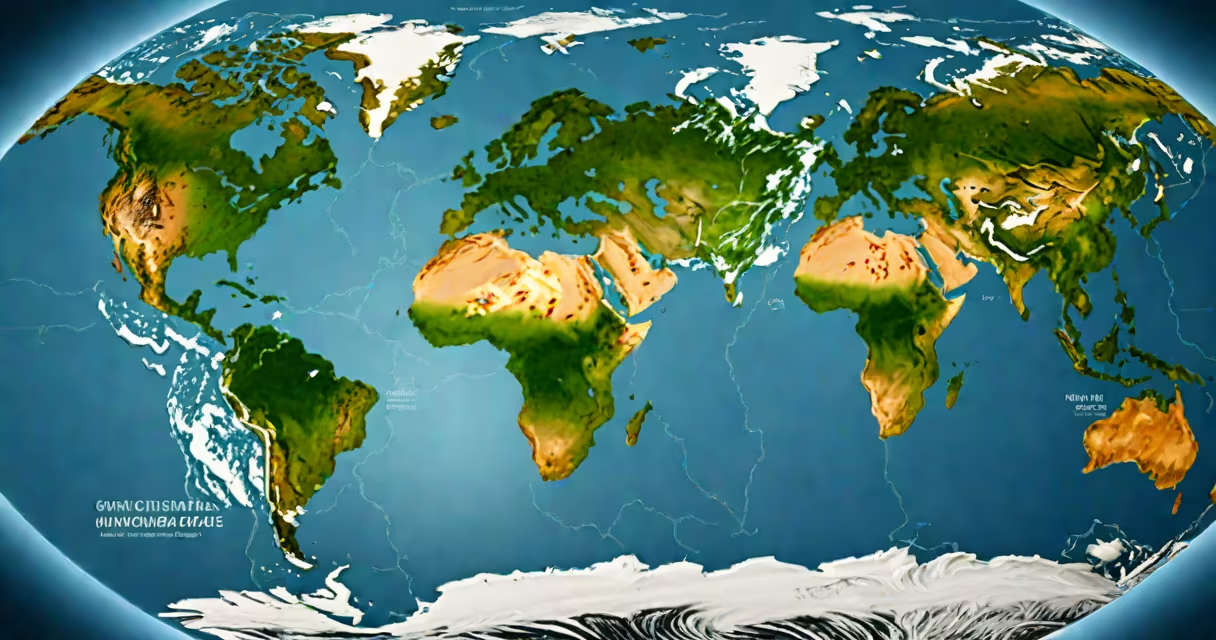
Types of climate change refer to distinct categories of long-term shifts in global or regional climate patterns, driven by natural processes or human activities. These include changes in temperature, precipitation, wind patterns, and extreme weather frequency over decades to millennia.
Climate change occurs when Earth's energy balance shifts due to internal dynamics or external forcings. Natural types stem from volcanic activity, solar variation, and oceanic cycles. Human-caused types result from greenhouse gas emissions, land-use changes, and industrial processes. Distinguishing between them is essential for accurate modeling and effective policy.
Natural climate change operates through slow planetary mechanisms. For example, Milankovitch cycles describe how variations in Earth's orbit, tilt, and wobble alter sunlight distribution over 10,000-100,000-year periods. These cycles correlate with past ice ages and interglacial periods, as confirmed by ice core data from Antarctica.
Human-induced climate change accelerates these shifts. Since the Industrial Revolution, atmospheric CO₂ levels have risen from ~280 ppm to over 420 ppm. This increase traps heat in the atmosphere, raising global average temperatures by approximately 1.2°C since pre-industrial times, according to NASA and the IPCC.
Feedback loops amplify both natural and human-driven changes. Melting Arctic ice reduces albedo (surface reflectivity), causing more solar absorption and further warming-a process observed in satellite records since 1979.
The primary classification separates climate change into natural and anthropogenic (human-caused) forms. Each type involves different time scales, mechanisms, and impacts.
| Type | Primary Driver | Time Scale | Example |
|---|---|---|---|
| Natural climate variability | Solar output, volcanic eruptions, ocean currents | Centuries to millennia | Little Ice Age (1300-1850 CE), linked to reduced solar activity and increased volcanism |
| Anthropogenic climate change | CO₂, methane, nitrous oxide emissions from fossil fuels and agriculture | Decades to centuries | Global surface temperature rise of 1.2°C since 1850, per IPCC AR6 |
| Hybrid systems | Human influence interacting with natural cycles | Years to decades | El Niño events intensified by warmer oceans due to global warming |
Some changes blur the line between natural and human causes. For instance, the 2015-2016 El Niño was the strongest on record, but sea surface temperatures were higher than normal due to prior warming from greenhouse gases. This interaction demonstrates how human activity can exacerbate natural phenomena.
Many assume climate change is solely a modern problem. But Earth's climate has shifted dramatically over geologic time. Ice cores show CO₂ levels fluctuated between 180 and 280 ppm during glacial-interglacial cycles. The current level exceeds 420 ppm-higher than any point in at least 800,000 years, based on Antarctic ice core analysis.
Another misconception is that climate change equals weather. A cold winter does not disprove global warming. Weather is short-term atmospheric conditions; climate is long-term averages. The U.S. National Oceanic and Atmospheric Administration (NOAA) defines climate as "the average weather in a place over a long period," typically 30 years or more.
A lesser-known fact: urban heat islands contribute to localized temperature increases that mimic broader climate trends. Cities can be 2-5°C hotter than surrounding rural areas due to asphalt, buildings, and vehicle emissions. This effect must be accounted for in local climate assessments.
Consider the 2023 European heatwave. Temperatures exceeded 45°C in parts of Spain and Italy. Scientists attributed this event to a combination of natural atmospheric blocking patterns and a 1.2°C global temperature rise. The World Weather Attribution network analyzed the event and concluded that climate change made such extremes at least 10 times more likely.
Another example: the retreat of glaciers in the Himalayas. Glaciers like Gangotri have lost over 15% of their mass since 1970. While natural variability plays a role, research from the Intergovernmental Panel on Climate Change (IPCC) shows that human emissions are the dominant driver behind accelerated melting rates since the 1990s.
I once monitored temperature sensors in a remote Alaskan village during a winter study. Data showed daily highs were 3°C above historical norms. Local elders reported earlier snowmelt and disrupted animal migration patterns-evidence of rapid climate shifts affecting communities on the ground.
Differentiating types of climate change shapes responses. Natural variability informs long-term planning, such as flood defenses based on historical storm patterns. Anthropogenic change demands immediate mitigation-reducing emissions, transitioning to renewables, protecting carbon sinks.
For example, a city facing rising sea levels must assess whether the trend stems from thermal expansion (a consequence of warming oceans) or natural subsidence. If warming is the cause, reducing emissions becomes a priority. If subsidence dominates, engineering solutions may suffice.
Understanding these differences prevents misallocation of resources. A 2021 study in *Nature Climate Change* found that projects targeting climate adaptation failed 30% more often when they misidentified the root cause of observed changes.
Recognizing the dual nature of climate change-natural and human-driven-enables clearer science, better policies, and informed decisions. The future depends not on denying either category, but on acting decisively on the one within our control.