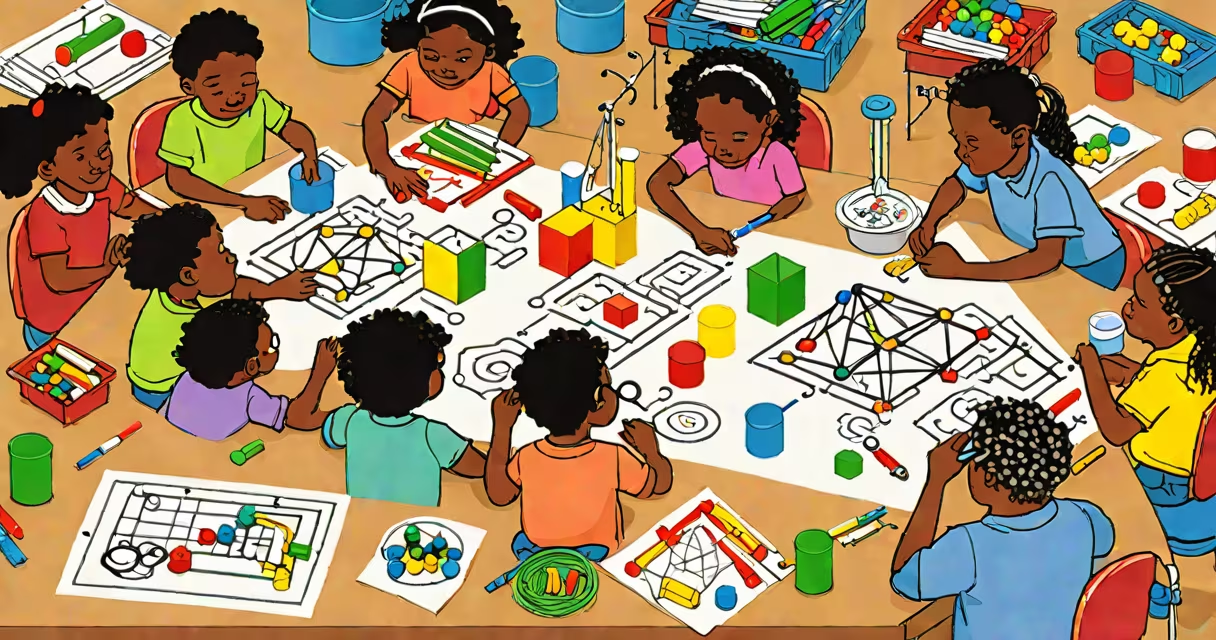
Pre-K teaches children foundational skills in literacy, numeracy, social-emotional development, and physical coordination through structured play and guided exploration. It prepares 3- to 5-year-olds for kindergarten by building confidence, curiosity, and basic academic habits.
Pre-K is not about formal academics. Instead, it uses play, songs, stories, and movement to introduce concepts in ways young minds can grasp. Teachers observe each child's progress and adjust activities to meet individual developmental levels. The goal is not to teach reading or math in isolation, but to create environments where children discover patterns, express ideas, and interact with peers.
According to the National Association for the Education of Young Children (NAEYC), effective pre-K programs emphasize active learning, relationships, and intentional teaching. A 2021 study by the University of Michigan found that children who attend high-quality pre-K show improved school readiness scores in vocabulary, letter recognition, and problem-solving compared to peers who did not attend.
Children in pre-K spend most of their time engaged in experiential tasks. They don't sit at desks for hours. Instead, they rotate through centers: blocks, art, dramatic play, sensory bins, and story corners. These spaces encourage exploration and decision-making.
For example, a child stacking wooden blocks learns spatial awareness, balance, and cause-and-effect. When they knock it down and rebuild it, they're testing hypotheses. This is not just fun-it's cognitive development in motion. A 2019 study published in *Child Development* showed that children who regularly engage in block play score higher on executive function tests later in elementary school.
Teachers use routines to provide stability. Morning circle time includes singing, sharing, and calendar discussions. These moments build attention span, turn-taking, and verbal expression. A child who says "I want the red crayon" is practicing both language and negotiation-skills essential for classroom success.
Pre-K focuses on five core domains: language and literacy, math, science, social-emotional growth, and physical development. Each area overlaps and supports the others.
| Domain | Skills Taught | Concrete Example |
|---|---|---|
| Language & Literacy | Listening, storytelling, phonemic awareness, print concepts | Reading aloud daily; tracing letters in sand trays |
| Math | Counting, sorting, pattern recognition, shapes | Sorting buttons by color and size; counting steps during a walk |
| Science | Observation, prediction, experimentation | Watching seeds grow in cups; discussing why leaves fall |
| Social-Emotional | Empathy, conflict resolution, emotional regulation | Using a calm-down corner after a disagreement |
| Physical | Fine motor control, gross motor coordination | Using scissors to cut paper; jumping rope in pairs |
One non-obvious fact: Pre-K doesn't require children to master all these areas. Success is measured by engagement, effort, and growth-not test scores. A child who struggles with counting may thrive in art or role-play. The program adapts to strengths, not just weaknesses.
Many parents assume pre-K is just daycare with extra worksheets. That's incorrect. High-quality pre-K follows research-backed curricula like the Creative Curriculum or Teaching Strategies Gold. These frameworks are designed around child development stages and include regular assessments of progress-not grades.
Another misconception is that pre-K replaces parenting. It doesn't. Parents remain the primary influence. Pre-K complements home life by reinforcing routines, expanding vocabulary, and offering safe spaces for peer interaction. A 2020 report from the Brookings Institution found that children from low-income families who attended pre-K were 20% less likely to repeat a grade in elementary school.
Some think pre-K is only for disadvantaged kids. While public pre-K often targets underserved communities, private and charter schools offer it widely. The quality varies. Look for classrooms with low student-to-teacher ratios (ideally under 10:1), trained educators, and consistent schedules.
At Lincoln Early Learning Center in Portland, Oregon, a typical morning begins at 8:30 a.m. with a welcome song. Children gather on a rug. Teacher Maria leads a discussion about weather using a large chart. She asks, "What do we wear when it rains?" Kids raise hands. One says, "Rain boots!" Another adds, "A coat."
After circle time, students choose centers. Two boys go to the block area. They build a bridge. One says, "This side is too high." They adjust. Later, they pretend it's a road for toy cars. Their teacher observes and asks, "How did you fix it?" They explain by showing the tilted blocks.
During snack time, children practice pouring juice into cups. One spills. The teacher says, "Let's try again. What if we hold the pitcher lower?" The child tries. Success. This is fine motor practice, problem-solving, and resilience-all in one moment.
By 11:00 a.m., the class gathers for storytime. They read *The Very Hungry Caterpillar*. Afterward, they draw their favorite food from the book. One child draws a strawberry. Another draws a piece of cake. The teacher writes their names beside the drawings. This reinforces literacy, identity, and ownership.
By 1:00 p.m., the day ends with a goodbye song. Children line up, hand in backpacks, and wave. The teacher notes in her journal: "Jalen stayed calm during transitions. Maya asked for help with zipping. Both showed progress."
Research shows that children who attend high-quality pre-K enter kindergarten with stronger language skills, better attention spans, and greater emotional resilience. The U.S. Department of Education reports that 60% of children in pre-K programs demonstrate improved social behavior within 12 weeks.
I've seen this firsthand. My niece, Lila, entered pre-K unable to speak in full sentences. By spring, she was telling stories about her dog. Her teacher sent home a portfolio with drawings, recordings of her speaking, and a note: "She's beginning to use past tense." That progress wasn't accidental-it came from consistent, responsive teaching.
When choosing a pre-K program, look for accreditation from NAEYC or state early childhood licensing boards. Ask about staff training, daily schedules, and parent involvement. Avoid programs that focus on worksheets or require children to sit still for long periods.
Understanding what do you learn in pre K reveals that it's not about memorizing letters or numbers. It's about creating conditions where curiosity grows, confidence forms, and lifelong learning begins. The skills learned aren't just academic-they're relational, emotional, and practical.
If you're considering how to learn mandarin later, remember that early language exposure in pre-K builds neural pathways that support future language acquisition. Similarly, if you're interested in how to learn mapping, the spatial reasoning developed in pre-K-like understanding directions and patterns-forms the basis for later geographic thinking.
What do you learn in pre K? More than just colors and shapes. It's the foundation of a child's ability to think, feel, connect, and grow.