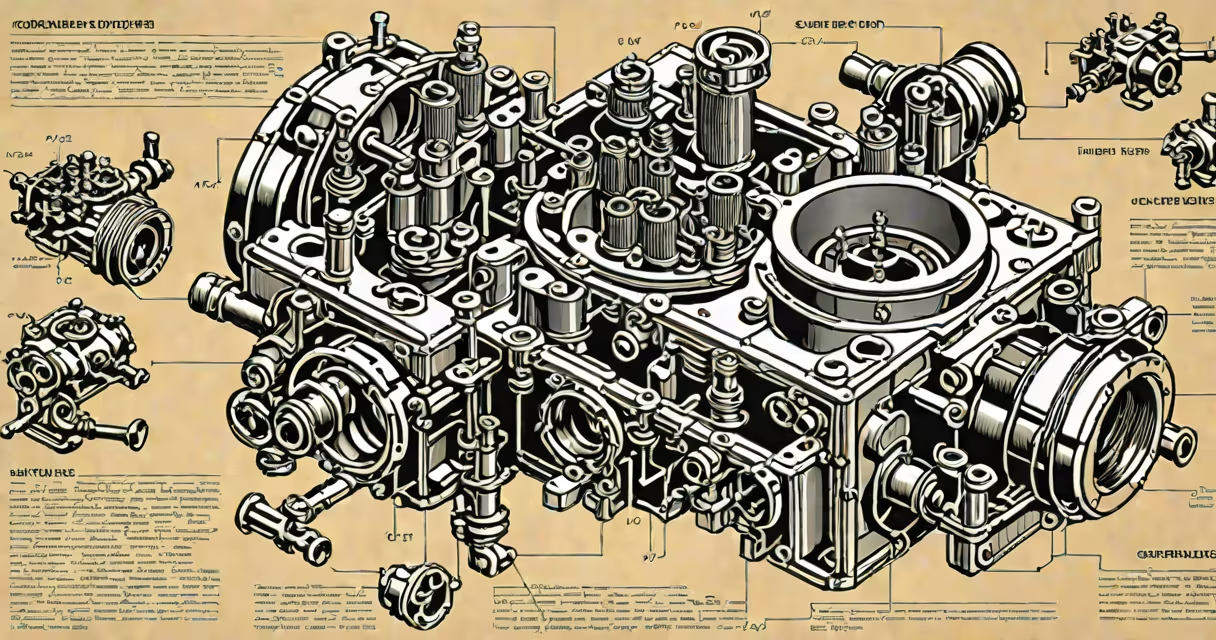
A carburetor meters fuel into an engine's intake airstream, mixing it with air to create a combustible mixture that powers internal combustion engines. It adjusts the fuel-to-air ratio based on engine load and speed, ensuring efficient combustion across operating ranges.
Carburetors operate via the Venturi effect: air flowing through a narrowed tube creates low pressure, drawing fuel from a float chamber through a jet. As airflow increases-such as when the throttle opens-the pressure differential pulls more fuel, enriching the mixture. This mechanical feedback allows the engine to maintain performance without electronic sensors.
Modern engines use fuel injection, but carburetors remain standard in small engines like lawnmowers, chainsaws, and vintage motorcycles. They require no computer control, making them simpler and cheaper to maintain in low-tech applications.
The carburetor's primary task is balancing air and fuel flow. Air enters through the air filter and passes through a venturi-a narrowing in the intake tube. As air speeds up in the constriction, static pressure drops. This pressure drop draws fuel from the float bowl through a main jet and into the airstream.
Fuel delivery is regulated by a float mechanism. A hollow metal float rises and falls with fuel level in the bowl. When fuel drops below a set point, the float lowers, opening a needle valve. Fuel flows in until the float rises and closes the valve. This maintains a constant fuel level, preventing overflow or starvation.
Throttle position controls airflow volume. At idle, a small passage called the idle jet supplies fuel. As the throttle opens, air velocity increases, pulling more fuel through the main jet. A power valve may open at high loads to enrich the mixture further, preventing lean burn and detonation.
Each component in a carburetor serves a precise function. The throttle plate regulates airflow and engine speed. The choke valve restricts air intake during cold starts, increasing fuel concentration to aid ignition. The float chamber stores fuel at a stable level. Jets-main, idle, and accelerator-control fuel flow rates.
Adjustment screws fine-tune mixture strength. The idle screw sets fuel flow at low RPM. The mixture screw adjusts the air-fuel ratio at mid-range operation. Over-adjustment can cause poor fuel economy, rough idling, or excessive emissions.
Some carburetors include a vacuum diaphragm that adjusts fuel delivery based on intake manifold pressure. This compensates for altitude changes or engine load shifts. For example, at 5,000 feet elevation, reduced air density requires less fuel-vacuum compensation prevents over-rich mixtures.
| Component | Function | Failure Consequence |
|---|---|---|
| Float | Maintains fuel level in the bowl | Fuel overflow or engine flooding |
| Main Jet | Delivers fuel at high throttle | Lean mixture, overheating, misfire |
| Idle Jet | Supplies fuel at low RPM | Stalling or rough idle |
| Choke Valve | Reduces air intake for cold start | Hard starting, black smoke |
Carburetors persist in small engines due to cost, simplicity, and reliability. A typical lawn mower engine uses a single-barrel carburetor with a manual choke. These engines run at fixed speeds and don't require precise fuel control, so carburetors meet performance needs without added complexity.
Vintage vehicles and classic motorcycles still rely on carburetors. The 1970s Honda CB750, for example, used a dual-choke carburetor system. Its design allowed smooth throttle response and predictable tuning. Enthusiasts maintain these systems manually, adjusting jets and floats for optimal performance.
Even in aviation, some light aircraft use carburetors. The Lycoming O-235 engine, common in Cessna 172s from the 1960s, employs a constant-speed carburetor. It maintains a consistent fuel-air ratio across altitudes and temperatures-critical for flight safety.
Many assume carburetors are obsolete. While they've largely replaced fuel injection in cars since the 1980s, they're still in use. The U.S. Environmental Protection Agency (EPA) recognizes carbureted engines in off-road vehicles and marine applications under specific emission standards.
Another myth is that carburetors always produce poor fuel economy. In reality, a properly tuned carburetor can achieve 25-30 miles per gallon in small engines. A 2018 study by the Society of Automotive Engineers (SAE) found that well-maintained carbureted small engines outperformed early fuel-injected models in fuel efficiency under light load.
Some confuse carburetors with fuel injectors. Injectors spray fuel directly into cylinders using solenoids and timing signals. Carburetors mix fuel and air upstream, relying on airflow dynamics. This difference affects responsiveness: injectors adjust faster, but carburetors adapt smoothly across wide-open throttle.
Consider a 5-horsepower Briggs & Stratton engine that won't start. After checking spark and compression, the issue lies in the carburetor. The float is stuck, allowing fuel to flood the bowl. Removing the carburetor, draining the fuel, and cleaning the float pivot restores proper fuel level.
After reassembly, the engine still sputters. Adjusting the idle screw clockwise reduces fuel flow. Turning it counterclockwise increases it. The correct setting produces steady idle at 2,800 RPM. The engine runs smoothly, cuts grass evenly, and restarts reliably.
This process takes 15 minutes with basic tools. No diagnostic scanner is needed. The mechanic relies on auditory feedback and visual inspection-methods unchanged since the 1950s.
Carburetors remain functional, effective, and teachable. They embody mechanical precision in a world increasingly reliant on electronics. Understanding their role clarifies how engines manage combustion without digital control.
For those maintaining older machinery, knowing what a carburetor does enables troubleshooting, tuning, and preservation. It's not outdated-it's enduring.