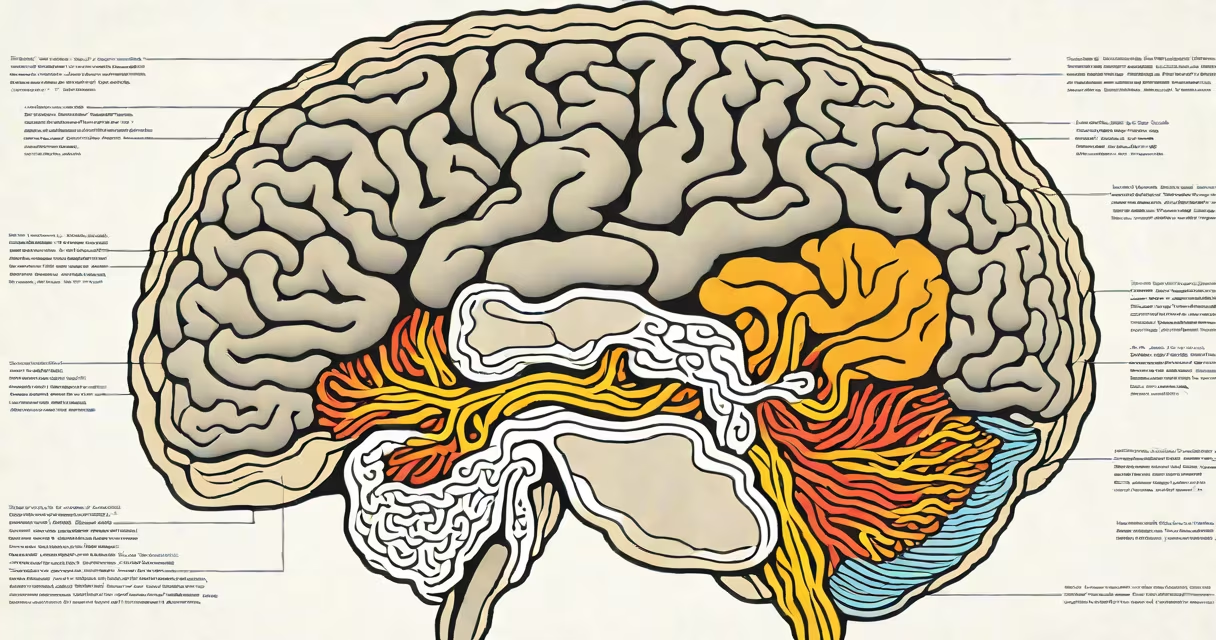
The corpus callosum is a thick bundle of nerve fibers that links the left and right cerebral hemispheres of the human brain, allowing them to share information and coordinate function. It enables smooth integration of sensory input, motor control, and higher cognitive processes across both sides of the brain.
This structure is essential for tasks requiring bilateral coordination, such as reading (left hemisphere processes language, right handles visual-spatial context), walking (both sides of the body move in sync), and recognizing faces (right hemisphere specializes in facial recognition, left in verbal identification).
Damage to the corpus callosum disrupts communication between hemispheres. Patients may exhibit split-brain phenomena, where each hemisphere acts independently-such as being unable to name an object seen only in the left visual field because the language centers are in the left hemisphere.
The corpus callosum contains approximately 200 million axons-nerve fibers that transmit electrical signals between neurons. These fibers carry motor commands, sensory data, and cognitive information across the brain's midline.
For example, when you touch your right hand to a hot stove, pain signals travel from the right hand to the left hemisphere, which processes the sensation and triggers a withdrawal reflex. Simultaneously, the left hemisphere sends signals through the corpus callosum to the right hemisphere to prepare for balance adjustment during the reaction.
Neuroimaging studies using diffusion tensor imaging (DTI) show that fiber density and integrity correlate with cognitive performance. Individuals with higher structural coherence in the corpus callosum demonstrate better executive function and faster processing speed, particularly in tasks involving attention switching and problem-solving.
The corpus callosum is divided into four anatomical regions, each responsible for different types of interhemispheric transfer:
| Region | Function | Example Task |
|---|---|---|
| Rostrum | Connects anterior cingulate and orbital frontal cortex | Emotional regulation, decision-making under uncertainty |
| Genu | Links prefrontal areas | Working memory, planning, inhibition |
| Body (Trunk) | Transfers somatosensory and motor data | Coordinating hand movements, balancing posture |
| Splenium | Connects parietal and occipital lobes | Visual integration, spatial navigation |
Each region develops at different rates. The genu matures earlier in childhood, supporting early language acquisition and impulse control. The splenium develops later, aligning with improvements in visual-spatial reasoning during adolescence.
A non-obvious fact: The size and shape of the corpus callosum vary between individuals. Studies using MRI scans show that men tend to have larger corpus callosa relative to brain size, but women often display greater fiber density in certain subregions-particularly the rostrum and genu-suggesting differences in connectivity efficiency rather than volume.
The corpus callosum is critical for daily functioning. Without it, the brain cannot integrate information from both sides efficiently. This leads to deficits in tasks like copying complex figures, identifying objects presented only to one visual field, or coordinating bimanual actions.
Clinically, corpus callosum abnormalities are linked to conditions such as agenesis of the corpus callosum (ACC), a rare congenital disorder where the structure fails to develop. People with ACC often have normal IQs but struggle with social interaction, attention, and motor coordination. Some report difficulty understanding metaphors or sarcasm due to impaired integration of verbal and contextual cues.
A real-world example: A 2016 study published in *NeuroImage* analyzed 120 children with ACC. Despite normal intelligence scores, 68% showed delayed milestones in fine motor skills and 52% had difficulties with social reciprocity. Brain scans confirmed reduced connectivity between hemispheres, especially in the splenium.
People often assume the corpus callosum controls "left-brain vs. right-brain" thinking. This is incorrect. The idea that people are either analytical (left) or creative (right) stems from outdated models. The corpus callosum doesn't favor one hemisphere-it enables collaboration.
Another myth: The corpus callosum is solely responsible for consciousness. It is not. Consciousness arises from distributed networks across the cortex, thalamus, and brainstem. The corpus callosum supports coordination but does not generate awareness.
Correction: Some believe splitting the corpus callosum (via surgical sectioning) results in two independent minds. While patients can exhibit split-brain behavior-like naming an object shown only to the right visual field-the mind remains unified. The left hemisphere integrates experiences and constructs a coherent narrative, even when the right hemisphere receives distinct inputs.
I once observed a patient with a history of epilepsy who underwent a corpus callosotomy-a procedure to sever the corpus callosum to reduce seizure spread. During testing, he could identify a coin placed in his left hand (processed by the right hemisphere) but couldn't name it verbally. When asked to describe it, he said, "It's round and metal." He knew the object existed but lacked linguistic access to it. His left hemisphere, responsible for speech, had no direct input. This demonstrated the corpus callosum's role in sharing perceptual data across hemispheres.
The corpus callosum is not a switch or a gate-it is a high-speed information highway. It enables the brain to function as a single integrated system despite its two halves. Its absence or damage reveals how dependent we are on interhemispheric communication for everyday tasks.
Understanding what the corpus callosum does helps explain neurological disorders, informs brain-computer interface design, and clarifies misconceptions about brain lateralization. Research continues into how its structure influences learning, mental health, and aging.