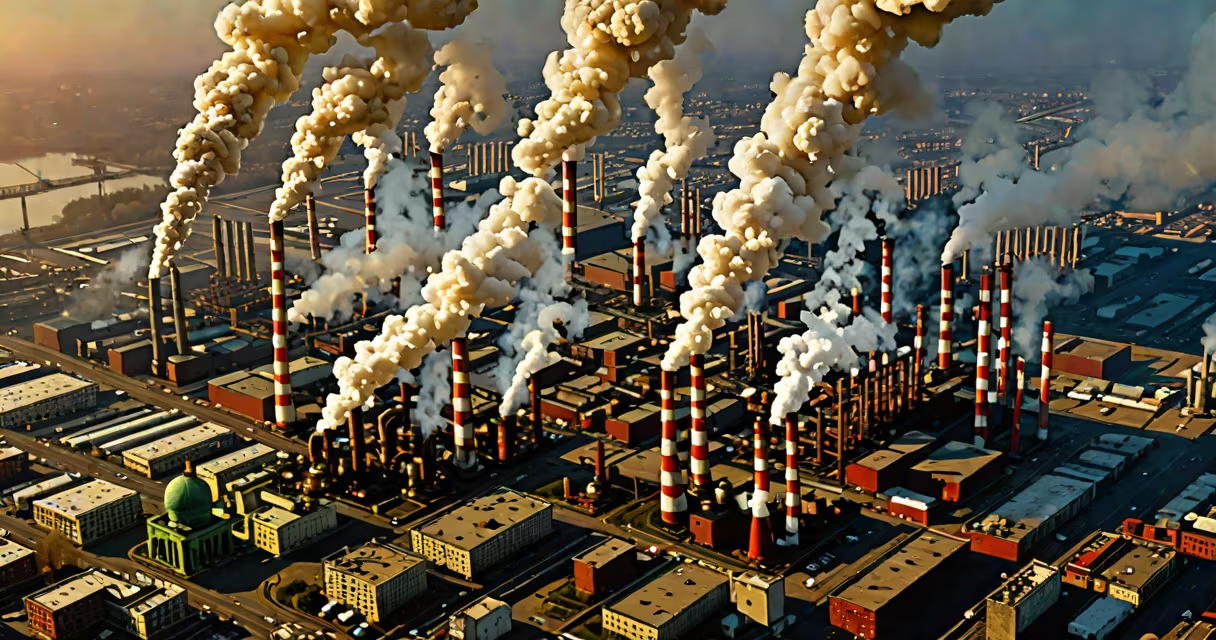
Human activities release greenhouse gases that accumulate in the atmosphere, trapping heat and altering Earth's climate system. The primary drivers are fossil fuel combustion, land-use changes like deforestation, and industrial processes such as cement production.
Greenhouse gases-including carbon dioxide (CO₂), methane (CH₄), and nitrous oxide (N₂O)-have increased since the Industrial Revolution. CO₂ levels rose from 280 parts per million (ppm) in pre-industrial times to over 420 ppm in 2023, according to the National Oceanic and Atmospheric Administration (NOAA). This rise correlates directly with energy use from coal, oil, and gas.
The Intergovernmental Panel on Climate Change (IPCC) reports that human influence is "unequivocal" in recent warming. Since 1850, global average temperatures have risen by approximately 1.2°C, with most of that increase occurring after 1970. This acceleration aligns with the expansion of industrial activity, transportation networks, and energy-intensive agriculture.
Fossil fuel use accounts for about 75% of global CO₂ emissions. Power plants burning coal and natural gas generate electricity but emit large quantities of CO₂. Transportation-cars, trucks, airplanes, and ships-relies heavily on gasoline and diesel, contributing 16% of global emissions in 2022, per the International Energy Agency (IEA).
Agriculture and land-use change contribute roughly 23% of total greenhouse gas emissions. Deforestation in tropical regions removes trees that absorb CO₂. For example, the Amazon rainforest, which once acted as a net carbon sink, now emits more CO₂ than it absorbs due to widespread logging and fires. The World Resources Institute estimates that 17% of the Amazon has been lost since 1970.
Industrial processes such as steel and cement manufacturing release CO₂ during chemical reactions, not just from fuel use. Cement production alone accounts for about 7% of global CO₂ emissions. The process involves heating limestone, which releases CO₂ as a byproduct, regardless of energy source.
| Activity | Primary Emission | Share of Global Emissions (approx.) |
|---|---|---|
| Burning fossil fuels for energy | Carbon dioxide (CO₂) | 45% |
| Transportation (road, air, shipping) | CO₂ and nitrogen oxides | 16% |
| Deforestation and land degradation | CO₂ and methane (CH₄) | 12% |
| Cement and steel production | CO₂ (process emissions) | 7% |
| Animal agriculture (methane from livestock) | Methane (CH₄) | 10% |
Many assume that natural factors like solar cycles or volcanic eruptions drive current climate change. However, NASA states that solar activity has remained stable or slightly declined since the 1950s, while global temperatures have risen sharply. Volcanic emissions are minor compared to human-caused ones-volcanoes release about 0.3 gigatons of CO₂ annually, while human activities emit over 35 gigatons each year.
Another confusion arises between "affect" and "effect." In context, "affect" is a verb meaning to influence. "Human activities affect climate change" is correct. "Effect" is a noun. Saying "climate change has a great effect on weather patterns" is accurate. Confusing the two leads to errors in scientific communication.
Some believe that individual actions don't matter because large industries dominate emissions. But collective behavior shapes policy and market demand. For example, the shift toward electric vehicles began with consumer choice, not government mandate. In Norway, over 80% of new car sales were electric or plug-in hybrid in 2023, driven by public preference and supportive policies.
In 2019, the United States emitted 5.2 billion metric tons of CO₂ equivalent from human activities, according to the U.S. Environmental Protection Agency (EPA). Of that, 77% came from energy use (electricity, transportation, industry), 13% from agriculture, and 10% from waste and industrial chemicals.
China, the world's largest emitter, released 14.5 billion metric tons of CO₂ in 2022. Over 60% of this came from coal-fired power plants. Despite rapid growth in renewable energy, coal still supplies nearly 60% of China's electricity. The country's reliance on coal illustrates how infrastructure decisions lock in emissions for decades.
On a smaller scale, a single passenger jet flight from New York to London generates about 1.2 tons of CO₂ per passenger-equivalent to the annual emissions of a person in a low-income country. Aviation contributes around 2.5% of global CO₂ emissions, rising steadily as air travel grows.
Climate change is not a distant threat-it is already altering ecosystems. Glaciers in the Alps have retreated by 50% since 1850. Sea levels have risen 20 cm since 1900, with the rate accelerating. These changes result from sustained human emissions, not natural variability.
I once observed a community garden in Detroit using compost from local food waste to grow vegetables. The project reduced landfill waste and lowered methane emissions from decomposing organic material. While small in scale, it demonstrated how localized action reduces emissions and builds resilience.
Addressing climate change requires systemic shifts. The Paris Agreement aims to limit warming to below 2°C, preferably 1.5°C, above pre-industrial levels. Achieving this demands rapid decarbonization of energy systems, sustainable land management, and technological innovation. The IPCC warns that global emissions must peak by 2025 and decline 43% by 2030 to meet targets.