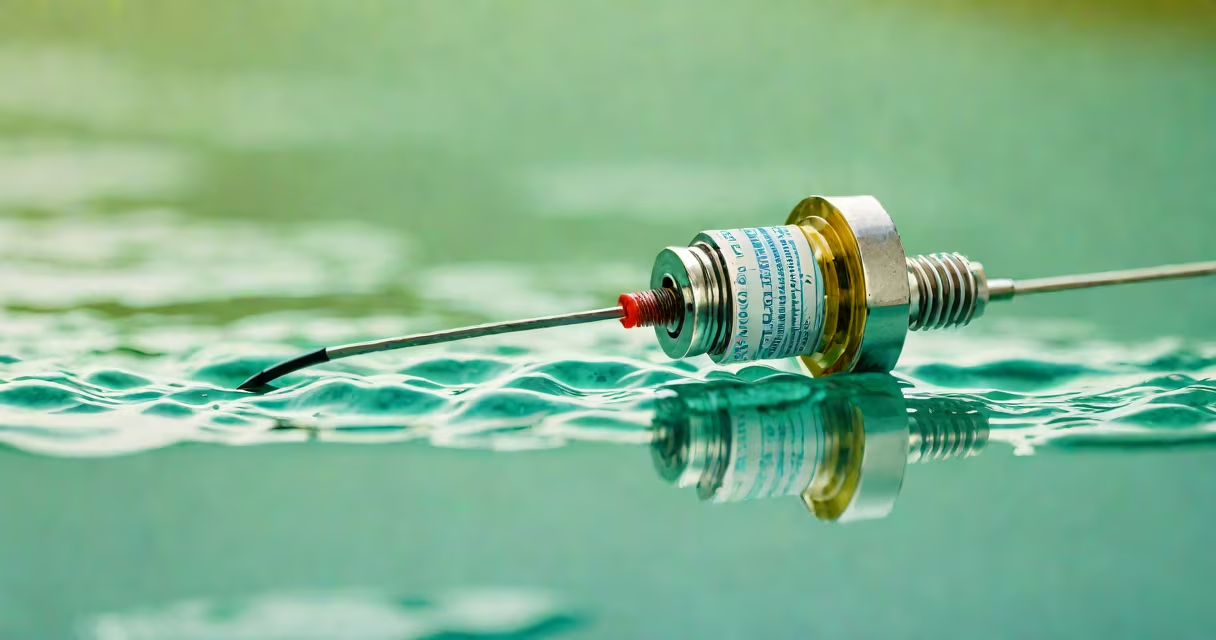
An ORP sensor measures oxidation-reduction potential (ORP) in liquids, indicating the ability of a solution to oxidize or reduce contaminants. It provides real-time data on water's disinfectant strength, important for maintaining safety in pools, drinking water, and industrial processes.
ORP sensors operate by detecting electron transfer between substances in solution. A platinum or gold electrode reacts to redox-active species such as chlorine, ozone, or hydrogen peroxide. The voltage difference between this electrode and a reference electrode correlates directly to ORP levels, reported in millivolts (mV).
For example, a pool with free chlorine at 1 ppm typically registers an ORP of 650-750 mV. Below 600 mV, microbial risk increases. The U.S. Environmental Protection Agency (EPA) recommends ORP values above 650 mV for effective pathogen inactivation in recreational water.
ORP sensors rely on a half-cell electrochemical reaction. The sensing electrode-usually platinum or gold-exposes to the liquid and develops a voltage based on the net redox activity. This signal is compared against a stable reference electrode, often silver/silver chloride (Ag/AgCl), which maintains a constant potential.
The resulting voltage is converted into ORP in millivolts. A positive reading indicates oxidizing conditions (e.g., presence of chlorine), while negative values suggest reducing environments (e.g., high organic load or low oxygen).
Calibration is critical. Most sensors require periodic verification using standard solutions like 100 mV or 500 mV buffers. Without calibration, readings drift by up to 30 mV per month, leading to false alarms or missed contamination events.
ORP sensors come in two primary configurations: direct immersion probes and modular systems with replaceable electrodes.
| Type | Use Case | Pros | Cons |
|---|---|---|---|
| Immersion Probe | Pools, aquariums, small-scale treatment | Low cost, easy installation | Short lifespan, prone to fouling |
| Modular System | Wastewater plants, industrial process control | Replaceable electrodes, long-term stability | Higher initial cost, complex setup |
Electrode materials affect performance. Platinum offers broad sensitivity but degrades in sulfide-rich environments. Gold resists sulfur compounds better but is less responsive to weak oxidizers like bromine.
Some models include temperature compensation. Since ORP varies with temperature, sensors with built-in thermistors adjust readings to 25°C baseline. A 10°C change can shift ORP by 20-30 mV, making temperature correction essential for accuracy.
ORP sensors are widely used in water treatment, aquaculture, and environmental monitoring. In municipal drinking water systems, ORP helps verify residual disinfectant levels after chlorination. A drop below 600 mV triggers alerts for additional chlorine dosing.
In industrial cooling towers, ORP monitors corrosion risk. High ORP (>700 mV) accelerates metal degradation. Operators use ORP data alongside pH and conductivity to balance system chemistry and extend equipment life.
A common error is confusing ORP with chlorine concentration. ORP reflects oxidative power, not chlorine amount. A pool may have 2 ppm chlorine but register only 500 mV due to high pH or organic load. This explains why some pools feel "safe" but still harbor pathogens.
Another misconception: ORP is not a standalone measure. It must be paired with other parameters. For instance, ORP alone cannot detect heavy metals. A study by the American Water Works Association (AWWA) found that combining ORP with UV absorbance improved contaminant detection accuracy by 41% in surface water samples.
At the City of Portland's Columbia Boulevard Wastewater Treatment Facility, ORP sensors monitor biological treatment zones. Anaerobic digesters maintain ORP below -200 mV to support methanogenic bacteria. Aerobic zones require ORP above +200 mV to sustain nitrifying organisms.
When ORP dropped below -250 mV in one anaerobic chamber, operators detected a feedline leak introducing oxygenated influent. Corrective action reduced methane production loss by 18% within 48 hours. The sensor caught the issue before biomass die-off occurred.
Field testing showed that uncalibrated ORP probes drifted by 45 mV over 14 days. After recalibration with a 500 mV buffer, readings stabilized. This confirmed that routine maintenance prevents operational errors.
ORP differs from pH in function. While pH measures hydrogen ion concentration, ORP reflects redox capacity. A solution can be highly acidic (low pH) yet have low ORP if it lacks oxidizers.
ORP sensors are not suitable for measuring dissolved oxygen (DO). DO sensors use polarographic membranes and report oxygen concentration in mg/L. ORP reports electron transfer potential in mV. Confusing the two leads to incorrect chemical decisions.
Best practice: calibrate ORP sensors weekly in high-use settings. Clean electrodes monthly with mild acid (e.g., 1% citric acid) to remove scale and biofilm. Always store sensors in a moist environment to prevent electrode drying.
I once installed an ORP sensor in a marine fish hatchery. Despite proper calibration, readings fluctuated wildly. Troubleshooting revealed a damaged reference junction allowing electrolyte leakage. Replacing the probe restored stability. This experience taught me that physical integrity matters as much as electrical specs.
Understanding what is ORP sensor reveals its role beyond simple measurement-it's a diagnostic tool for chemical balance, safety, and efficiency. Whether in a backyard pool or a global water plant, accurate ORP data prevents health risks and system failures.