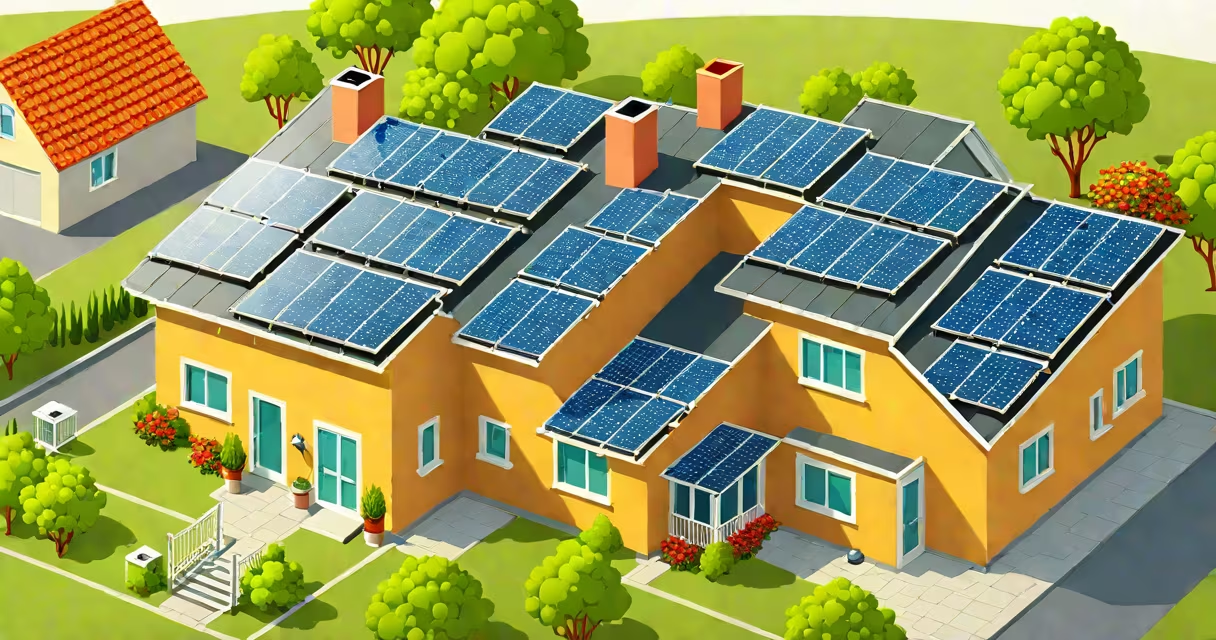
Solar PV (photovoltaic) is a technology that converts sunlight directly into electricity using semiconductor materials, typically silicon. It's the most common method for generating solar power at homes, businesses, and utility-scale plants.
The term "photovoltaic" comes from "photo" (light) and "voltaic" (electricity), describing the direct conversion process. Unlike solar thermal systems that heat water or fluid, solar PV produces electrical current without moving parts or emissions during operation.
Modern solar PV systems consist of interconnected photovoltaic cells arranged into modules, then grouped into arrays. These arrays feed electricity into inverters, which convert the generated direct current (DC) into alternating current (AC) usable by homes and the grid.
At the core of solar PV is the photovoltaic effect-the phenomenon where certain materials generate electric current when exposed to light. When photons from sunlight strike a silicon-based cell, they transfer energy to electrons, freeing them from their atomic bonds. This movement creates a flow of electricity.
Each solar cell contains a p-n junction-a boundary between two layers of doped silicon. One layer has excess positive charge carriers (p-type), the other excess negative ones (n-type). When sunlight hits the junction, the electric field separates electrons and holes, driving electrons toward the n-side and holes toward the p-side. Metal contacts collect this flow, producing usable DC current.
A typical residential system uses 20 to 30 panels, each rated between 300 and 400 watts. A 6-kW system (20 panels × 300 W) can produce about 8,000 kWh annually in a sunny U.S. region like California, enough to cover most household electricity use.
Every solar PV installation includes several essential parts:
| Component | Purpose | Typical Range |
|---|---|---|
| Photovoltaic Panels | Convert sunlight to DC electricity | 300-450 W per panel |
| Inverter | Convert DC to AC for home/grid use | 1-5 kW capacity |
| Mounting System | Secure panels to roof or ground | Aluminum or steel frames |
| Wiring & Disconnects | Connect components safely | NEC-compliant cables and switches |
| Monitoring System | Track energy production and detect faults | Real-time app or web dashboard |
There are three main system configurations:
When installing a system, the orientation and tilt of panels matter. In the Northern Hemisphere, south-facing roofs at a 30° angle maximize annual yield. Shading from trees or chimneys can reduce output by up to 50%.
Many people assume solar PV systems work only on sunny days. But they generate electricity on cloudy days-just at reduced levels. On overcast days, output drops to 10-25% of peak capacity depending on cloud thickness.
Another myth is that solar panels degrade quickly. In reality, high-quality panels lose less than 0.5% of efficiency per year. After 25 years, they still operate at 80-90% of original output. Manufacturers often guarantee 80% performance after 25 years.
Some confuse solar PV with solar thermal. While both use sunlight, solar thermal heats fluids for space heating or hot water. Solar PV generates electricity. They serve different purposes and are not interchangeable.
A lesser-known fact: solar PV doesn't require direct sunlight. Diffuse light-sunlight scattered by clouds or atmosphere-still powers panels. This means solar works in places like Germany and the Pacific Northwest, not just deserts.
A homeowner in Austin, Texas, installs a 7.2-kW solar PV system on a south-facing roof. The system uses 24 panels, each 300 W. The inverter is a 7.2-kW hybrid model with battery backup.
Annual production: ~10,500 kWh. Average monthly output: ~875 kWh. This covers 90% of the household's electricity use. The remaining 10% is drawn from the grid during winter months.
After incentives, the net cost was $14,500. With a 26% federal tax credit and state rebates, the effective cost dropped to $10,730. Payback period: 8.2 years. Net savings over 25 years: ~$58,000.
This project aligns with the U.S. Department of Energy's goal of achieving 100% clean electricity by 2035. Solar PV accounts for over 40% of new U.S. electricity capacity additions since 2020.
Solar PV is deployed globally due to its scalability, low operating costs, and declining prices. The International Renewable Energy Agency (IRENA) reports that utility-scale solar PV costs fell 89% between 2010 and 2022, reaching $0.04/kWh on average.
Residential installations dominate in countries like Germany, Japan, and Australia. In the U.S., states such as California, New Jersey, and Colorado lead in adoption due to favorable policies and high electricity rates.
Utility-scale projects, like the 579-MW Topaz Solar Farm in California, demonstrate large-scale deployment. This facility powers over 150,000 homes and uses over 9 million panels. It operates at 15% capacity factor-meaning it runs at full output 15% of the time, which is typical for solar.
Commercial rooftops also host solar PV. Walmart stores in Arizona have installed solar arrays totaling 10 MW across 100 locations. These systems reduce energy bills and support corporate sustainability goals.
A solar PV system integrates all components into a functional unit. It begins with photovoltaic panels capturing sunlight, channels DC current through wiring and disconnects, converts it to AC via an inverter, and feeds it into the building's electrical panel or the grid.
For off-grid or hybrid setups, batteries store excess energy. Charge controllers regulate voltage and prevent overcharging. Monitoring software tracks daily output, detects anomalies, and alerts users to maintenance issues.
Proper design requires site assessment-roof condition, shading analysis, local weather patterns, and utility interconnection rules. A certified installer performs load calculations and ensures compliance with the National Electrical Code (NEC) and local regulations.
During my last home renovation, I oversaw the installation of a 5.5-kW system. We used a microinverter setup-each panel had its own inverter-to minimize losses from partial shading. The system produced 7,200 kWh in the first year, exceeding our initial estimate by 12%. The monitoring dashboard showed real-time output and savings.
Understanding what is solar PV enables informed decisions about energy independence, cost savings, and environmental impact. As solar technology advances, efficiency gains and lower costs continue to drive adoption worldwide.