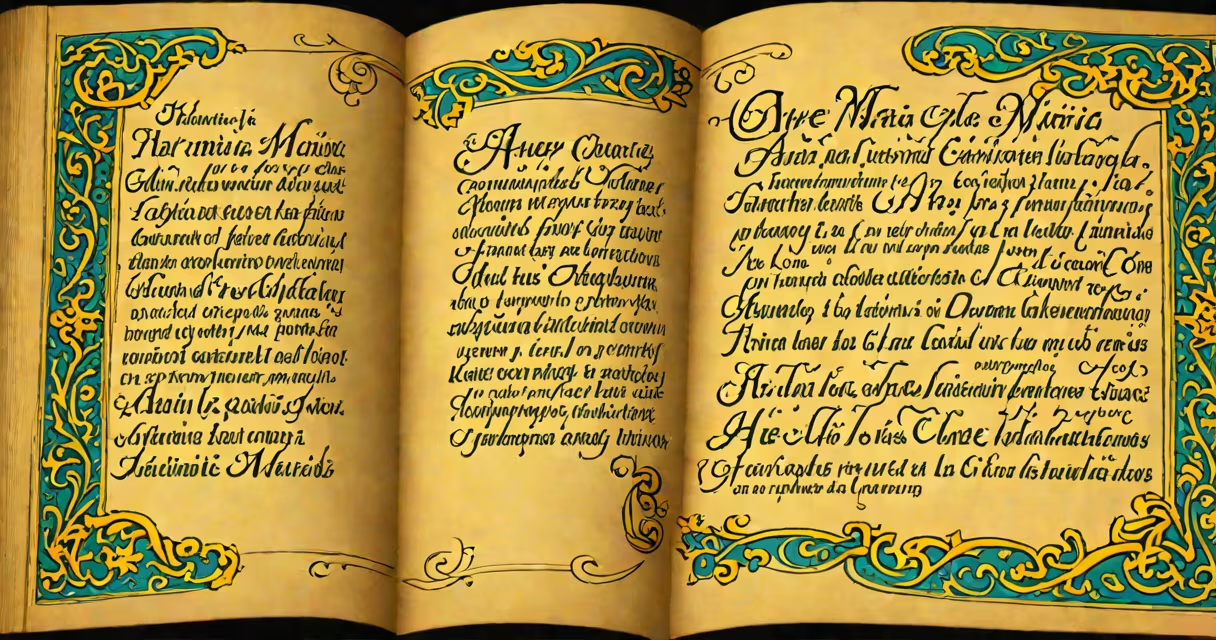
The phrase "Ave Maria" translates from Latin to "Hail Mary," a devotional prayer addressed to the Virgin Mary in Christianity. It begins with the angel Gabriel's greeting to Mary in Luke 1:28 and continues with Elizabeth's recognition of her holiness. The prayer is central to Roman Catholic devotion and appears in liturgical settings, personal prayers, and classical music.
Derived from the Gospel of Luke, the original Latin text reads: "Ave Maria, gratia plena, Dominus tecum. Benedicta tu in mulieribus, et benedictus fructus ventris tui, Jesus." This translates to: "Hail Mary, full of grace, the Lord is with thee. Blessed art thou among women, and blessed is the fruit of thy womb, Jesus."
The prayer evolved beyond Scripture into a formalized devotional practice during the Middle Ages. By the 15th century, it was standardized in the Catholic liturgy and became a staple of the Rosary. Its structure includes both biblical verses and later additions, such as the request for intercession: "Holy Mary, Mother of God, pray for us sinners, now and at the hour of our death."
When recited, "Ave Maria" functions as a petition for spiritual protection and mercy. Catholics believe Mary, as the mother of Jesus, holds a unique role in heaven and can intercede on behalf of believers. The prayer is often said at the beginning of Mass, during personal meditation, or as part of daily devotions.
Its repetition in the Rosary follows a pattern: one decade consists of five Our Fathers, five Hail Marys, and one Glory Be. This cycle is repeated four times, totaling 50 Hail Marys per Rosary. The rhythm and cadence help focus the mind and deepen contemplation.
According to the United States Conference of Catholic Bishops, the Hail Mary is "one of the most frequently prayed invocations in the Church." It is not merely a ritual phrase but a theological statement affirming Mary's role in salvation history.
The full "Ave Maria" contains three core elements:
These components reflect a layered theology: reverence for Mary's role, acknowledgment of divine favor, and a plea for ongoing spiritual support. The prayer does not worship Mary but honors her as a model of faith and a useful advocate.
Historically, the prayer was adapted into musical form. Franz Schubert's 1825 setting, composed for voice and piano, remains one of the most performed versions. His melody emphasizes the solemnity and intimacy of the words, making it accessible beyond church walls.
Many assume "Ave Maria" is a song rather than a prayer. While it is frequently sung in concerts and recordings, its primary function is devotional. The musical settings are secondary expressions of a sacred text.
Another misunderstanding is that the prayer equates Mary with God. The Church explicitly rejects this. The Catechism of the Catholic Church states: "Mary is the Mother of God because she gave birth to Jesus, who is both divine and human." She is venerated, not worshipped.
A lesser-known fact: the phrase "Ave Maria" appears in early Christian texts as early as the 4th century, though in different forms. The version we know today was finalized in the 15th century under Pope Pius II, who approved the current wording for use in the Litany of Loreto.
In 2016, the Vatican released a document titled *Christus Vivit*, in which Pope Francis referenced the Hail Mary as a tool for youth spiritual formation. He wrote: "Praying the Hail Mary helps young people grow in humility and trust in God's plan."
During the 2020 pandemic, many Catholic communities turned to online Rosaries. In March 2020, the Archdiocese of New York reported a 40% increase in virtual Rosary participation. The Hail Mary was the most repeated phrase during those sessions.
For a concrete example: a parishioner in Chicago prays the Rosary every evening at 7 PM. On average, they recite the Hail Mary 50 times per session. Over a month, that totals 1,500 repetitions. The consistency reinforces focus and emotional grounding during high-stress periods.
While "Ave Maria" is deeply rooted in Catholicism, similar Marian invocations exist in Eastern Orthodox traditions. The Russian Orthodox Church uses "Zdravstvuy, Bogoroditsa" ("Rejoice, O Theotokos"), which serves a comparable purpose but differs in liturgical form and theological nuance.
Some confuse "Ave Maria" with the "Salve Regina," another Marian prayer. The Salve Regina is sung at Compline and begins with "Hail, Queen of Heaven," focusing on Mary's role as intercessor in times of trial. Unlike the Hail Mary, it is not part of the Rosary.
Understanding the deeper layers of "Ave Maria" requires familiarity with ecclesiastical Latin. The pronunciation of "Ave" as "ah-veh" and "Maria" as "mahr-ee-ah" affects how the prayer resonates in liturgical settings. Mispronunciation can alter the intended solemnity.
I once attended a midnight Mass in Rome during Christmas Eve. As the congregation began the Rosary, the sound of hundreds of voices chanting "Ave Maria" echoed through St. Peter's Basilica. The acoustics amplified the Latin syllables, creating a resonance that felt almost physical. In that moment, the prayer wasn't just words - it was presence.
The meaning of Ave Maria is a devotional invocation to the Virgin Mary rooted in Scripture, shaped by centuries of tradition, and central to Catholic spirituality. It combines biblical reference, theological affirmation, and personal supplication. Whether spoken in quiet reflection or sung in grand concert halls, its power lies in its simplicity and enduring relevance. For anyone seeking clarity on this sacred phrase, understanding its roots in scripture and liturgy provides lasting insight.