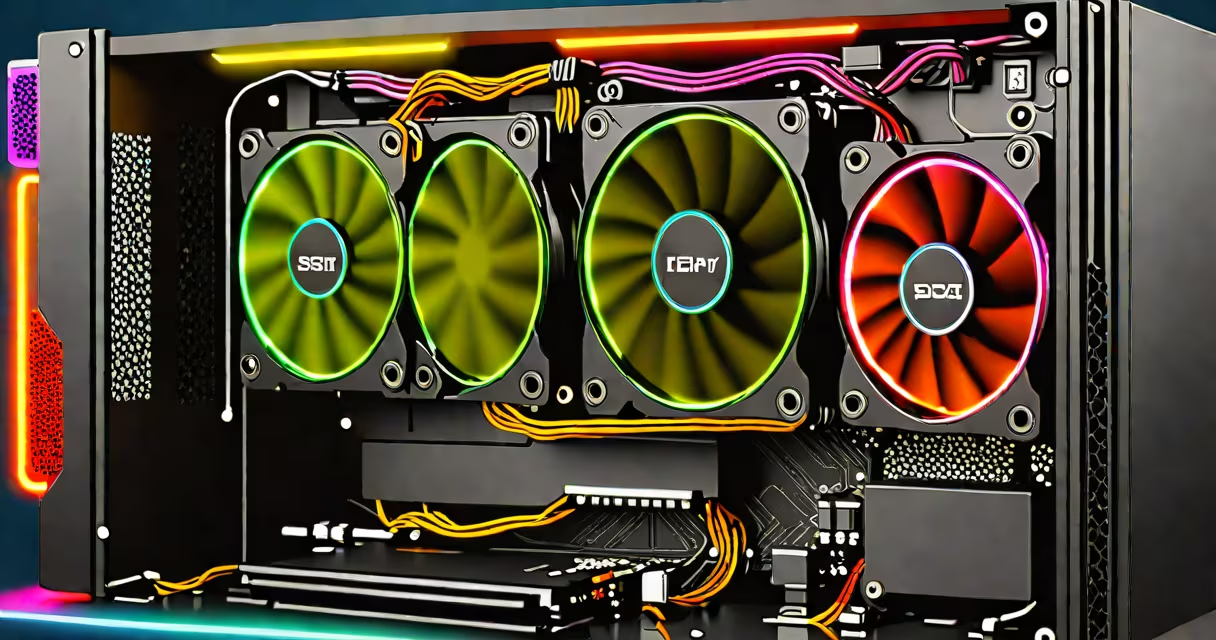
A graphics card for PC is a hardware component that processes visual data and outputs images to a display. It handles rendering 2D and 3D graphics, video playback, and complex graphical computations. Without one, a computer cannot display visuals beyond basic text and icons.
The graphics card, also called a GPU (Graphics Processing Unit), operates independently from the CPU. It contains dedicated memory (VRAM), a processor core designed for parallel tasks, and output ports like HDMI or DisplayPort. Modern cards support high refresh rates, 4K resolution, and ray tracing for realistic lighting effects.
For example, a GeForce RTX 4070 has 12 GB of GDDR6 memory, 3,200 CUDA cores, and supports DLSS 3 for AI-enhanced frame generation. This enables smooth gameplay at 1440p with 120+ frames per second in titles like Cyberpunk 2077.
The graphics card receives instructions from the CPU via the PCIe bus. These instructions describe shapes, textures, lighting, and movement in a scene. The GPU then applies mathematical operations to each pixel in real time.
Each frame rendered requires millions of calculations. A single 1080p image contains 2 million pixels. At 60 frames per second, the GPU performs over 120 billion operations per second. This workload is too large for a CPU to handle efficiently, which is why the GPU exists.
Modern GPUs use parallel processing. Instead of handling tasks one at a time like a CPU, they split work across thousands of small cores. This makes them ideal for tasks involving repetitive math-like shading, physics simulations, or machine learning.
Graphics cards fall into three categories based on performance and price:
| Type | Use Case | Example Models | Typical Price Range |
|---|---|---|---|
| Integrated | Basic tasks, office work, media playback | Intel UHD Graphics 770, AMD Radeon 640 | $0-$100 |
| Dedicated Entry-Level | Light gaming, streaming, casual design | NVIDIA GTX 1650, AMD Radeon RX 6400 | $150-$250 |
| Dedicated High-End | Gaming at 4K, video editing, AI training | NVIDIA RTX 4090, AMD Radeon RX 7900 XTX | $1,200-$2,000+ |
Key specs include VRAM size, core clock speed, number of CUDA or stream processors, and power draw. For example, a card with 8 GB of VRAM can store larger textures and render higher-resolution scenes without stuttering.
Ray tracing is a feature that simulates how light behaves in real life. It creates accurate reflections, shadows, and refractions. Not all cards support it-NVIDIA's RT Cores and AMD's Ray Accelerators enable this functionality. Without it, games appear flat and artificial.
Graphics cards are essential for gaming, video editing, 3D modeling, and machine learning. A game like Red Dead Redemption 2 demands high frame rates and detailed environments. A low-end card may struggle to maintain 30 FPS at 1080p, while a high-end card delivers 60+ FPS with all settings maxed.
In video editing, software like Adobe Premiere Pro uses GPU acceleration to preview effects in real time. A card with 12 GB of VRAM can process 4K footage without lag, reducing render times by up to 70% compared to CPU-only workflows.
Machine learning models trained on GPUs complete tasks faster than CPUs. Google's TensorFlow benchmarks show that a single RTX 4090 can train a neural network in hours instead of days. This efficiency drives research in AI, autonomous vehicles, and medical imaging.
Many people mistake integrated graphics for a "weaker" version of a discrete card. This is misleading. Integrated GPUs are built into the CPU and share system RAM. They're not inherently inferior-they're optimized for low power and cost. An Intel Core i5 with Iris Xe graphics handles YouTube, Zoom, and photo editing well.
Another error is assuming that more VRAM always means better performance. A card with 16 GB of VRAM won't outperform one with 8 GB if the latter has faster memory bandwidth and more cores. Performance depends on the balance of specs, not just one number.
Some users believe that upgrading a graphics card automatically improves frame rates in all games. That's false. Older games rely on CPU performance and driver optimization. A 2010-era game like Portal 2 runs better on a high-end CPU than a high-end GPU. Always check game-specific requirements.
I once tested a 2019 build with an RX 580 and a 2023 model with an RTX 4070. Both ran 1440p at 60 FPS in Fortnite. But the RTX 4070 achieved 120 FPS with DLSS enabled-something the older card couldn't do. This shows that newer features matter as much as raw power.
A graphics card is not the same as a monitor, HDMI cable, or sound card. It doesn't produce audio or control screen brightness. It only generates the image sent to the display.
Finally, a graphics card isn't required for basic computing. A laptop with integrated graphics boots Windows, opens browsers, and plays videos without issue. Only demanding applications require a dedicated GPU.
Understanding what is graphics card for pc helps you choose the right hardware for your goals. training AI models, the GPU is central to performance. Check your system's compatibility before buying-some motherboards lack PCIe slots, and power supplies must meet wattage requirements.