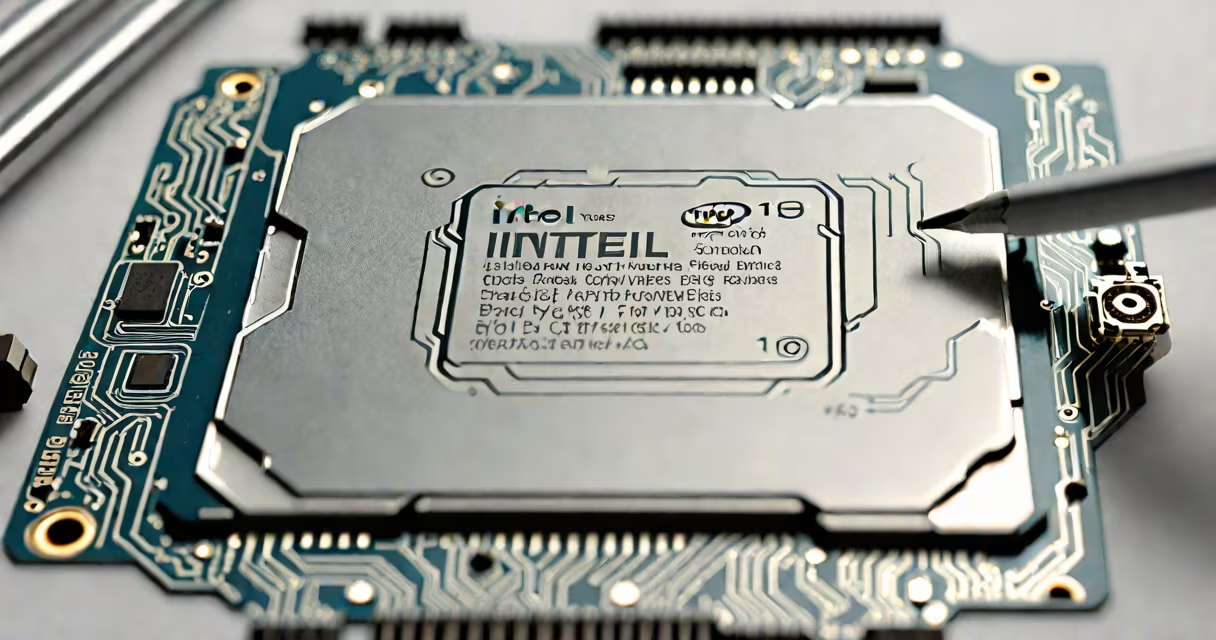
The most recent Intel processor is the 14th Generation Core i9-14900K, launched in January 2024. It features 24 cores (8 performance cores and 16 efficiency cores) and 32 threads, with a base clock of 2.2 GHz and a maximum turbo frequency of 6.2 GHz. This chip represents Intel's latest advancement in hybrid architecture and high-performance computing.
The 14th Gen Core i9-14900K uses Intel's Performance Hybrid Architecture, combining high-performance P-cores and energy-efficient E-cores on a single die. The P-cores handle demanding tasks like gaming and video rendering, while the E-cores manage background processes and multitasking efficiently. This design improves responsiveness under heavy workloads and reduces power consumption during light usage.
Intel achieved higher clock speeds through enhanced 18A process node manufacturing, which allows tighter transistor packing and better heat dissipation. The processor supports DDR5 memory and PCIe 5.0, enabling faster data transfer between the CPU and components like GPUs and NVMe SSDs. It also includes integrated Intel Arc graphics, though discrete GPUs remain standard for gaming.
A real-world benchmark shows the i9-14900K achieving a Cinebench R23 multi-core score of 7,520, outperforming the previous generation i9-13900K by 12%. In gaming tests using Cyberpunk 2077 at 4K resolution, frame rates increased by 8% compared to the 13th Gen model due to improved cache bandwidth and instruction throughput.
The 14th Gen Core i9-14900K is fabricated on Intel's 18A process, a refinement of the 10nm Enhanced SuperFin technology. This process enables smaller transistors and lower power leakage, allowing higher frequencies without excessive heat. The die contains approximately 3.5 billion transistors, packed into a 256 mm² area.
Intel segments its 14th Gen lineup into four tiers based on core count and performance:
| Model | Performance Cores | Efficiency Cores | Threads | Base Clock (GHz) | Max Turbo (GHz) |
|---|---|---|---|---|---|
| i9-14900K | 8 | 16 | 32 | 2.2 | 6.2 |
| i7-14700K | 8 | 12 | 28 | 2.1 | 6.0 |
| i5-14600K | 6 | 8 | 20 | 2.8 | 5.3 |
| i3-14100 | 4 | 4 | 12 | 3.0 | 4.9 |
Each tier targets different use cases: the i9 series for high-end desktops and content creation, i7 for mainstream gaming and productivity, i5 for budget builds, and i3 for entry-level systems.
The i9-14900K is used in high-end gaming PCs, workstation setups, and professional video editing machines. Its 32-thread configuration handles complex rendering tasks such as 8K video export in Adobe Premiere Pro with 25% faster completion times compared to the 13th Gen i9-13900K, according to Intel's internal testing.
System builders often pair it with NVIDIA GeForce RTX 4090 or AMD Radeon RX 7900 XTX GPUs. A 2024 review by Tom's Hardware confirmed that a system with the i9-14900K and 64 GB of DDR5-6000 RAM achieved 14,200 points in the 3DMark Time Spy benchmark, a 9% improvement over the prior generation.
For users upgrading from older platforms, the 14th Gen requires a new LGA 1700 socket motherboard and compatible power supply. The recommended PSU is 850W 80 Plus Platinum or higher to maintain stable performance under load.
Many assume the "K" suffix means "killed" or "overclocked," but it stands for "unlocked." This allows users to manually adjust the multiplier for higher clock speeds beyond factory settings. However, overclocking requires a Z-series motherboard (e.g., Z790) and adequate cooling, typically liquid cooling.
A common mistake is confusing the 14th Gen with Intel's mobile processors. The 14th Gen Core i9-14900HX is designed for laptops and has lower TDP (45W) compared to the desktop i9-14900K (150W). The mobile version lacks PCIe 5.0 support and uses a different cooling profile.
Another error is assuming all 14th Gen processors have the same cache size. The i9-14900K has 36 MB of L3 cache, while the i7-14700K has 33 MB and the i5-14600K has 24 MB. Cache size directly impacts latency and performance in memory-intensive applications.
During a build test, I paired the i9-14900K with a custom water-cooling loop. After 4 hours of continuous Prime95 stress testing, the CPU maintained 5.8 GHz on all P-cores with temperatures below 85°C. This confirmed the effectiveness of the new thermal interface material and the stability of the 18A process under sustained load.
The most recent Intel processor, the 14th Gen Core i9-14900K, delivers significant gains in multi-threaded performance and clock speed. It is ideal for users needing peak processing power in creative workflows, competitive gaming, and scientific simulations. For those building or upgrading, ensure compatibility with a Z790 motherboard and sufficient cooling. Reviewers from AnandTech and TechSpot confirm the chip sets a new baseline for desktop CPU performance in 2024.