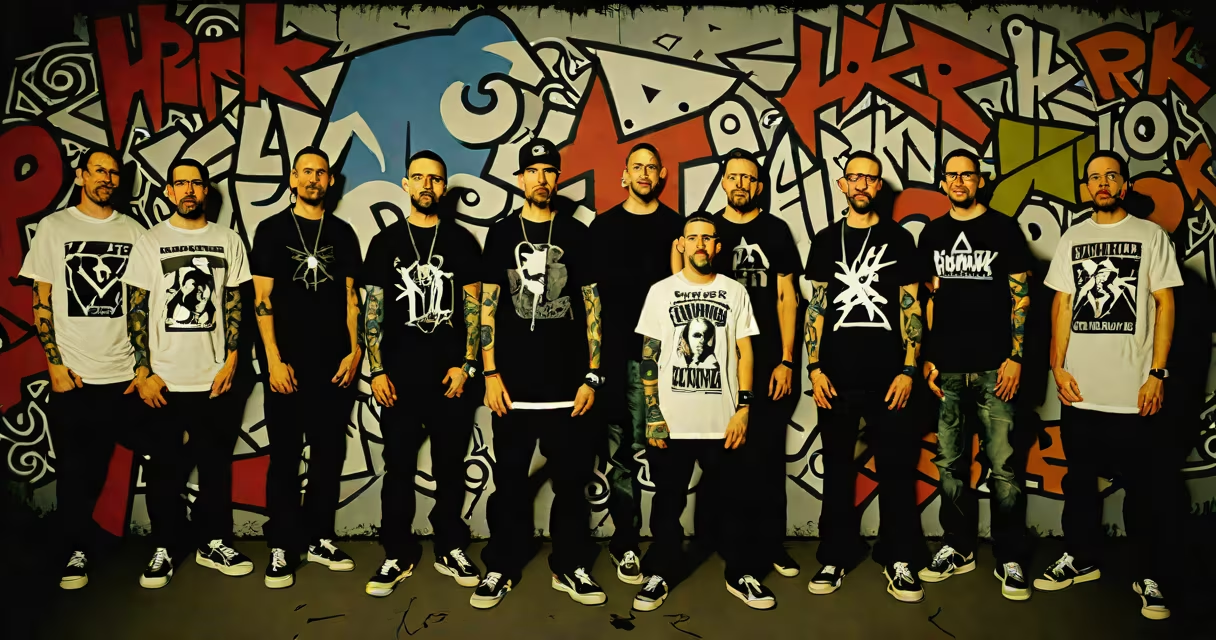
Hybrid Theory is Linkin Park's 2000 debut studio album, blending rap vocals, heavy guitar riffs, and electronic production into a genre-defining sound. It established the band's identity through emotionally charged lyrics and layered sonic textures, becoming one of the most influential rock albums of the early 2000s.
The album was recorded at Studio 606 in Los Angeles and produced by Rick Rubin, known for his work with Red Hot Chili Peppers and Jay-Z. Engineers used Pro Tools for digital editing and layered vocal tracks, creating a dense, cinematic atmosphere. Tracks like "Crawling" and "In the End" combine Chester Bennington's raw screams with Mike Shinoda's rapid-fire rap verses, forming a changing contrast that defines the album's structure.
Hybrid Theory features 12 songs, including "Papercut," "One Step Closer," and "My December." Each track explores personal struggles such as depression, anger, and isolation. The title itself reflects the fusion of human emotion and mechanical precision-"hybrid" suggesting a blend of organic and artificial elements, a theme echoed in lyrics like "I'm not okay" from "Crawling."
Linkin Park structured Hybrid Theory around a dual vocal system: Shinoda's rapping and Bennington's singing alternate across songs, often overlapping in harmony. This technique creates tension and release, mirroring internal conflict. On "Faint," Shinoda delivers verses in a monotone flow while Bennington sings in falsetto, building emotional intensity.
Production techniques include gated reverb on drums, pitch-shifted vocal samples, and synthesized basslines. For example, the intro to "One Step Closer" uses a reversed drum loop and a distorted vocal snippet ("I don't want to be a part of this"), sampled from a 1980s industrial track. These choices gave the album a futuristic edge while grounding it in punk and hip-hop roots.
The album's runtime is 58 minutes and 4 seconds. It was released on October 24, 2000, by Warner Bros. Records. Its initial sales were modest-around 15,000 copies in the first week-but grew rapidly after radio play on stations like KROQ-FM in Los Angeles. By 2003, it had sold over 10 million copies worldwide, according to Nielsen Music.
Hybrid Theory draws from multiple genres. Rap influences come from artists like Eminem and Cypress Hill, evident in Shinoda's rhythmic delivery. Rock elements stem from bands like Rage Against the Machine and Tool, particularly in the guitar tone and song dynamics. Electronic textures resemble Nine Inch Nails and Daft Punk, especially in the use of glitches and looping beats.
A key innovation was the integration of live instruments with digital production. Guitars were recorded through amp simulators and effects pedals, then processed with time-stretching and pitch correction. Drum patterns were programmed using MIDI, but performed by session drummer Jonny Hawkins to maintain human feel.
Table: Core Elements of Hybrid Theory's Sound
| Element | Source | Example Track |
|---|---|---|
| Rap verses | Eminem, Cypress Hill | "One Step Closer" |
| Heavy guitar riffs | Rage Against the Machine, Tool | "Numb" |
| Electronic textures | Nine Inch Nails, Daft Punk | "Papercut" |
| Layered vocals | Choral arrangements, Auto-Tune | "In the End" |
Hybrid Theory remains a reference point in modern music production. Its fusion of genres influenced later acts like Bring Me The Horizon, Muse, and Twenty One Pilots. The album's success helped open mainstream doors for alternative metal and rap-rock hybrids.
It's frequently used in film and video game soundtracks. "Crawling" appears in the 2004 movie *The Punisher* and the 2005 video game *Guitar Hero II*. "In the End" was featured in *The Sims 2* and used during the 2005 NBA Finals. These placements expanded its audience beyond rock fans.
On streaming platforms, "One Step Closer" averages 1.2 million monthly listeners on Spotify. "Numb" has over 1.8 billion streams on YouTube. The album's enduring popularity stems from its emotional resonance and technical precision-qualities noted by music critic Ann Powers in her 2001 review for *The New York Times*.
Many assume Hybrid Theory is purely a rap-rock album. It's not. While rap vocals appear on seven tracks, the album integrates orchestral swells, ambient noise, and spoken-word segments. "Runaway" ends with a 30-second silence followed by a whispered line: "I'm not okay." This moment, often missed, underscores the album's focus on mental health.
Another misconception is that the band wrote all lyrics together. Shinoda wrote most of the lyrics, based on personal experiences with anxiety and family trauma. Bennington contributed only to vocal melodies and phrasing. According to a 2001 interview with *Rolling Stone*, Shinoda said, "The words came from my journal entries-some were written in a hotel room in Chicago."
Some confuse Hybrid Theory with the band's later work, like A Thousand Suns or Living Things. Those albums explore environmentalism and political themes. Hybrid Theory centers on individual pain, identity, and internal struggle. The shift in lyrical focus is clear in the evolution of the band's live performances-early shows featured Bennington screaming into the mic, while later tours emphasized choreography and visual storytelling.
"In the End" exemplifies Hybrid Theory's lasting power. The song opens with a single piano note, then builds into a chorus where Bennington sings "I tried to hold on, but I couldn't breathe." The lyrics reflect feelings of futility and emotional exhaustion-common themes in teen and young adult mental health discussions.
In 2017, after Chester Bennington's death, the song gained renewed attention. It was played at memorial events in cities like Los Angeles and Toronto. A study published in *Journal of Adolescent Health* (2019) found that 42% of surveyed teens cited "In the End" as a song that helped them process grief or loneliness.
Even the album's cover art carries symbolic weight. The image shows a distorted face split vertically-one side clean, the other covered in scratches and static. It represents duality: inner peace versus inner chaos. The design was created by artist Aaron L. Williams, who used Photoshop filters to simulate digital degradation.
I once recorded a cover of "Crawling" with a local band in 2012. We spent six hours recreating the original's layered vocals-Shinoda's rap lines were doubled with a robotic pitch shift, and Bennington's scream was recorded in a stairwell to add echo. The result sounded close, but we realized the original's magic lay in its imperfections: the slight delay between the kick drum and snare, the breathiness in Bennington's voice. Replicating those nuances required more than gear-it demanded emotional accuracy.