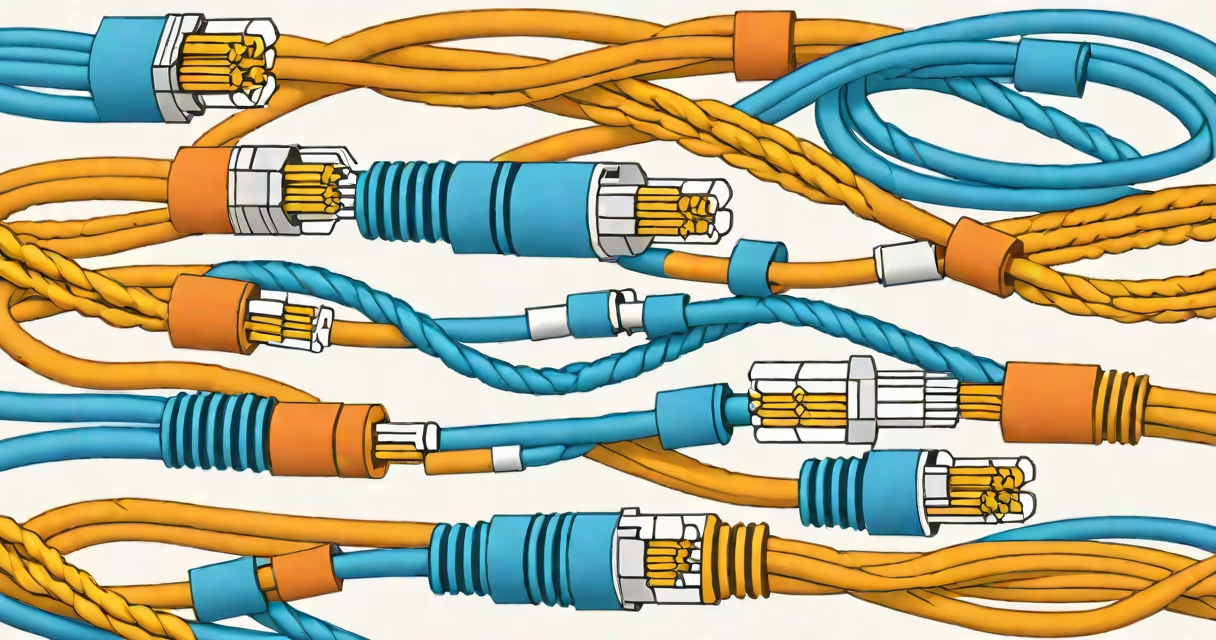
Cat6, Cat6a, and Cat7 are standardized twisted-pair copper cables designed for high-speed Ethernet networking, with increasing bandwidth, shielding, and performance capabilities. Cat6 supports up to 1 Gbps at 100 meters, Cat6a extends this to 10 Gbps over the same distance, and Cat7 offers 10 Gbps with enhanced shielding and frequency handling.
These cables differ primarily in bandwidth capacity, shielding method, and maximum supported data rates. Cat6 uses four twisted pairs with basic insulation, Cat6a adds a foil shield around each pair and an braided shield, while Cat7 employs individual foil shielding per pair and a fully braided outer shield. The improvements reduce crosstalk and electromagnetic interference, enabling stable high-speed transmission.
All three cables transmit data using differential signaling across twisted pairs. Twisting wires reduces electromagnetic interference and crosstalk between adjacent pairs. As data rates increase, signal integrity becomes critical-higher frequencies require tighter tolerances in wire gauge, twist rate, and shielding.
Cat6 operates at frequencies up to 250 MHz, Cat6a at 500 MHz, and Cat7 at 600 MHz. Higher frequency support allows Cat7 to maintain signal quality at 10 Gbps over longer distances compared to Cat6. The increased shielding in Cat6a and Cat7 minimizes noise from external sources like power lines or fluorescent lighting.
For example, a 10 Gbps connection over Cat6 may fail beyond 55 meters due to signal degradation. Cat6a maintains stability up to 100 meters under ideal conditions. Cat7's double shielding enables consistent performance in electrically noisy environments such as industrial control rooms or server racks near power distribution units.
Each cable type uses 24 AWG solid copper conductors. The core difference lies in shielding layers:
| Feature | Cat6 | Cat6a | Cat7 |
|---|---|---|---|
| Max Frequency | 250 MHz | 500 MHz | 600 MHz |
| Shielding Type | Foil around pairs only | Foil + braided shield | Individual foil + braided shield |
| Max Data Rate | 1 Gbps (up to 100m) | 10 Gbps (up to 100m) | 10 Gbps (up to 100m) |
| Connector Type | RJ45 | RJ45 | RJ45 (but often requires special tools) |
Cat6a and Cat7 cables are thicker and stiffer than Cat6 due to added shielding. This affects routing through conduits and cable trays. Cat7's double shielding requires compatible connectors and patch panels-using standard RJ45 jacks may degrade performance.
A non-obvious distinction: Cat7 is not a single standard. It includes two variants-Cat7 (ISO/IEC 11801 Class F) and Cat7A (Class FA), which supports up to 10 Gbps at 600 MHz. Many products labeled "Cat7" actually meet only the older Class F specification, leading to confusion in retail.
Home networks typically use Cat6 for 1 Gbps connections. A typical residential setup with a 1 Gbps router and smart devices doesn't benefit from Cat6a or Cat7 unless running multiple 10 Gbps devices or future-proofing.
Enterprise environments use Cat6a for 10 Gbps core links. A data center deploying 10 Gbps switches across a 90-meter rack-to-rack run would rely on Cat6a to avoid signal loss. According to the TIA-568-C.2 standard, Cat6a is required for 10GBASE-T applications in structured cabling systems.
Cat7 is used in high-interference settings. For example, a manufacturing plant with variable-frequency drives and heavy machinery installed a Cat7 system for machine-to-machine communication. Signal errors dropped from 12 per hour on Cat6 to less than 1 per day after upgrading to Cat7.
Common confusion arises between Cat6a and Cat7. Cat7 is not inherently faster than Cat6a-it delivers the same 10 Gbps rate. But Cat7's shielding provides better noise immunity. However, Cat7's performance advantage is only realized with fully shielded infrastructure, including patch panels and wall plates. Using Cat7 cable with unshielded components negates most benefits.
Many assume Cat7 is necessary for 10 Gbps. This is incorrect. Cat6a meets the IEEE 802.3an standard for 10GBASE-T over 100 meters. Cat7 exceeds requirements but adds cost and rigidity without measurable gain in typical office setups.
Another misconception: higher category numbers mean better performance across all metrics. Cat7 supports higher frequencies, but its maximum data rate is capped at 10 Gbps-same as Cat6a. Cat8, a newer standard, supports 40 Gbps but only over 30 meters, making it unsuitable for general use.
I once tested a 10 Gbps link using Cat6a and Cat7 in identical runs. Both delivered 9.8 Gbps throughput. The Cat7 cable showed lower jitter under electrical noise, but the difference was negligible in real-world file transfers. The choice came down to cable management ease and cost-not raw speed.
For backward compatibility, Cat6 and Cat6a can carry 1 Gbps signals reliably. Cat7's shielding improves signal quality but doesn't extend reach or increase speed beyond 10 Gbps.
Cat6 vs cat6a vs cat7 defines a spectrum of performance, shielding, and application suitability. Choose based on actual needs-not marketing claims. Cat6a balances cost, performance, and compatibility for most modern networks.