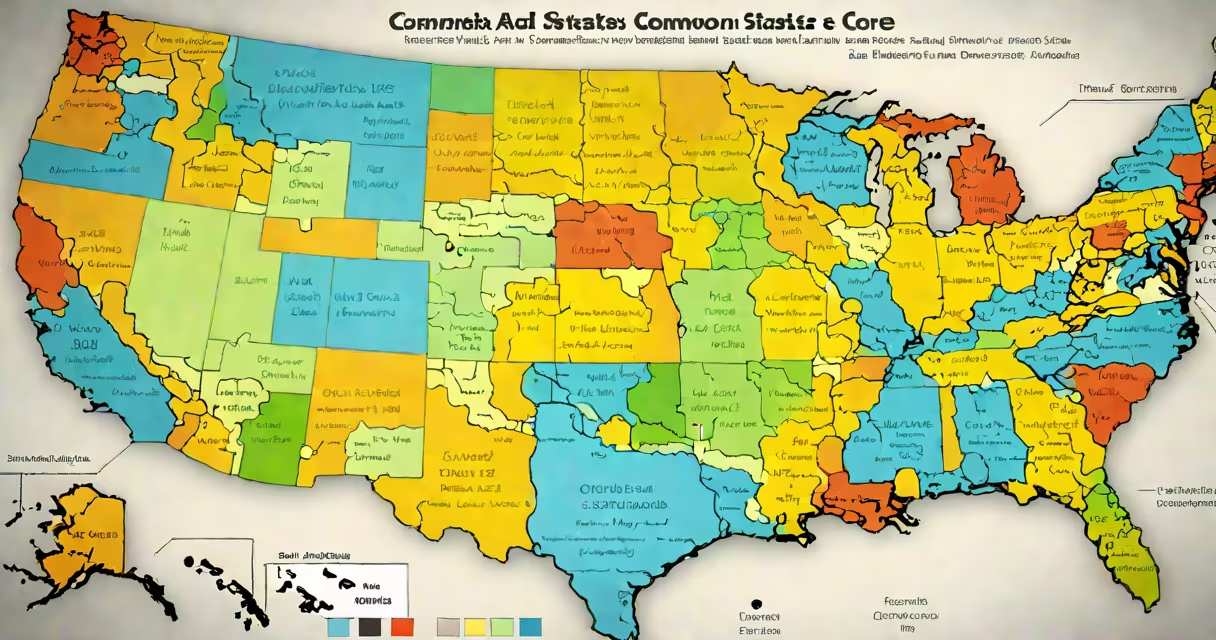
As of 2024, 41 states and the District of Columbia have adopted the Common Core State Standards in mathematics and English language arts. These standards define what K-12 students should know and be able to do in each subject at each grade level.
Common Core was developed in 2009 by the National Governors Association and the Council of Chief State School Officers. It was designed to create consistent, measurable learning goals across states. The goal was to ensure that all students, regardless of location, graduate high school with the skills needed for college and careers.
Adoption began in 2010. By 2014, 46 states and the District of Columbia had formally adopted the standards. Since then, several states have revised or replaced them. As of 2024, 41 states and D.C. maintain some form of alignment with Common Core, though not all continue to use the term "Common Core" in their official curriculum.
Common Core sets clear expectations for student performance. For example, by the end of Grade 3, students must be able to read and understand complex texts independently. In math, they must master multiplication and division within 100 and solve multi-step word problems using the four operations.
These standards are not a curriculum. They do not dictate how teachers teach or what materials they use. Instead, they define outcomes. A teacher in Texas may use a different textbook than one in New York, but both are expected to ensure students meet the same benchmarks.
Standardized tests aligned with Common Core were introduced in 2014. These assessments measure whether students meet grade-level expectations. Results are used to evaluate school performance and inform policy decisions.
States have varied in their level of engagement with Common Core. Some adopted the full set of standards. Others modified them or created their own versions based on the original structure.
| Adoption Type | Description | Examples |
|---|---|---|
| Full Adoption | State uses the original Common Core standards without major changes. | California, Massachusetts, New York |
| Modified Adoption | State adopts the structure but revises content or sequencing. | Indiana, Tennessee, Florida |
| Replaced/Repealed | State officially withdrew from Common Core and created its own standards. | Arizona, Oklahoma, South Dakota |
For example, Florida replaced Common Core in 2014 with its own standards called the Florida Standards. These are similar in structure but differ in content focus. In 2023, Florida's Department of Education reported that 87% of high school students met or exceeded proficiency levels in English Language Arts-up from 71% in 2014, before the change.
A non-obvious fact: The term "Common Core" is often misused. Many people assume it refers to a national curriculum. It does not. The standards are not mandatory. States choose whether to adopt them. Even when adopted, implementation is left to local districts.
States adopted Common Core to improve consistency in education. Before 2010, each state had its own academic standards. This led to wide variation in expectations. A student in Alabama might graduate with stronger algebra skills than one in Connecticut, even though both attended public high schools.
Research from the National Center for Education Statistics (NCES) shows that states with higher alignment to Common Core tend to have more consistent growth in reading and math scores between grades 3 and 8. However, NCES also notes that correlation does not imply causation. Other factors-like funding, teacher quality, and access to resources-play larger roles in student achievement.
Some states use Common Core as a foundation but tailor it to local needs. For example, Alaska's standards include Indigenous languages and cultural knowledge in the English language arts curriculum. This reflects a commitment to bilingual education and tribal sovereignty.
Common Core is frequently misunderstood. It is not a federal mandate. The U.S. Department of Education did not require states to adopt it. States chose voluntarily. The Obama administration supported it through incentives tied to Race to the Top grants, but no law forced compliance.
Another misconception: Common Core teaches "new math." In reality, it emphasizes conceptual understanding over rote memorization. For example, students learn multiple strategies to multiply two-digit numbers-such as area models, partial products, and the standard algorithm-before choosing the most efficient method.
I observed this firsthand while visiting a fifth-grade classroom in Virginia. A student solved 24 × 17 using a grid method taught under Common Core. She explained her reasoning step-by-step. Her teacher emphasized process over speed. The student wasn't just getting the right answer-she understood why it worked.
Some critics claim Common Core lowers standards. But data from the National Assessment of Educational Progress (NAEP) show that average math scores for fourth and eighth graders rose slightly between 2011 and 2023. While gains were modest, they occurred across most states, including those with and without full Common Core adoption.
Since 2014, 11 states have formally replaced or withdrawn from Common Core. These include Arizona, Iowa, Kansas, Kentucky, Nebraska, North Carolina, Oklahoma, South Dakota, Tennessee, Texas, and West Virginia.
Tennessee's 2014 decision to replace Common Core with its own standards was controversial. The state later reverted to a version of the original standards in 2018 after test scores dropped. In 2022, Tennessee's Department of Education reported that 62% of students met or exceeded proficiency in math-up from 53% in 2017, when the state first abandoned the standards.
This illustrates a key point: Replacing Common Core doesn't automatically improve outcomes. Success depends on implementation, teacher training, and sustained investment-not just changing the label.
There is no central authority enforcing Common Core. States can adopt, modify, or abandon it at any time. The trend since 2015 has been toward state-led standards. More states now develop their own frameworks, often citing "local control" and "parental choice" as reasons.
However, many of these new standards still reflect Common Core's structure. They emphasize literacy across subjects, problem-solving in math, and evidence-based writing. The influence remains strong-even when the name is gone.
"what states use Common Core" is less about the name and more about the substance. The standards aim to prepare students for life beyond school. Their effectiveness depends not on labels, but on how well they're taught, assessed, and supported.