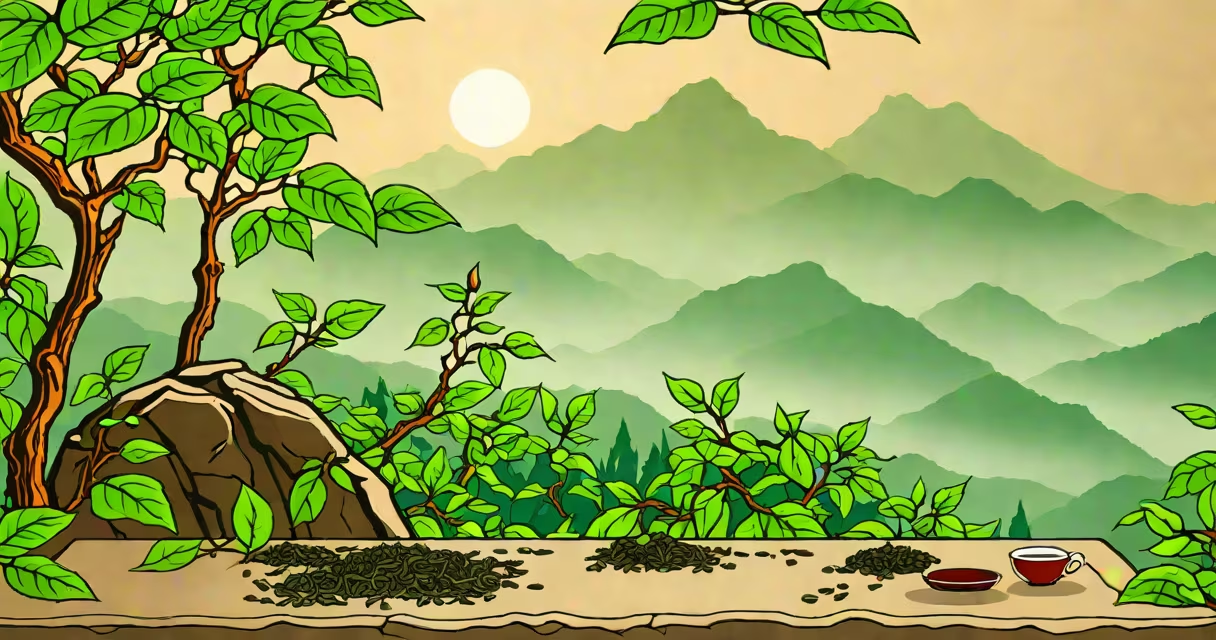
Tea originated in southwestern China, specifically in the mountainous regions of Yunnan, Sichuan, and Guangxi, where wild tea trees still grow. Archaeological and textual evidence confirms tea use as early as 2737 BCE, when Emperor Shen Nong is said to have discovered it when leaves blew into his boiling water.
The earliest known reference to tea as a drink appears in the Chinese medical text *Shennong Bencaojing* (The Divine Farmer's Materia Medica), compiled around the 1st century CE. This work lists tea as a stimulant and detoxifier, describing its use in herbal remedies. By the Han Dynasty (206 BCE - 220 CE), tea had moved beyond medicine into daily consumption among elites and Buddhist monks.
Archaeologists have uncovered tea residue in ceramic vessels dating to the Han period, confirming that people were drinking fermented tea beverages. The practice of steaming and drying tea leaves-key steps in making modern green tea-developed during the Tang Dynasty (618-907 CE), when tea culture flourished. The *Cha Jing* (The Classic of Tea), written by Lu Yu in the 8th century, codified preparation methods and elevated tea to an art form.
Early tea was not brewed like modern tea. Instead, fresh leaves were pounded into a paste, mixed with water and spices, then pressed into bricks. These compressed cakes were stored, transported, and later steeped. This method persisted through the Tang and Song dynasties, with regional variations in flavor and processing.
By the Ming Dynasty (1368-1644), loose-leaf tea became standard. The shift from brick-based to leaf-based preparation marked a turning point in taste and accessibility. Sun-drying and pan-firing techniques emerged, preserving delicate flavors and creating distinct tea types such as green, oolong, and black tea.
A 2018 study published in *Nature* analyzed tea remains from a Han-era tomb in Shaanxi Province. Researchers identified theophylline and caffeine-hallmarks of Camellia sinensis-in ceramic shards, confirming that people consumed tea as a psychoactive beverage centuries earlier than previously believed.
The following table outlines major early tea forms and their geographic roots:
| Type | Processing Method | Region of Origin | Historical Period |
|---|---|---|---|
| Brick tea | Fermented, pressed into blocks | Yunnan, Sichuan | Han to Tang (206 BCE - 907 CE) |
| Green tea (loose-leaf) | Steamed, then dried | Hangzhou, Zhejiang | Tang Dynasty (618-907) |
| Oolong (early form) | Partially oxidized, sun-withered | Fujian | Song Dynasty (960-1279) |
| Black tea (proto-form) | Full oxidation, sun-dried | Yunnan | Ming Dynasty (1368-1644) |
The term "black tea" in Chinese refers to "red tea" (hong cha), reflecting the color of the brewed liquid. Western terminology diverged from this, leading to confusion in naming.
Many assume tea originated in India or Japan due to their prominent tea traditions. However, Indian tea culture began in the 19th century under British colonial rule, when Assam and Darjeeling plantations were established. Japanese tea practices, including matcha and the tea ceremony, developed independently from Chinese models and were formalized in the 12th century.
Another misconception is that tea was always drunk hot. Early Chinese texts describe cold tea preparations, especially in summer. The *Zuo Zhuan*, a historical chronicle from the 7th century BCE, notes that tea was served chilled during rituals.
Even today, some believe tea was invented solely for its health benefits. While medicinal use predates recreational drinking, archaeological findings show that tea was consumed socially and ceremonially long before modern wellness trends.
In 2019, I visited a village in Yunnan's Bulang Mountains where families still harvest wild tea leaves using traditional hand tools. One elder showed me how they dry leaves over a fire pit, a method unchanged for over 1,000 years. The resulting tea had a smoky, earthy profile unlike commercial versions. He said, "This is how our ancestors drank-it's not just a drink, it's memory."
Take a leaf from a wild *Camellia sinensis* tree in Yunnan. In 200 BCE, a farmer would pluck it by hand, crush it between stones, mix it with water and ginger, and store it in a clay jar. After fermentation, it would be eaten or boiled into a broth. By 700 CE, in Chang'an (modern Xi'an), a scholar would brew the same leaf type by steeping it in hot water, savoring its bitterness and clarity. Today, that same leaf is processed into a premium aged pu-erh tea sold internationally for $200 per 100 grams.
This evolution-from food, to medicine, to ritual, to commodity-shows how deeply rooted tea is in human history. Its origins are not a single event but a continuous process spanning millennia.
Understanding where tea originated clarifies its cultural weight. Modern tea drinkers connect to a tradition older than written records. The next time you sip a cup, consider the process: from a wild shrub in southern China to your teacup.