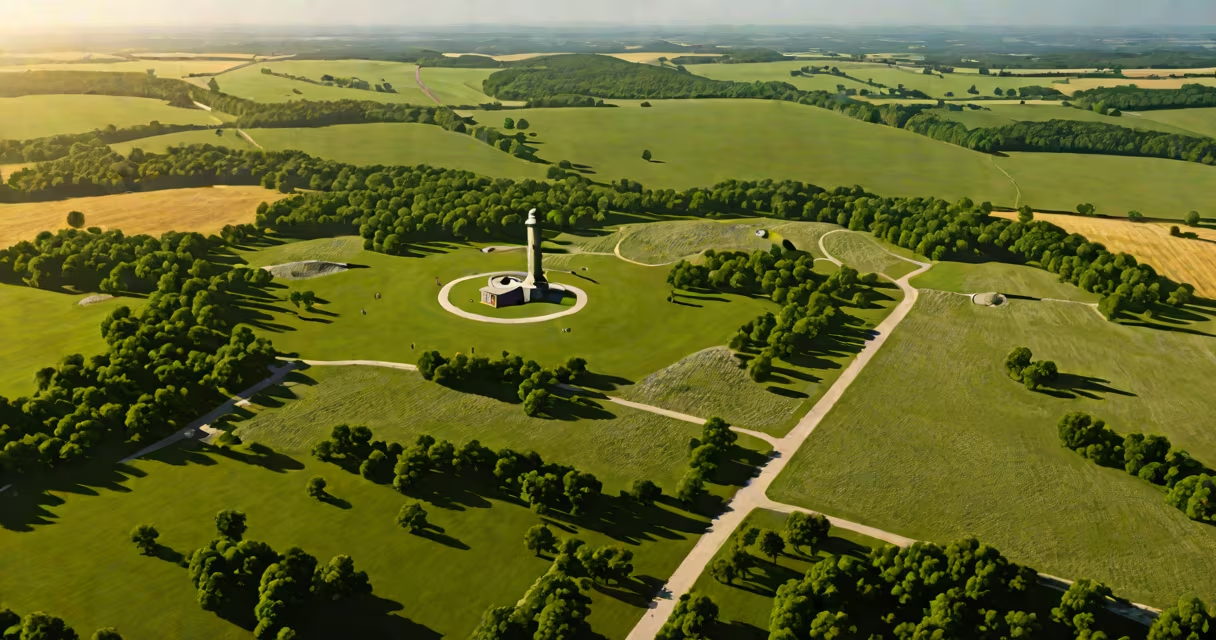
Gettysburg is a town in southern Pennsylvania, located about 70 miles west of Washington, D.C., and 30 miles north of Frederick, Maryland. It is best known as the site of the Battle of Gettysburg, fought from July 1 to July 3, 1863, during the American Civil War.
The town lies at the intersection of U.S. Route 15 and State Route 116, nestled in Adams County. Its coordinates are approximately 39.7833° N latitude and 77.1944° W longitude. The area sits at an elevation of about 1,000 feet above sea level, surrounded by gently rolling farmland and wooded ridges.
Gettysburg became a focal point of military strategy due to its central location between Union-held Washington, D.C., and Confederate-held Richmond, Virginia. The town itself was not heavily damaged during the war, which helped preserve much of its 19th-century architecture. Today, it remains a major historical destination, drawing over 1.5 million visitors annually to the Gettysburg National Military Park.
The Battle of Gettysburg began when Confederate General Robert E. Lee launched his second invasion of the North. His Army of Northern Virginia advanced through Maryland and into Pennsylvania, hoping to win a decisive victory on Union soil. This would pressure the North to seek peace and potentially gain foreign recognition for the Confederacy.
Lee's forces encountered Union troops near Gettysburg on July 1, 1863. The fighting escalated rapidly as both sides reinforced their positions. By July 2, the Union Army of the Potomac, commanded by Major General George G. Meade, had established strong defensive lines along Cemetery Ridge and Culp's Hill. The Confederates attacked repeatedly but failed to break through.
The turning point came on July 3, when Confederate General James Longstreet led a massive infantry assault known as Pickett's Charge. Over 12,000 Confederate soldiers marched across open fields toward Union lines on Cemetery Ridge. They were met with devastating artillery and rifle fire. The charge collapsed within minutes, marking the end of Lee's campaign. The Union repelled the attack with heavy losses on both sides.
Gettysburg National Military Park preserves the battlefield and surrounding areas. The park spans over 6,000 acres and includes 1,300 monuments, memorials, and markers. Visitors walk trails that follow the routes of Union and Confederate units, seeing where soldiers charged, entrenched, and fell.
Key sites include:
A 3-mile loop trail called the "Battlefield Trail" allows visitors to walk through the heart of the conflict. Audio guides narrate events as you pass each site. The park also offers guided bus tours, reenactments during summer weekends, and educational programs for school groups.
Many assume Gettysburg was a city or large urban center during the Civil War. In reality, it was a small farming community of about 2,400 residents in 1863. Most buildings were private homes, churches, and inns. The town was unprepared for the scale of violence that unfolded.
Another misconception is that the Gettysburg Address was delivered on the first day of the battle. It was not. Lincoln spoke at the cemetery dedication ceremony nearly four months later. He arrived in Gettysburg on November 18, 1863, and gave the speech the following day. The address lasted just over two minutes and contained 272 words.
Some visitors think the battlefield is entirely flat. In fact, the terrain features significant elevation changes. The Union army held higher ground, which gave them a tactical advantage. The Confederates had to advance uphill against entrenched defenders-a key factor in the failure of Pickett's Charge.
The Battle of Gettysburg resulted in approximately 51,000 casualties-killed, wounded, or missing-over three days. The Union suffered around 23,000 casualties; the Confederacy lost about 28,000. These numbers represent the bloodiest battle in American history.
By comparison, the Battle of Antietam in September 1862 saw 23,000 casualties in a single day. Gettysburg's death toll was higher because it spanned three days of intense fighting. The Union's victory halted Lee's northern advance and shifted momentum toward the North.
Today, the National Park Service manages the site. According to the NPS, over 1.5 million people visited Gettysburg National Military Park in 2023. The most common travel origin is within 100 miles of the park, with visitors coming from New York, Philadelphia, Baltimore, and Washington, D.C.
| Feature | Details |
|---|---|
| Location | Adams County, Pennsylvania, USA |
| Battle Dates | July 1-3, 1863 |
| Commanders | Union: George G. Meade; Confederacy: Robert E. Lee |
| Estimated Casualties | ~51,000 total |
| Visitor Count (2023) | 1.5 million |
I visited Gettysburg in early October 2022. I walked the entire length of Cemetery Ridge during a late afternoon light. The wind carried the scent of pine and dry grass. As I passed the monument to the 20th Maine, I noticed a young woman reading Lincoln's speech aloud. Her voice cracked on the line "that this nation, under God, shall have a new birth of freedom." That moment reminded me that history here is not just studied-it's felt.
Gettysburg is not just a place on a map. It is a living memorial to sacrifice, leadership, and the enduring cost of division. The battlefield remains a place of reflection, education, and remembrance. Whether you come for history, patriotism, or quiet contemplation, the answer to "where is Gettysburg?" leads to a field shaped by courage and consequence.
Gettysburg is a town in Pennsylvania where the key Civil War battle took place in 1863. The site continues to serve as a national shrine and educational resource, preserving the memory of those who fought and died on its fields.