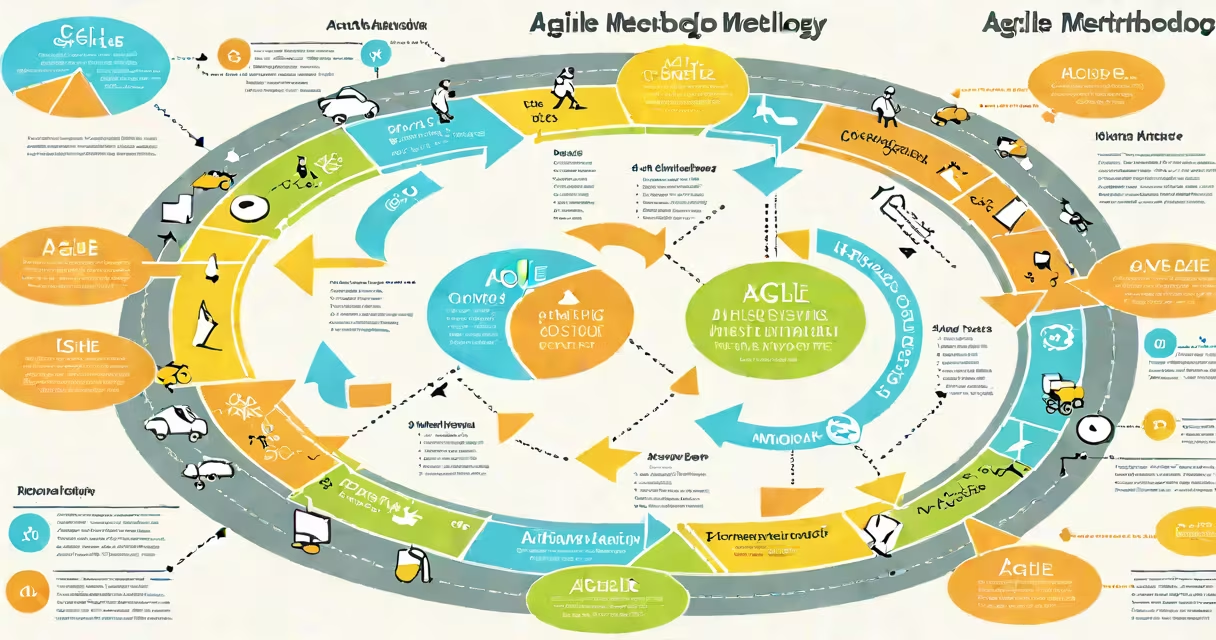
The agile methodology cycle is a structured, iterative process used in software development and project management to deliver working products in small, incremental stages. It emphasizes collaboration, flexibility, and continuous improvement through repeated cycles of planning, execution, review, and adaptation.
Each cycle-commonly called a sprint in Scrum-lasts between one and four weeks. Teams define goals, build features, test results, and reflect on performance before starting the next iteration. This approach allows rapid response to changing requirements and early detection of issues.
According to the Agile Manifesto, values such as individuals and interactions over processes and tools, working software over complete documentation, customer collaboration over contract negotiation, and responding to change over following a plan form the foundation of the cycle's design. These principles guide how teams structure their work and measure progress.
The agile methodology cycle follows a four-stage loop: Plan, Do, Check, Act (PDCA), adapted from quality control theory. This model ensures consistent evaluation and refinement across iterations.
In the Plan phase, teams identify priorities, define user stories, estimate effort, and commit to a set of tasks for the upcoming sprint. The product owner and development team collaborate to ensure the backlog is well-groomed and aligned with business goals.
The Do phase involves executing the planned work. Developers code, testers validate functionality, and the team holds daily stand-up meetings to track progress and resolve blockers. All activities are time-boxed to maintain focus and momentum.
During Check, the team demonstrates the completed work to stakeholders. A sprint review meeting evaluates whether the features meet acceptance criteria. Feedback is collected and documented for inclusion in the next cycle.
The Act phase includes a sprint retrospective. The team reflects on what went well, what didn't, and how processes can improve. Action items are assigned to address inefficiencies, reduce technical debt, or improve communication.
This cycle repeats continuously. After each sprint, the product increment is potentially shippable, meaning it could be released to users if desired. Over time, multiple cycles build a stable, high-quality product.
While the PDCA structure underlies most agile implementations, specific frameworks apply variations. Scrum is the most widely adopted, using fixed-length sprints, defined roles (product owner, Scrum master, development team), and regular ceremonies.
| Structure | Sprint Duration | Primary Focus | Common Use Cases |
|---|---|---|---|
| Scrum | 1-4 weeks | Team coordination, transparency, frequent delivery | Software development, product teams, startups |
| Kanban | Continuous flow | Work-in-progress limits, visual workflow | Support teams, maintenance, operations |
| SAFe (Scaled Agile Structure) | 1-2 weeks | Enterprise-scale alignment, program increments | Large organizations with multiple teams |
Scrum's cycle is tightly bound to its events. The sprint begins with a sprint planning session, continues with daily stand-ups, includes a sprint review at the end, and concludes with a retrospective. These rituals reinforce discipline and collective ownership.
A lesser-known but critical distinction: not all agile cycles are equal in structure. Some teams adopt "adaptive" or "changing" cycles where sprint lengths vary based on complexity or stakeholder demand. This flexibility improves responsiveness but requires strong team maturity and trust.
Agile methodology cycles are standard in software development, especially in tech companies, startups, and digital product teams. They enable rapid feature deployment, faster feedback loops, and reduced risk of project failure.
For example, a fintech startup building a mobile banking app uses two-week sprints. In Sprint 1, they implement login authentication and biometric sign-in. After the sprint review, users report slow load times. In Sprint 2, the team optimizes backend API calls and reduces latency by 60%. This adjustment was made possible because the cycle allowed immediate testing and iteration.
Non-tech sectors also benefit. Healthcare providers use agile cycles to roll out electronic health record updates. Marketing teams apply sprint-based planning to launch campaigns, adjusting messaging based on early user engagement data.
According to a 2023 report by the Project Management Institute, 71% of organizations using agile reported higher project success rates compared to traditional waterfall methods. The ability to pivot quickly and align with evolving user needs is a major driver of adoption.
Many assume agile methodology cycle means "no planning." This is incorrect. The cycle requires disciplined planning at the start of each sprint. Without clear goals, teams risk building features that don't solve real problems.
Another myth: agile is only for small teams. While it originated in small, co-located groups, frameworks like SAFe and LeSS (Large-Scale Scrum) scale agile practices to hundreds of people across departments and geographies.
Some confuse agile with simply "working fast." Agile prioritizes delivering value, not speed. A team may complete fewer features per sprint but achieve higher user satisfaction due to better quality and relevance.
I've observed this firsthand while consulting for a logistics company implementing a warehouse management system. Early sprints focused on tracking inventory movements. After the first review, warehouse staff requested barcode scanning integration. The team added it in the next cycle, reducing manual entry errors by 85% within three months. This outcome wasn't possible without the feedback loop built into the agile cycle.
Agile doesn't eliminate documentation. It shifts focus from upfront, exhaustive specs to just-in-time, living documents updated during and after each cycle. Technical specifications evolve alongside the codebase.
The agile methodology cycle remains a proven way to manage complex projects with uncertainty. Its strength lies not in rigid rules, but in the discipline to inspect, adapt, and deliver value consistently.