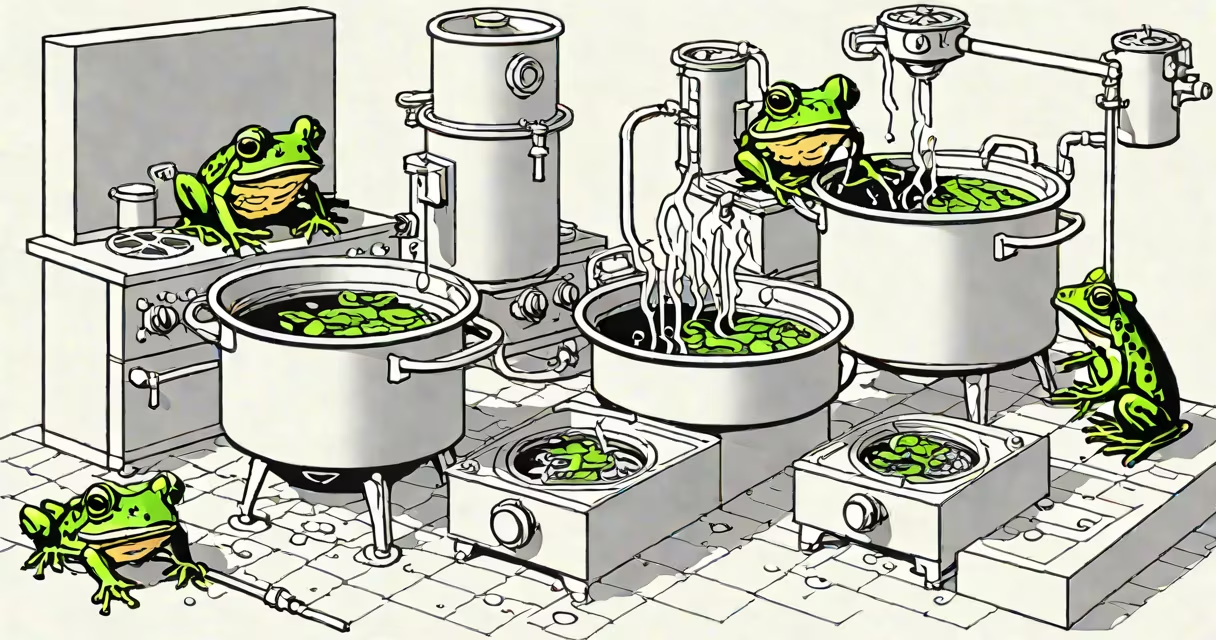
The phrase "boil the frog" refers to a metaphor for how people fail to respond to slow, incremental threats because they don't notice the danger until it's irreversible. It illustrates the psychological tendency to overlook gradual changes that eventually lead to crisis.
The metaphor originates from a hypothetical experiment: if you place a frog in boiling water, it jumps out immediately. But if you place it in cold water and heat it slowly, the frog doesn't react-and dies. This is not a documented scientific study, but it has become a widely cited analogy for systemic failure.
According to the American Psychological Association, this concept aligns with the idea of "normalization of deviance"-where small deviations from safety standards go unnoticed until a major incident occurs. The U.S. National Transportation Safety Board has cited similar patterns in aviation accidents, where minor errors accumulated over time before causing disasters.
The core mechanism behind "boil the frog" is perceptual adaptation. Humans adjust their baseline over time. A slight increase in temperature feels normal after a few minutes. Over time, the change becomes invisible, even though the outcome is fatal.
In decision-making contexts, this explains why employees may ignore declining workplace morale, managers may overlook growing project delays, or individuals may neglect worsening health habits. The change happens too slowly to trigger alarm.
A real-world example: the 2008 financial crisis. Regulators and banks ignored small increases in risky lending practices over years. By the time the housing bubble burst, the damage was irreversible. As economist Robert Shiller noted in *Irrational Exuberance* (2005), "People don't react to slow trends-they react to sudden shocks."
Many assume the frog experiment is scientifically valid. It is not. Actual experiments show frogs do jump out of gradually heated water. The myth persists because the idea resonates, not because it's accurate.
Another misconception is that the metaphor applies only to negative outcomes. It also explains positive drift-like when a company slowly adopts weaker quality standards, leading to customer loss. The problem isn't the direction of change-it's the lack of awareness.
The metaphor doesn't mean change is always bad. It warns against unawareness. A company that improves efficiency by 1% monthly may thrive, but only if leadership monitors the trend. The issue is absence of feedback loops.
Not all slow changes are equal. Some are predictable, others are hidden. Here's how they differ:
| Type | Characteristics | Example |
|---|---|---|
| Gradual erosion | Slow decline in performance, morale, or quality | Team productivity drops 0.5% per month for 12 months-no one notices until results fall below target. |
| Incremental compromise | Small trade-offs that accumulate into major risks | Software team skips testing steps to meet deadlines-bugs grow until system crashes. |
| Normalization of deviation | Rules are bent slightly, then accepted as standard | Employees start arriving late once a week-eventually, punctuality disappears. |
Each scenario shares the same root: absence of early warning systems. Without metrics, feedback, or regular audits, teams miss the turning point.
Businesses use the metaphor to train leaders in risk detection. For example, Amazon's internal culture emphasizes "disagree and commit," which includes challenging small decisions before they compound. Leaders are taught to ask: "Is this change visible? Is it measurable?"
In healthcare, the Institute for Healthcare Improvement reports that nearly 70% of patient safety incidents involve unrecognized gradual deterioration. Monitoring important signs every hour, rather than every four hours, prevents many such failures.
I once observed a startup where engineers began skipping code reviews to ship faster. At first, the change seemed minor. After six months, bug rates doubled. The team didn't realize the pattern until a critical outage occurred. That moment was the "frog in the pot" - the change had been happening for months, but no one noticed.
Prevention requires deliberate structure. Set thresholds for acceptable change. Track metrics weekly, not annually. Establish red flags: "If X increases by 10% over three weeks, we pause."
Use regular audits. Google's "postmortems" require teams to analyze every failure-even small ones-to prevent normalization. They ask: "What did we miss? Why didn't we see it?"
For individuals, apply the rule to habits. If you're gaining weight slowly, track it weekly. A 0.5-pound gain per week adds up to 26 pounds in a year. Awareness stops the boil.
When you notice a small shift-whether in work, health, or relationships-act early. The goal isn't perfection. It's noticing the change before it becomes irreversible.
Understanding "boil the frog" isn't about fear. It's about attention. Small changes matter. The difference between success and collapse often lies in spotting the first ripple.