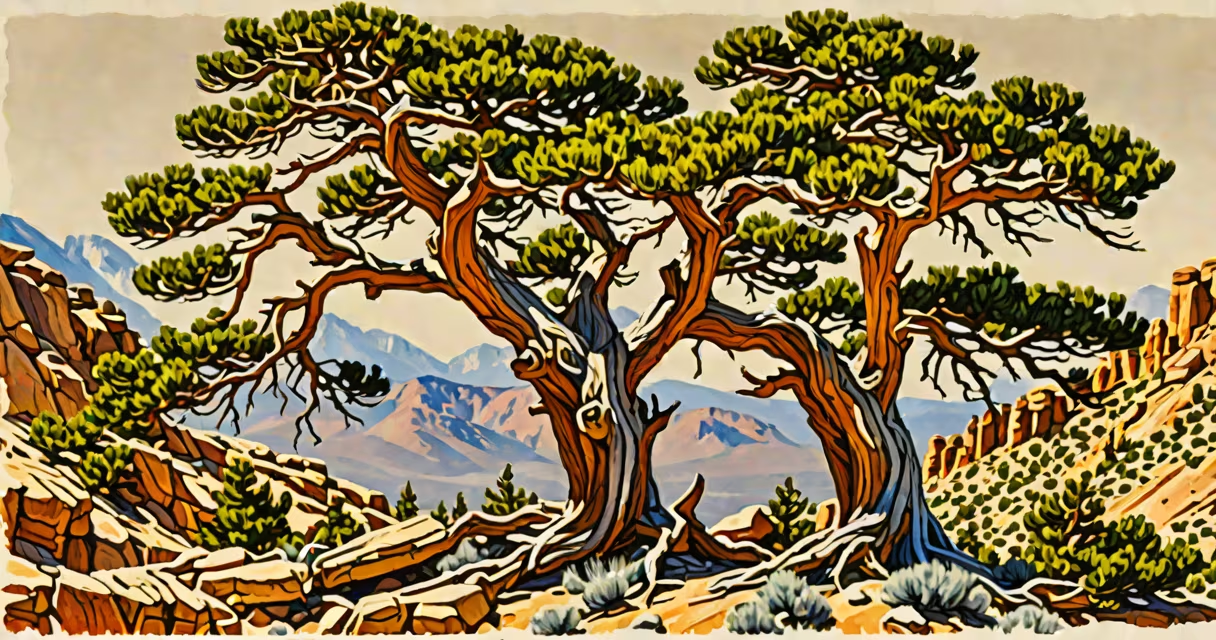
The bristlecone pine tree (Pinus longaeva) is a species of pine native to the high-elevation mountains of the western United States, renowned for its extraordinary lifespan-individuals have lived over 5,000 years, making them the oldest known living organisms on Earth. These trees thrive in harsh, arid environments where few others survive.
Bristlecone pines grow slowly, often forming twisted, gnarled shapes due to wind and cold. Their dense wood resists decay, allowing them to endure centuries of exposure. They are found primarily in the Great Basin region, especially in the White Mountains of eastern California, the Snake Range in Nevada, and parts of Utah and Wyoming.
These trees are not just biological curiosities-they serve as critical tools in climate science. Scientists use their annual growth rings to reconstruct past climate conditions, extending climate records back over 9,000 years. This data helps validate models of long-term environmental change.
Bristlecone pines grow at elevations between 2,500 and 3,500 meters (8,200-11,500 feet), where temperatures drop below freezing for months and soil is thin and nutrient-poor. Their survival hinges on several adaptations:
A single study documented a bristlecone pine in the White Mountains with 4,862 growth rings. Radiocarbon dating confirmed its birth around 2830 BCE, placing it in the early Bronze Age. This individual predates the construction of the Great Pyramid of Giza by nearly 1,000 years.
While Pinus longaeva is the most famous species, bristlecone pines include three closely related taxa, each adapted to specific mountain ranges:
| Species | Range | Typical Altitude | Distinct Feature |
|---|---|---|---|
| Pinus longaeva | California, Nevada, Utah | 2,500-3,500 m | Twisted trunks, needle clusters of five |
| Pinus aristata | Colorado, New Mexico | 2,700-3,600 m | More upright form, shorter needles |
| Pinus flexilis | Rocky Mountains, Idaho, Montana | 2,400-3,300 m | Flexible branches, longer seed cones |
Pinus longaeva dominates the oldest populations. Its habitat overlaps with the Ancient Bristlecone Pine Forest in California's Inyo National Forest, a protected area managed by the U.S. Forest Service. Access to the grove is restricted to preserve the trees from human disturbance.
Many assume bristlecone pines are rare or endangered. This is incorrect. While individual trees are fragile, their populations remain stable across vast stretches of remote terrain. The International Union for Conservation of Nature (IUCN) lists Pinus longaeva as "Least Concern" due to wide distribution and resilience.
Another misconception is that all ancient trees are equally old. In reality, age varies by location. A 4,000-year-old bristlecone pine in Nevada may be younger than a 5,000-year-old specimen in California. Tree age depends on microclimate, soil chemistry, and historical fire patterns.
Some confuse bristlecone pines with other long-lived conifers like yews or sequoias. Sequoias live longer in height and volume but not in individual age. The oldest known bristlecone pine, named Methuselah, is older than any living giant sequoia.
Bristlecone pines provide the longest continuous tree-ring record in the world. Researchers at the University of Arizona's Laboratory of Tree-Ring Research have used these rings to build the "Master Chronology," a reference dataset spanning over 9,000 years. This chronology helps date archaeological sites and calibrate radiocarbon dating methods.
I once stood near a 4,500-year-old bristlecone pine in the White Mountains during a winter storm. The tree was bent sideways from decades of wind, its bark flaking like old paint. Despite the cold and snow, it still produced viable seeds. That moment underscored how life persists under relentless pressure.
The bristlecone pine tree stands as proof of persistence. Its slow growth, resistance to decay, and ability to survive in isolation make it a living record of Earth's climate history. With lifespans exceeding 5,000 years, these trees offer insights into environmental stability, human history, and the quiet endurance of nature.