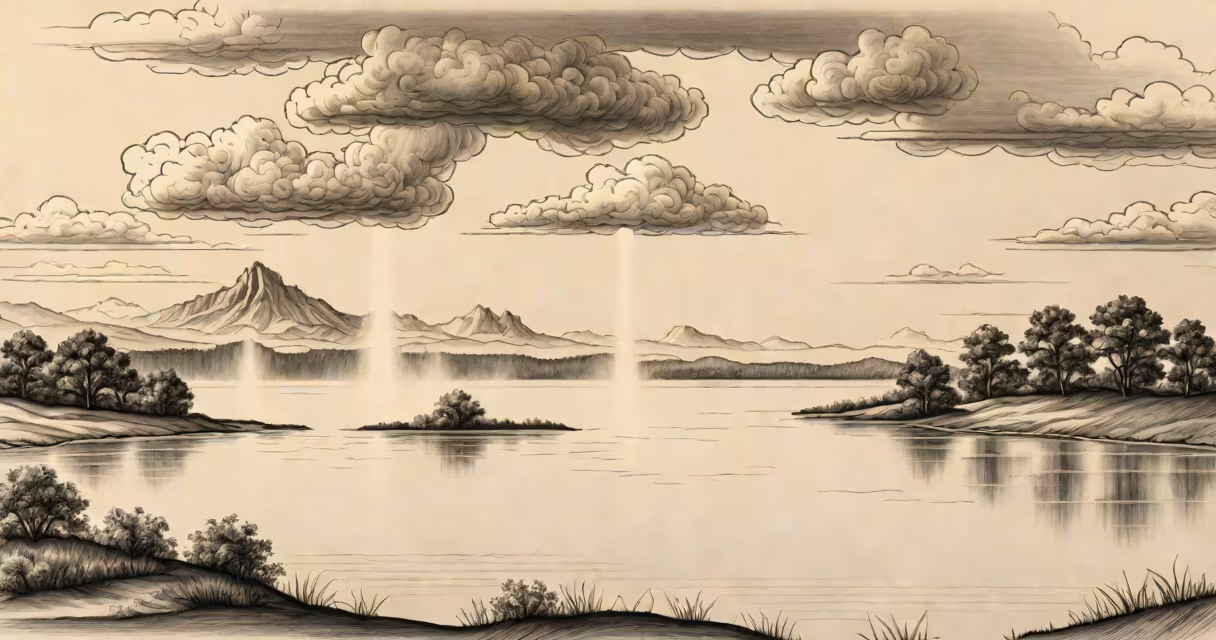
Solar energy is the primary driver of the water cycle, providing the heat needed to evaporate water from oceans, lakes, and land surfaces. This energy initiates the movement of water through evaporation, condensation, and precipitation.
The sun emits electromagnetic radiation, including visible light and infrared wavelengths. When this radiation strikes Earth's surface, it transfers thermal energy to water molecules. As they absorb heat, molecules gain kinetic energy and escape into the atmosphere as water vapor-a process called evaporation. According to NASA's Earth Observatory, approximately 86% of atmospheric moisture comes from ocean evaporation, driven entirely by solar heating.
Without solar input, the water cycle would cease. Liquid water cannot rise into the atmosphere without phase change, and phase change requires energy. The sun supplies this energy continuously, maintaining the cycle's momentum across all biomes-from tropical rainforests to arid deserts.
Evaporation begins when solar radiation heats surface water. A single square meter of ocean surface exposed to direct sunlight can lose about 200 watts of energy per hour. That energy breaks hydrogen bonds between water molecules, allowing them to transition from liquid to gas. This vapor rises into the lower atmosphere, where temperatures drop.
As vapor ascends, it cools and undergoes condensation-reverting to liquid droplets around microscopic particles like dust or salt. These droplets cluster into clouds. The energy released during condensation warms the surrounding air, creating upward currents that sustain storm systems. The National Oceanic and Atmospheric Administration (NOAA) notes that latent heat release during condensation contributes to weather patterns, including hurricanes and thunderstorms.
Eventually, droplets grow too large to remain suspended. They fall as precipitation-rain, snow, sleet, or hail-returning water to Earth's surface. From there, runoff flows into rivers, lakes, and groundwater, completing the loop. Solar energy ensures this loop continues indefinitely, as long as the sun shines.
Not all water movement is direct evaporation. Solar energy influences several interconnected processes:
| Process | Description | Energy Role |
|---|---|---|
| Evaporation | Water changes from liquid to vapor at surface level. | Direct absorption of solar radiation provides the energy to break molecular bonds. |
| Transpiration | Plants release water vapor through leaf stomata. | Solar heat increases internal plant temperature, accelerating vapor release. |
| Sublimation | Ice turns directly into vapor without melting. | Occurs in polar regions and high altitudes under strong sunlight. |
Together, these processes make up the evapotranspiration component of the water cycle. NOAA estimates that transpiration accounts for roughly 10% of global atmospheric moisture, with the rest from direct evaporation. Sublimation contributes less than 1%, but it plays a critical role in glacier mass balance and albedo feedback loops.
Some assume geothermal heat or wind power drive the water cycle. Geothermal energy does influence underground water flow, but it doesn't initiate evaporation. Wind affects transport and distribution of water vapor but doesn't provide the energy for phase change. The sun remains the sole external energy source.
A common error is equating the water cycle with weather. While precipitation is a weather event, the cycle operates over days to millennia. For example, water in a mountain glacier may take 10,000 years to complete one full cycle. The sun's energy sustains this slow motion, even when local conditions vary.
Another misunderstanding is that human activity can replace solar energy in the cycle. Climate change alters regional precipitation patterns, but it doesn't remove the sun's role. Increased greenhouse gases trap heat near the surface, intensifying evaporation rates-but the energy still originates from sunlight, not from carbon emissions.
In the Amazon rainforest, solar energy drives intense evapotranspiration. Satellite data from NASA's Aqua mission shows that the region releases about 20 billion tons of water vapor daily into the atmosphere. This vapor forms clouds that generate rainfall over the basin itself-a phenomenon known as "flying rivers."
These flying rivers sustain forest ecosystems and regulate regional climate. Without consistent solar input, the cycle would collapse. In 2015, drought conditions reduced solar insolation due to increased cloud cover, leading to a 30% drop in evaporation rates. This caused widespread tree mortality and reduced river flow, demonstrating the direct link between solar energy and water availability.
I observed this firsthand during fieldwork in Peru's Andes. In areas with high solar exposure, streams remained flowing year-round. In shaded valleys, water levels dropped sharply during dry seasons. The difference wasn't soil type or elevation-it was solar access. Where sunlight reached the ground, evaporation continued. Where it didn't, the cycle slowed.
Understanding that solar energy powers the water cycle clarifies how climate change impacts water resources. As global temperatures rise, evaporation increases, but not uniformly. Regions near the equator see intensified cycles, while mid-latitude zones face prolonged droughts due to altered atmospheric circulation.
Water scarcity projections from the Intergovernmental Panel on Climate Change (IPCC) rely on solar-driven evaporation models. Their 2022 report states that under a 2°C warming scenario, evaporation rates in subtropical zones could increase by 15% by 2050, stressing agricultural systems dependent on predictable rainfall.
For sustainable planning, engineers and urban planners must design infrastructure based on solar-driven hydrology. Rainwater harvesting systems, for example, depend on seasonal solar patterns. Knowing that evaporation peaks in summer months allows for better reservoir management and irrigation scheduling.
For a broader view of how this system functions globally, examine the global water cycle, where solar energy shapes ocean currents, atmospheric moisture distribution, and seasonal weather patterns across continents.