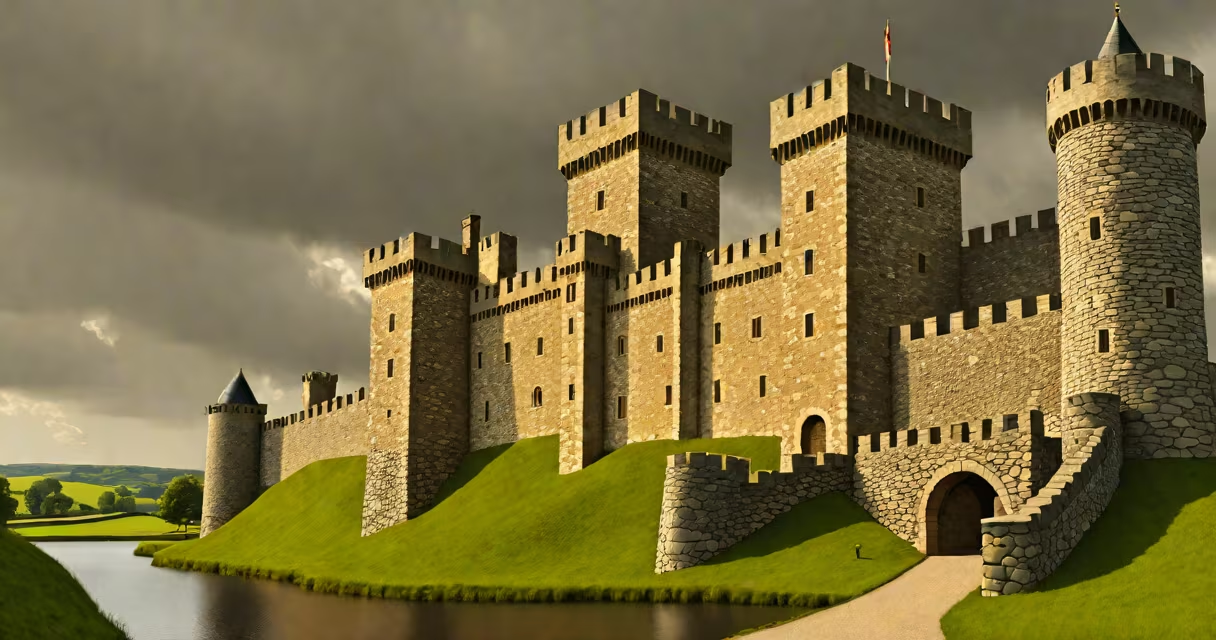
Castles reading comprehension answers are specific, evidence-based responses to questions derived from a passage describing castles, their history, structure, and function. These answers test a reader's ability to extract facts, infer meaning, and analyze details within a narrative or informational text.
The original passage typically covers topics such as castle construction methods, defensive features like moats and portcullises, daily life inside the fortress, or the role of castles during conflicts like the Norman Conquest. Questions then ask readers to identify key events, explain cause-and-effect relationships, or interpret implied meanings.
For example, a passage may state: "The keep was the strongest part of the castle, often built last to serve as a final refuge." A corresponding question might be: "Why was the keep usually constructed last?" The correct answer-"To ensure it remained the most secure area during attacks"-requires both literal recall and inference.
These answers are designed to measure reading proficiency through structured questioning. They follow a standard format: a short passage (usually 200-300 words), followed by 4-6 questions that assess different cognitive levels. Questions progress from basic recall to higher-order thinking, such as comparing structures or predicting outcomes.
Each answer must be supported by direct evidence from the text. For instance, if a passage says, "Moats were filled with water to prevent enemy siege engines from reaching the walls," a valid answer to "What was the purpose of a moat?" must include the phrase "to prevent enemy siege engines" as justification.
Teachers and test developers use rubrics to score responses. A full-point answer includes a clear statement backed by a quote or paraphrase from the passage. Partial credit may be awarded for answers with correct reasoning but missing textual support.
Answers are composed of three core elements: accuracy, specificity, and textual grounding. Accuracy ensures the response reflects the passage's content. Specificity requires naming exact features-such as "battlements" or "machicolations"-rather than vague terms like "defensive parts." Textual grounding means citing or summarizing relevant lines.
There are three common types of questions that generate these answers:
| Type | Description | Example Question | Sample Answer |
|---|---|---|---|
| Literal | Direct facts from the text | What material was used to build the outer wall? | Stone and mortar were used to construct the outer wall. |
| Inferential | Implied meaning not stated outright | Why did lords prefer living in the keep? | Because it offered the best protection during sieges. |
| Evaluative | Judgment based on evidence | Was the drawbridge a good defense feature? Why? | Yes, because it could be raised quickly to cut off access. |
Some passages include subtle details that mislead readers who rely on prior knowledge. For example, a passage may describe a castle with a wooden gate and stone walls, but a student familiar with typical castles might assume the gate was stone. Correct answers must reflect only what the text states.
These materials are widely used in U.S. public schools, especially in grades 4-8. They appear in standardized assessments like the Smarter Balanced Assessment Consortium (SBAC) and the Partnership for Assessment of Readiness for College and Careers (PARCC), which align with Common Core State Standards.
According to the National Council of Teachers of English (NCTE), students who engage with structured reading comprehension tasks show improved performance in both literacy and content-area learning. A 2021 study published in the Journal of Educational Psychology found that students using guided reading passages with embedded questions scored 18% higher on follow-up assessments than those using unstructured texts.
Classroom applications include warm-ups, homework assignments, and formative assessments. Teachers use the answers to identify gaps in understanding-such as confusion between "battlements" and "crenelations"-and adjust instruction accordingly.
Many users mistake castles reading comprehension answers as subjective interpretations. This is incorrect. Answers must be rooted in the passage, not personal opinion. For example, a student cannot claim "castles were scary" unless the text uses emotionally charged language like "dark corridors echoed with footsteps."
A frequent error is overgeneralization. A student might answer, "Castles were used for defense," which is true but incomplete. A stronger answer specifies: "Castles were primarily built to defend against invasions and protect nobles during warfare."
Another misconception is equating "answers" with "summary." A summary condenses the entire passage into a brief overview. Answers focus on individual questions and require precision. A summary of a castle passage might be: "This text explains how castles evolved from wooden forts to stone strongholds." An answer to "What was the purpose of a portcullis?" must be: "To drop quickly and block entry during attacks."
I once reviewed a set of student answers from a sixth-grade class. One student wrote: "The king lived in the tower because he liked being high up." The teacher marked it incorrect. The passage had said: "The royal family resided in the keep due to its central location and security." The student had projected personal preference onto the text-a classic failure of textual fidelity.
Consider this excerpt from a 2022 grade 6 reading passage titled "Life Inside a Medieval Castle": "Daily routines varied by rank. Servants rose before dawn to prepare meals and clean. Knights trained in the courtyard, while the lord and lady dined in the great hall. At night, the family gathered around a fire, listening to stories told by minstrels."
Question: What was the role of minstrels in the castle?
Correct answer: Minstrels told stories to entertain the family during evening gatherings.
This answer is accurate, specific, and grounded in the text. It cites "listening to stories told by minstrels" as evidence. A weaker answer-"They played music"-omits context and fails to connect the role to the social setting described.
When reviewing castles reading comprehension answers, always verify that each response contains: (1) a direct claim, (2) a supporting detail from the passage, and (3) no external assumptions.
Understanding how castles reading comprehension answers are constructed improves both assessment reliability and student learning outcomes. Use them not just to check knowledge-but to reveal how students think.