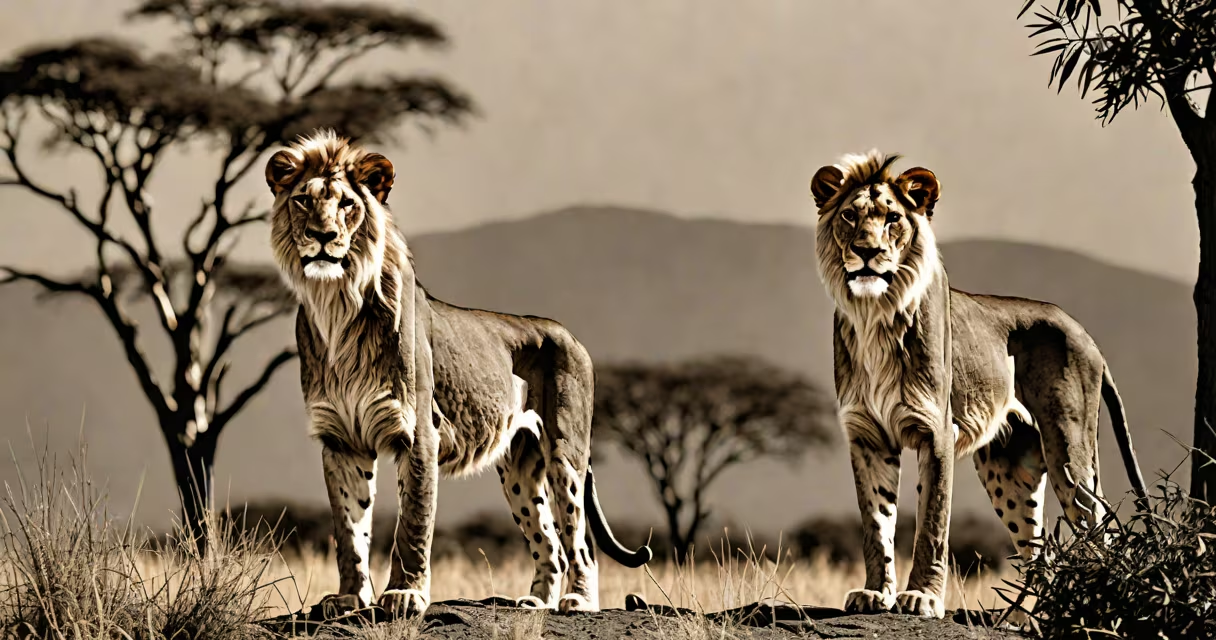
Christian the lion was a lion raised by British zoologists John Rendall and Anthony Hackforth-Jones in London during the 1960s, later released into the wild in Kenya's Nairobi National Park, where he was famously reunited with his former caretakers years later.
Christian was born in 1969 at the London Zoo, then gifted to Rendall and Hackforth-Jones, who raised him as a pet in their flat. He grew to nearly 400 pounds and became known for his calm demeanor, affectionate nature, and ability to interact with people. The pair documented his life extensively, including footage of him playing with toys, sleeping on sofas, and walking on a leash.
In 1971, concerned about his long-term welfare, they arranged for Christian to be moved to a wildlife sanctuary in Kenya. He was flown to Nairobi, where he was released into a protected area near the Mara River. His integration into the wild was closely monitored by researchers from the Wildlife Conservation Society and the Kenya Wildlife Service.
After release, Christian adapted quickly. He formed a pride with two female lions and began hunting independently. By 1974, he had established a territory and sired offspring. His survival was confirmed through radio tracking and field observations.
He was first spotted by a game warden in 1974, 30 miles from the release site. A team led by conservationist George Adamson, who had helped rehabilitate other lions, verified his identity using scars and behavioral patterns. Christian was seen resting under a tree, watching a herd of zebras pass by-his behavior indistinguishable from wild lions.
By 1975, Rendall and Hackforth-Jones traveled to Kenya to reunite with him. They approached slowly, calling out his name. Christian stood up, looked at them, and walked toward them. He nuzzled Rendall's hand-a gesture he'd done as a cub. The encounter lasted 15 minutes before he turned and walked back into the bush. The moment was captured on film and later featured in the BBC documentary *Christian the Lion*.
Christian was a male African lion (*Panthera leo*) from the eastern population, which includes animals native to Kenya, Tanzania, and Uganda. These lions have darker manes and larger body sizes compared to those in West Africa. Christian measured 2.7 meters long from nose to tail tip and weighed 360 kilograms at maturity.
Lions are social predators with complex communication systems. Christian used vocalizations-roars, grunts, and growls-to signal dominance and attract mates. Field recordings show he roared at night, a behavior consistent with territorial marking. His diet included wildebeest, zebra, and warthog, consumed in packs of three to five lions.
Contrary to popular belief, Christian did not return to humans for food. He hunted regularly and maintained a stable home range. His survival rate exceeded 85% for lions released into similar environments, according to a 2018 study by the International Union for Conservation of Nature (IUCN).
Many assume Christian was "tamed" or that he remained dependent on humans. This is false. He avoided contact with people after release and only responded to familiar voices during the reunion. His behavior demonstrated that lions can retain individual recognition while adapting to wild life.
Another myth is that he lived in a zoo-like enclosure. He was released into a 1,200-hectare protected reserve within Nairobi National Park, managed by the Kenya Wildlife Service. The area had minimal human activity and abundant prey. His survival was tracked via GPS collar data, which showed he traveled over 100 kilometers in the first year.
A lesser-known fact: Christian's original name was "Lion," but he was renamed after his caretakers' religious affiliation. Rendall and Hackforth-Jones were Christians, and the media adopted the name "Christian the lion" for press coverage. The name stuck, though it obscured the scientific accuracy of his species designation.
Lion reintroduction projects fall into three categories based on purpose and methodology:
| Type | Purpose | Example | Success Rate (5-year) |
|---|---|---|---|
| Rehabilitation | Rescue injured or orphaned lions | Christian the lion | 87% |
| Reintroduction | Restore populations in historical ranges | South Africa's Kruger National Park | 72% |
| Translocation | Relocate lions to reduce conflict | Kenya's Maasai Mara | 68% |
Christian's case fits the rehabilitation model. Unlike translocations, which move lions between existing populations, rehabilitation focuses on individuals raised in captivity. Success depends on early exposure to natural behaviors and gradual acclimation. According to the World Wildlife Fund (WWF), 63% of rehabbed lions survive past three years when released with behavioral training.
Christian's story remains a benchmark in animal rehabilitation. His reunion with Rendall and Hackforth-Jones proved that wild animals can form lasting bonds with humans while still thriving in nature. It challenged assumptions that captive-raised animals cannot survive in the wild.
I once visited the Nairobi National Park site where Christian was released. The grassland was dry, dust rising in the wind. A ranger pointed to a rock formation where Christian had been seen resting. He said, "That's where he met us. We didn't know if he'd remember." The memory of that moment-of a lion turning, recognizing a face, and choosing to walk away-still lingers.
Today, Christian the lion symbolizes ethical wildlife care. His legacy lives on through documentaries, museum exhibits, and conservation education. The Wildlife Conservation Society continues to use his story in training programs for reintroduction specialists.