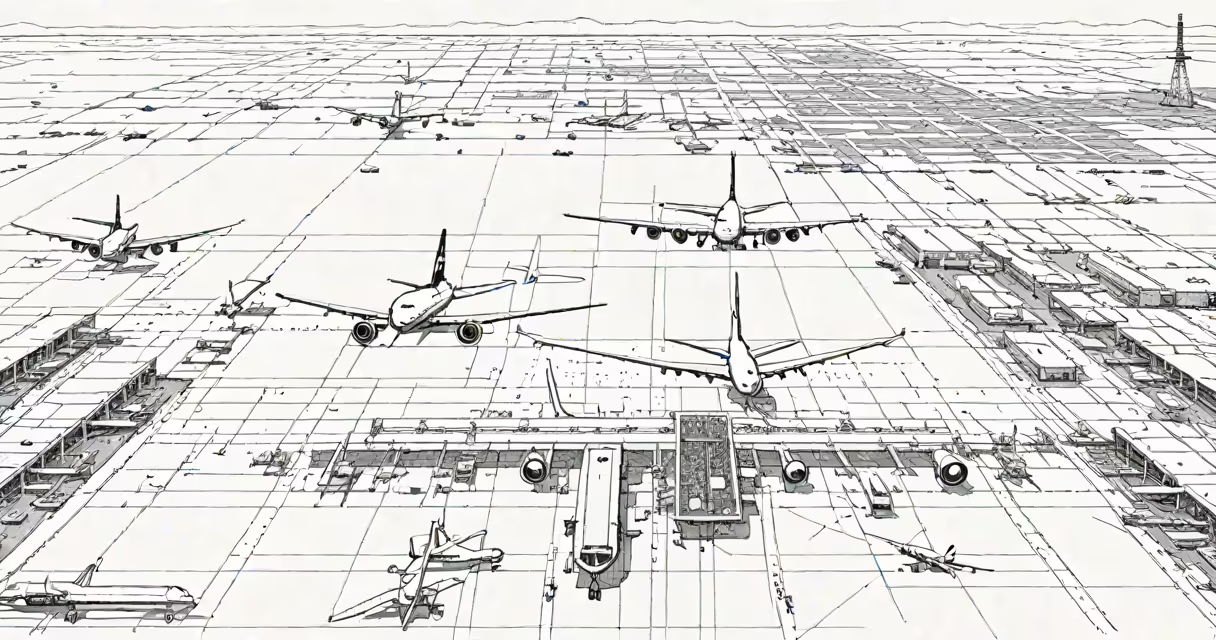
Class B airspace is a designated controlled airspace surrounding the nation's busiest airports, designed to manage high-volume air traffic through strict entry requirements and air traffic control oversight. It extends from the surface up to 10,000 feet above mean sea level and typically includes multiple layers forming a complex, pyramid-shaped zone around major hubs.
Regulated by the Federal Aviation Administration (FAA), Class B airspace requires all aircraft to receive prior authorization before entering. This clearance ensures separation between thousands of daily flights, including commercial airliners, business jets, and military operations. Without approval, flying into Class B airspace is illegal and poses serious safety risks.
The structure of Class B airspace is defined by specific dimensions and boundaries. For example, around New York's John F. Kennedy International Airport (JFK), Class B airspace spans approximately 30 nautical miles in radius, with vertical limits from the surface to 10,000 feet MSL. Inside this zone, aircraft must maintain two-way radio communication with ATC and comply with speed, altitude, and transponder requirements.
Class B airspace operates under Instrument Flight Rules (IFR) and Visual Flight Rules (VFR) simultaneously, but only with explicit clearance. All aircraft must establish contact with Air Traffic Control (ATC) before entering and maintain continuous communication while inside. Controllers assign routes, altitudes, and separation standards to prevent collisions.
Entry is granted via a clearance issued by ATC. Pilots must request permission using their call sign and current position. Once approved, they follow assigned headings, speeds, and altitudes. Even experienced VFR pilots must file a flight plan and obtain clearance before crossing into Class B airspace.
Aircraft operating within Class B must have a Mode C transponder, which automatically reports altitude to ground radar systems. This enables controllers to monitor vertical separation. The FAA mandates this equipment for all aircraft intending to enter Class B airspace, regardless of size or purpose.
Class B airspace is not a single uniform zone. It consists of multiple layers-often referred to as "shells"-that form a stepped pyramid. Each shell has distinct horizontal and vertical boundaries. The innermost shell, closest to the airport, has tighter restrictions and lower ceilings.
For example, at Los Angeles International Airport (LAX), Class B airspace has five concentric layers:
| Layer | Radius (nm) | Altitude Range (MSL) | Primary Use |
|---|---|---|---|
| Inner | 5 | Surface - 3,000 ft | Terminal arrivals/departures |
| Outer | 30 | 3,000 - 10,000 ft | En route traffic management |
These layers allow ATC to manage different phases of flight separately. Aircraft approaching LAX for landing may be vectored through the outer layer at 8,000 feet, then descend into the inner layer for final approach. This layered design prevents congestion and maintains safe separation.
Commercial airlines dominate Class B airspace due to high traffic volume. Major carriers such as Delta, American Airlines, and United operate hundreds of daily flights through Class B zones. These flights require precise routing and coordination with ATC to avoid delays and ensure safety.
General aviation pilots also use Class B airspace, though less frequently. A private pilot flying a Cessna 172 from a nearby airport to attend a medical appointment in downtown Chicago must file a flight plan and receive clearance before entering the Class B zone around O'Hare International Airport (ORD).
Business jets and air ambulance services operate within Class B airspace regularly. These aircraft often fly under IFR and rely on ATC guidance for navigation and separation. Military aircraft conducting training missions near major airfields also transit through Class B zones under special authorization.
Many pilots assume that flying VFR through Class B airspace is simple if they stay below 10,000 feet. This is incorrect. Even VFR flights require clearance and must remain in constant communication with ATC. Failure to do so results in violations and potential enforcement actions.
Another misconception is that Class B airspace applies only to large cities. While most Class B zones surround major metropolitan areas, smaller airports with significant traffic can also have Class B status. For example, San Diego International Airport (SAN) has Class B airspace despite being smaller than LAX or JFK.
A critical distinction: Class B airspace is not the same as a terminal control area (TCA). TCAs are advisory zones used in some countries but not recognized in U.S. airspace classification. The FAA defines Class B exclusively through federal regulation (14 CFR §91.137).
Consider a pilot flying a Piper PA-28 from Athens, Georgia, to Atlanta Hartsfield-Jackson International Airport (ATL). The flight path crosses into Class B airspace approximately 15 miles west of the airport.
Before entering, the pilot contacts Atlanta Approach Control on the assigned frequency. They report their position, altitude (6,000 feet), and intent to land at ATL. ATC responds with a clearance: "Piper 789, cleared into Atlanta Class B airspace, maintain 6,000 feet, expect vectors to Runway 26R."
The pilot acknowledges and follows the assigned heading. ATC monitors the aircraft's transponder signal and adjusts routing based on traffic flow. As the plane descends, ATC provides descent instructions and updates on runway availability. Without clearance, this flight would be illegal and unsafe.
This scenario reflects standard procedures across all Class B zones. The FAA publishes detailed charts called Terminal Area Charts (TACs) that show exact boundaries, frequencies, and operational notes. Pilots must study these before any flight into Class B airspace.
Class B airspace exists to reduce risk in high-density environments. According to the National Transportation Safety Board (NTSB), 87% of midair collision incidents involving commercial aircraft occurred in or near Class B airspace between 2000 and 2020. Proper adherence to ATC instructions and clearance protocols reduces this risk.
Pilots must complete specific training to qualify for operations in Class B airspace. This includes passing a knowledge test and demonstrating proficiency in communication, navigation, and emergency procedures. The FAA requires this training for all pilots seeking instrument ratings or commercial licenses.
When planning flights, pilots use tools like the FAA's Flight Information Publication (FLIP) and the Aviation Weather Center's graphical forecasts. These resources integrate airspace data with weather patterns to support decision-making. For example, a thunderstorm moving into the Dallas-Fort Worth Class B zone can trigger rerouting or temporary closures.
Class B airspace is not static. It changes based on traffic demand, infrastructure upgrades, and safety reviews. The FAA conducts annual airspace redesigns to improve efficiency. In 2023, a major update to the New York TRACON airspace reduced average delay times by 18% through optimized routing.
Understanding Class B airspace is essential for anyone involved in aviation. a researcher analyzing air traffic patterns, knowing how Class B functions ensures compliance and safety.
Class B airspace remains a core component of the U.S. National Airspace System. Its structure, rules, and operational demands reflect decades of engineering and policy development. With proper preparation and respect for ATC authority, pilots can operate safely and efficiently within these high-traffic zones.