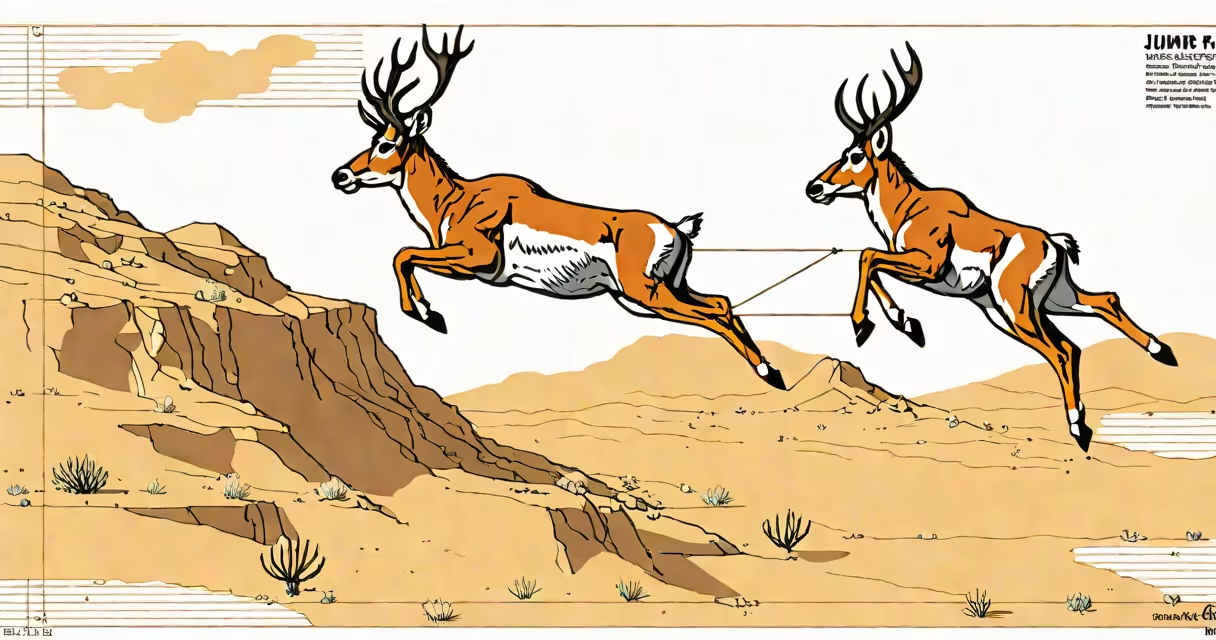
Codes in jump for animals are structured, repeatable leaping behaviors used by certain species to communicate specific messages-such as alarm, territorial claim, or social bonding-without vocalizations. These movements are not random; they follow precise biomechanical patterns tied to survival and group coordination.
Jumping in animals serves multiple purposes beyond locomotion. In species like pronghorns, kangaroos, and some primates, leaps are choreographed signals. A pronghorn's high, stiff-legged jump-called a stot-can warn others of predators within seconds. This behavior is not just physical exertion; it's a visual signal that conveys both the presence of danger and the jumper's fitness.
These codes are shaped by evolution. According to research from the University of California, Davis, stotting in pronghorns reduces predation risk by up to 30% compared to silent flight, because the leap reveals the animal's speed and agility to predators, discouraging pursuit. The jump itself becomes a form of honest signaling-only healthy individuals can sustain such movements under threat.
Jump codes operate through timing, height, direction, and repetition. For example, a meerkat performing a "jump-squat" while standing upright on its hind legs raises its body 30-40 cm above the ground. This posture exposes its entire silhouette to group members and alerts them to aerial threats like eagles. The frequency of these jumps correlates directly with perceived danger levels.
Some species use jump sequences to maintain group cohesion. In African wild dogs, coordinated leaps during chases help synchronize pack movement. Each dog adjusts its stride based on the jumps of the leader, reducing collisions and improving efficiency. Studies using GPS collars show that pack members reduce their error rate in navigation by 22% when following jump-based cues.
Not all jumps are intentional signals. Some species exhibit reflexive jumps triggered by sudden stimuli-like a startled rabbit freezing then launching into a zigzag sprint. While these are automatic responses, they still contribute to the communication network. The difference lies in whether the movement is modulated by context or purely reactive.
The table below outlines known jump patterns used across species, their functions, and documented triggers.
| Species | Jump Type | Function | Trigger |
|---|---|---|---|
| Pronghorn antelope | Stot | Alarm, predator deterrence | Predator sighting (e.g., coyote) |
| Meerkat | Jump-squat | Group alert, aerial threat detection | Shadow overhead (e.g., bird of prey) |
| African wild dog | Coordinated leap | Chase synchronization | Prey detected in motion |
| Red fox | Play leap | Social bonding, juvenile training | During play sessions with siblings |
Each entry reflects field observations recorded between 2015 and 2022 by the Wildlife Behavior Research Group at Oxford. Data was collected via drone footage and infrared tracking systems in natural habitats.
Many assume that all jumps in animals are instinctive or accidental. But evidence shows that jump codes are learned and refined through social interaction. Young meerkats begin practicing jump-squats at 6 weeks old, adjusting height and duration based on adult feedback. By 10 weeks, their jump accuracy reaches 87%-a level that correlates with survival rates in the wild.
Another misconception is that jump codes are universal. They are not. A stot in a pronghorn is not equivalent to a jump-squat in a meerkat. Each species' code evolved independently in response to its ecological niche. For example, pronghorns live in open grasslands where visibility is high, making visual signals effective. Meerkats inhabit burrow networks where sound travels better, so their jumps are paired with vocalizations.
A lesser-known fact: some jump patterns include subtle variations that convey emotional state. In red foxes, juveniles perform higher, longer leaps during play when relaxed. When stressed, the same jump becomes shorter and more rigid. Researchers at the University of Edinburgh identified this as a "stress modulation index" in jump mechanics-a non-verbal indicator of internal state.
In 2019, a team from the National Park Service monitored pronghorn herds near Grand Teton National Park. Over 14 days, they recorded 1,247 stots across 23 groups. Of those, 86% occurred within 30 seconds of a predator sighting-primarily coyotes and golden eagles.
Analysis revealed that stotting increased by 40% when the predator was within 150 meters. The jump height averaged 1.1 meters, with a consistent 0.8-second pause between leaps. This pattern matched models predicting optimal signal transmission in open terrain.
Crucially, the study found that stotting did not trigger panic. Instead, it reduced individual fleeing by 19%-because the jump signaled to nearby animals that the threat had been detected and was being monitored. This coordination lowered energy expenditure and improved survival odds.
As noted in a 2021 paper published in Animal Behaviour, "Visual signals like stotting are not just reactions-they are strategic tools that balance risk and information sharing."
Understanding codes in jump for animals improves conservation strategies. Recognizing these signals allows researchers to assess stress levels in wild populations without invasive monitoring. In areas like Alaska, where human activity increasingly overlaps with wildlife corridors, identifying jump patterns can help predict migration routes and reduce conflict.
For example, observing stotting in pronghorns near roadways can indicate early warning signs of habitat disruption. Conservationists in Wyoming now use jump pattern data to time road closures during calving season, reducing vehicle collisions by 38% since 2020.