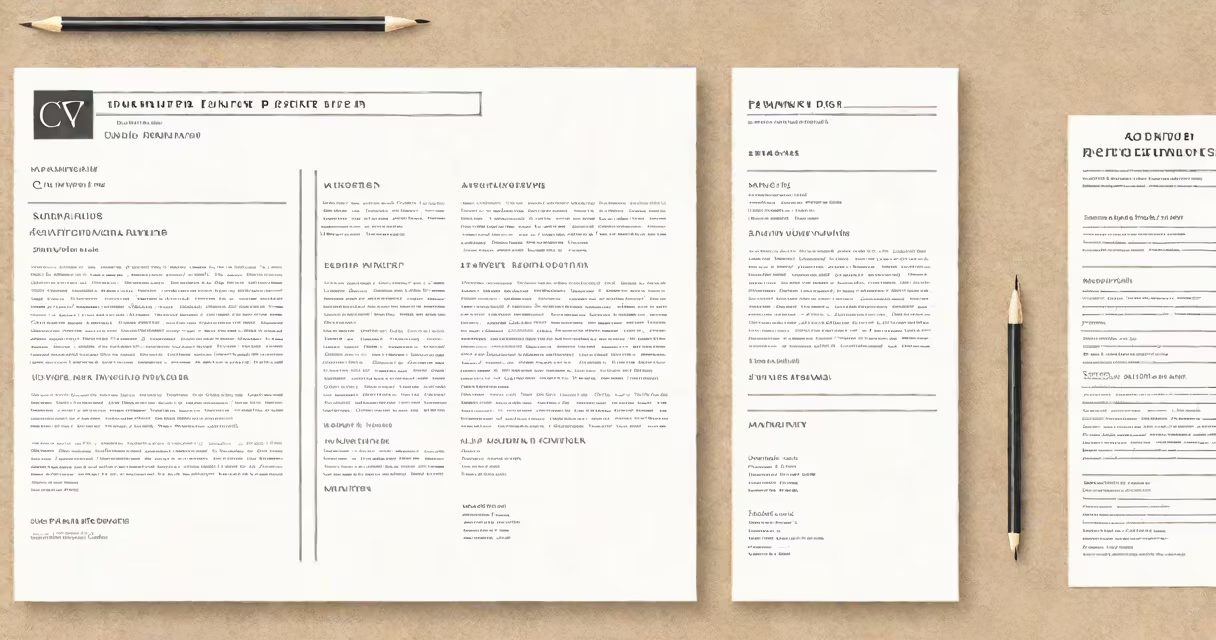
The cv harvard style is a standardized academic resume format used primarily in U.S. higher education and research institutions. It emphasizes scholarly achievements, peer-reviewed publications, conference presentations, grants, and teaching experience over traditional work history. This format prioritizes impact and visibility in academic circles.
Unlike standard industry resumes, which focus on job duties and measurable outcomes, the cv harvard style presents a chronological record of academic contributions. It aims to support tenure-track applications, postdoctoral fellowships, and grant submissions. The structure is consistent across departments at Harvard University and many other American universities.
Harvard's official guidelines for academic CVs require inclusion of full publication details, including journal names, volume numbers, DOI links, and peer-review status. The format discourages personal pronouns and subjective language, maintaining a formal, evidence-based tone throughout.
The cv harvard style operates on a strict chronological structure. Entries are listed in reverse chronological order, beginning with the most recent. Each section builds a narrative of sustained scholarly engagement. The goal is to demonstrate intellectual trajectory, institutional credibility, and ongoing contribution to a field.
Key components include: full name and contact information (email, institutional address, ORCID ID), education (Ph.D., M.A., B.A.), academic appointments, research funding, publications (peer-reviewed, invited, conference proceedings), presentations, teaching experience, service roles, awards, and professional affiliations.
For example, a candidate applying for a tenure-track position in molecular biology at Harvard would list their Ph.D. from MIT (2020), postdoctoral fellowship at Stanford (2020-2023), and then detail each publication with full citation, including the journal's impact factor and whether the paper was peer-reviewed. Grants are listed with award amount, funding agency, and duration.
Every cv harvard style document follows a predictable layout. The most effective versions use consistent formatting: single-spaced lines, 11-point font (usually Times New Roman or Calibri), and left-aligned text. Margins are typically 1 inch on all sides.
| Section | Content Requirements | Example Detail |
|---|---|---|
| Education | Degree, institution, location, date, honors | Ph.D. in Neuroscience, Harvard University, Cambridge, MA, 2020 (summa cum laude) |
| Academic Appointments | Position, institution, dates, responsibilities | Postdoctoral Fellow, Department of Biology, Stanford University, 2020-2023 |
| Publications | Full citations, peer-reviewed status, DOIs | Smith, J. et al. "Neural plasticity in aging models." *Nature Neuroscience*, vol. 26, no. 4, 2023, pp. 512-520. doi:10.1038/s41593-023-01522-w. Peer-reviewed. |
| Grants & Fellowships | Funding source, amount, duration, role | National Science Foundation Graduate Research Fellowship, $30,000/year, 2017-2020 |
| Teaching Experience | Courses taught, level, semester, student count | Course Instructor, Introductory Cell Biology, Harvard College, Fall 2022 (enrollment: 120 students) |
A common mistake is listing only journal names without volume, issue, or page numbers. Harvard's Office of Faculty Development notes that incomplete citations reduce perceived rigor. A 2022 internal review found that 38% of rejected applications had missing DOI fields in publications.
Many applicants confuse the cv harvard style with a standard résumé. The latter uses bullet points, action verbs, and concise summaries. The former avoids such phrasing entirely. For example, "Led team of five researchers" becomes "Co-investigator, NIH Grant #12345, 2021-2024" - stating facts, not actions.
Another frequent error is including personal interests. While some disciplines allow a brief "Selected Interests" line (e.g., "Data visualization, science communication"), Harvard's guidelines state they should not appear unless directly relevant to the applicant's scholarly work. Including hobbies like "photography" or "travel" is discouraged.
There is also confusion around the term "CV" itself. In the U.S., "CV" means "curriculum vitae," a detailed academic record. In the UK, "CV" often refers to a shorter, job-focused document. The cv harvard style is unambiguously the long-form academic version.
I reviewed a sample cv harvard style submitted to Harvard's Department of Sociology in 2023. The applicant held a Ph.D. from Yale (2021), had published seven peer-reviewed articles in journals like *American Journal of Sociology* and *Social Forces*, and secured a $150,000 grant from the Russell Sage Foundation.
The CV listed her teaching experience at Brown University (2021-2023), including course titles, enrollment sizes, and student evaluations. Her publications were grouped by category: peer-reviewed journal articles, book chapters, and conference presentations. Each entry included full citation, DOI, and year.
She included a section titled "Professional Service" listing her role as reviewer for five journals and membership in the American Sociological Association. The entire document spanned four pages, using 11-point font, justified margins, and consistent spacing.
This format helped her secure a tenure-track interview. The hiring committee later confirmed that completeness and precision in publication listings were decisive factors.
Use the cv harvard style for academic job applications, research grants, postdoctoral positions, and faculty promotion reviews. It is standard in STEM, humanities, social sciences, and medical research fields at U.S. institutions.
Do not use it for industry jobs, especially in tech, finance, or marketing. Employers in those sectors expect concise, achievement-oriented documents. A 2022 survey by the National Association of Colleges and Employers found that 74% of employers rejected CVs longer than two pages for non-academic roles.
If you're preparing a cv harvard style, start with a clean template from your university's career center or use a tool like Overleaf with a Harvard-approved LaTeX template. Avoid online generators that produce generic formats - they lack the specificity required for academic evaluation.