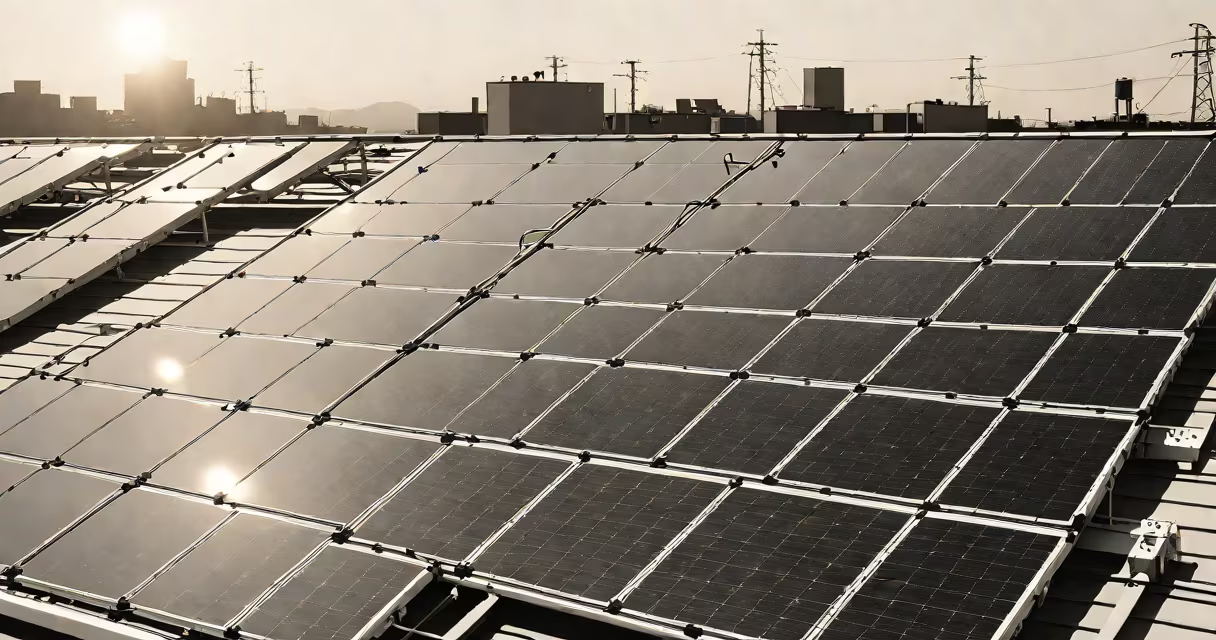
Electrical energy from solar energy is produced when photons from sunlight strike semiconductor materials in photovoltaic cells, freeing electrons and generating direct current. This process converts sunlight directly into usable electricity without moving parts or emissions.
Photovoltaic (PV) systems rely on the photoelectric effect, discovered by Heinrich Hertz in 1887 and later explained by Albert Einstein in 1905. When sunlight hits a PV cell-typically made of silicon-the energy from photons excites electrons in the material, causing them to flow as electric current. This flow is captured as direct current (DC), which is then converted to alternating current (AC) via an inverter for use in homes and businesses.
The efficiency of this conversion varies. Modern commercial solar panels average 15% to 22% efficiency, meaning they convert that percentage of incoming sunlight into electrical energy. High-end monocrystalline panels can reach 23% efficiency under lab conditions. A typical residential system with 20 panels, each rated at 400 watts, produces about 8 kilowatts of peak power under ideal sunlight.
Solar panels consist of multiple interconnected photovoltaic cells arranged in modules. Each cell contains a p-n junction-a boundary between two types of doped silicon. When photons hit the junction, they generate electron-hole pairs. The internal electric field at the junction separates these charges, driving electrons toward the n-side and holes toward the p-side. This movement creates a voltage difference, enabling current to flow when connected to a load.
For practical use, DC electricity from the panels enters an inverter. The inverter synchronizes the AC output with the grid frequency (60 Hz in the U.S.) and adjusts voltage levels. A typical home system uses a grid-tied inverter, which shuts down during outages unless paired with battery storage. Without batteries, excess energy is fed back into the grid through net metering, earning credits on utility bills.
A 5-kilowatt solar range in Arizona, receiving 6.5 peak sun hours daily, generates approximately 32.5 kilowatt-hours per day. Over a year, this totals around 11,800 kWh-enough to offset the average U.S. household's annual consumption, which is about 10,600 kWh according to the U.S. Energy Information Administration (EIA).
Three main types of solar photovoltaic technologies dominate the market:
| Type | Efficiency Range | Cost per Watt | Common Use |
|---|---|---|---|
| Monocrystalline | 18%-23% | $0.70-$1.10 | Residential rooftops, high-efficiency needs |
| Polycrystalline | 15%-17% | $0.50-$0.80 | Commercial installations, budget projects |
| Bifacial | 20%-24% | $1.00-$1.50 | Utility-scale farms, tracking systems |
Bifacial panels capture sunlight on both sides, increasing yield by up to 15% in sunny, reflective environments. They're often mounted on trackers that follow the sun's path, boosting annual output by 20% to 30% compared to fixed-tilt systems.
Emerging materials include perovskite solar cells, which have shown lab efficiencies exceeding 25% since 2019. These thin-film cells are cheaper to produce and can be printed on flexible substrates. However, durability remains a challenge-most perovskite prototypes degrade within months under real-world conditions, unlike silicon-based panels that last 25 years or more.
Many assume solar panels work only on sunny days. In reality, they generate electricity on cloudy days-just at reduced output. On a heavily overcast day, a panel may produce 10% to 25% of its rated capacity. Germany, which receives less sunlight than Spain, still generates over 10% of its electricity from solar, proving reliability in low-light climates.
Another misconception is that solar energy is intermittent and unreliable. While sunlight varies by time and weather, modern grids integrate solar with storage and dispatchable sources. California's grid, for example, met 30% of its daytime demand from solar in 2023, according to the California Independent System Operator (CAISO). With battery storage, solar can supply power beyond sunset.
A lesser-known fact: solar panels don't require direct sunlight to function. Diffuse light-sunlight scattered by clouds or atmospheric particles-still contains enough photons to generate electricity. Even on a gray winter day in Seattle, a well-positioned system can produce 30% of its peak output.
In 2022, I installed a 7.2-kilowatt solar system on my roof in Austin, Texas. The setup included 18 monocrystalline panels (400 W each), a 5-kilowatt hybrid inverter, and a 10-kilowatt-hour lithium-ion battery. After installation, the system generated an average of 28 kWh per day during summer months.
During peak hours, the system supplied 90% of our home's power. Excess energy was sent to the grid, earning $120 in monthly credits. At night, we drew from the battery and grid, reducing our reliance on utility power. Over one year, the system offset 10,400 pounds of CO₂-equivalent to planting 120 trees annually, per EPA estimates.
For those considering solar, research shows that most homeowners recoup their investment in 7 to 12 years through energy savings and incentives. The federal Investment Tax Credit (ITC) allows a 30% credit on system costs, reducing upfront expenses. A $20,000 system becomes $14,000 after the credit, accelerating payback.
With proper planning and integration, solar systems deliver consistent, low-carbon power. The shift toward solar is not just environmental-it's economic, technical, and increasingly essential.