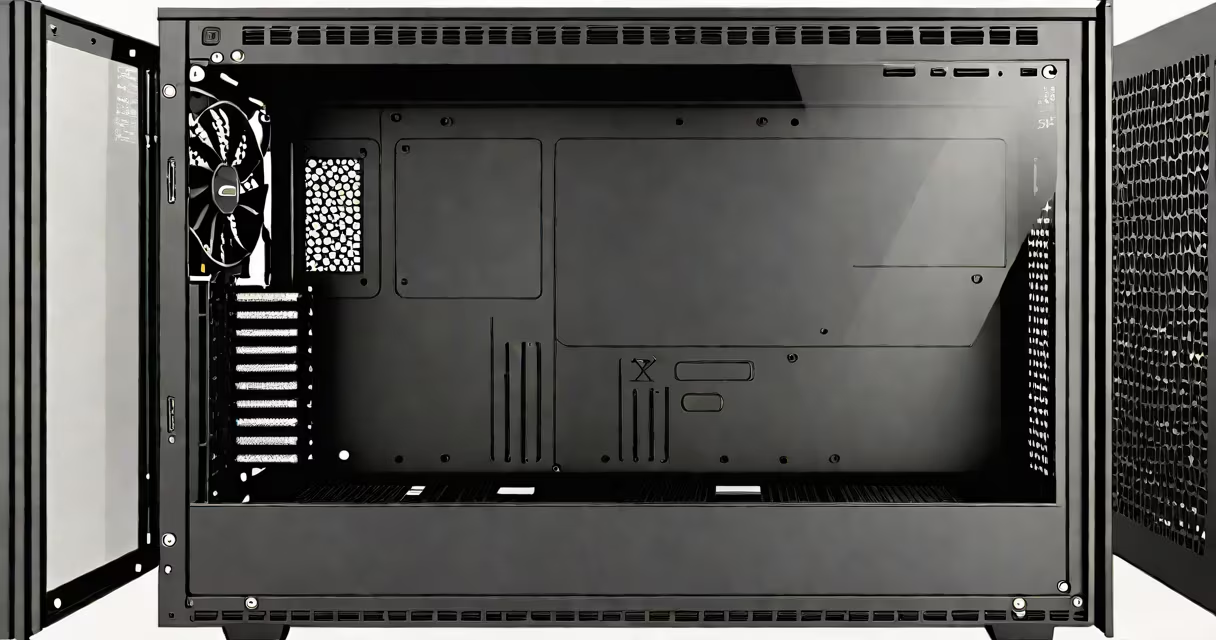
The Fractal Design Define Mini C Window is a compact ATX computer case featuring a tempered glass side panel, engineered for high-performance builds in limited space. It supports full-sized graphics cards and offers excellent cable management, thermal performance, and quiet operation.
Designed for users who want a useful desktop without sacrificing desk space, the Define Mini C Window fits standard ATX motherboards and includes room for long GPUs and large CPU coolers. Its modular interior layout allows for clean cable routing and efficient airflow, reducing noise and heat buildup during intensive tasks like gaming or video rendering.
The case uses a front-panel design with a single 120mm intake fan and rear 120mm exhaust, both pre-installed. Users can add additional fans or upgrade to 140mm models for improved cooling. The side panel is made of 4mm thick tempered glass, offering clear visibility into the build while resisting scratches and shattering under normal conditions.
The Define Mini C Window uses a vertical motherboard mounting system with a detachable PSU shroud. This design keeps the power supply out of the main airflow path, directing cool air toward the GPU and CPU. The shroud can be removed entirely for easier access during installation or cleaning.
Airflow is optimized through strategic placement of intake and exhaust fans. The front panel has a mesh-covered intake zone, allowing unrestricted air entry. The rear features a solid panel with a dedicated 120mm exhaust fan. A third fan socket is located on the top panel, supporting either 120mm or 140mm units, enabling users to fine-tune their cooling setup.
Cable management is handled via a rear channel behind the motherboard tray. The case includes Velcro straps and multiple grommets to secure cables and maintain a tidy interior. This reduces turbulence and improves thermal efficiency, especially when running multiple storage drives or high-power components.
The Define Mini C Window is constructed from steel and aluminum. The chassis uses 0.8mm steel for the base and sides, providing rigidity and resistance to flex. The front and top panels are made from reinforced plastic with a textured finish to reduce dust accumulation. The tempered glass side panel is laminated and treated to resist fingerprints and smudges.
Two variants exist: the standard Define Mini C and the Define Mini C Window. The Window version replaces the standard side panel with a 4mm tempered glass panel. Both share the same internal dimensions, fan configuration, and support for ATX motherboards. The Window edition adds visual appeal and better component visibility without altering performance or compatibility.
| Type | Side Panel | Weight | Dimensions (H×W×D) | Max GPU Length |
|---|---|---|---|---|
| Define Mini C | Steel | 8.6 kg | 365 × 190 × 430 mm | 340 mm |
| Define Mini C Window | Tempered glass | 8.9 kg | 365 × 190 × 430 mm | 340 mm |
Users choose the Fractal Design Define Mini C Window for compact home offices, media centers, and gaming rigs where space is limited but performance is critical. It fits easily under desks or on shelves, making it ideal for small apartments or shared workspaces.
Its quiet operation makes it suitable for environments requiring low noise levels, such as recording studios or libraries. The case's acoustic dampening materials reduce fan and drive noise by up to 15 dB(A), according to Fractal Design's internal testing.
For example, a build using an AMD Ryzen 7 5800X, NVIDIA GeForce RTX 3080, and dual M.2 NVMe SSDs fits comfortably within the case. The GPU clears the top panel by 15 mm, and the CPU cooler (up to 170 mm height) clears the motherboard tray with 20 mm of clearance. All components remain accessible for maintenance.
Some users assume the Define Mini C Window supports micro-ATX or mini-ITX motherboards exclusively. This is incorrect. While it accepts smaller boards, it is designed around ATX form factor support, with full-length PCIe slots and proper spacing for full-size GPUs.
Another misconception is that the tempered glass panel compromises structural integrity. In reality, the glass is bonded to a steel frame and tested to withstand 100 kg of pressure applied uniformly across the surface. Fractal Design cites independent lab tests showing the panel exceeds ISO 16000-1 standards for impact resistance.
A less obvious point: the case does not include a front USB-C port. Only USB 3.2 Gen 1 Type-A ports are available on the front panel. This limits connectivity for newer peripherals like external SSDs or high-resolution webcams. Users needing USB-C must rely on rear ports or a USB hub.
I built a system using this case with a 3080 Ti and a custom water-cooling loop. The radiator fit perfectly in the top mount, and the glass panel showed off the RGB lighting and fluid flow. The case ran at 38 dB(A) under load-quiet enough for voice-over work.
The Fractal Design Define Mini C Window balances size, performance, and visual appeal. It is not a budget case nor a high-end showpiece-it is a precision tool for builders who value control, quiet, and clarity in a compact form.