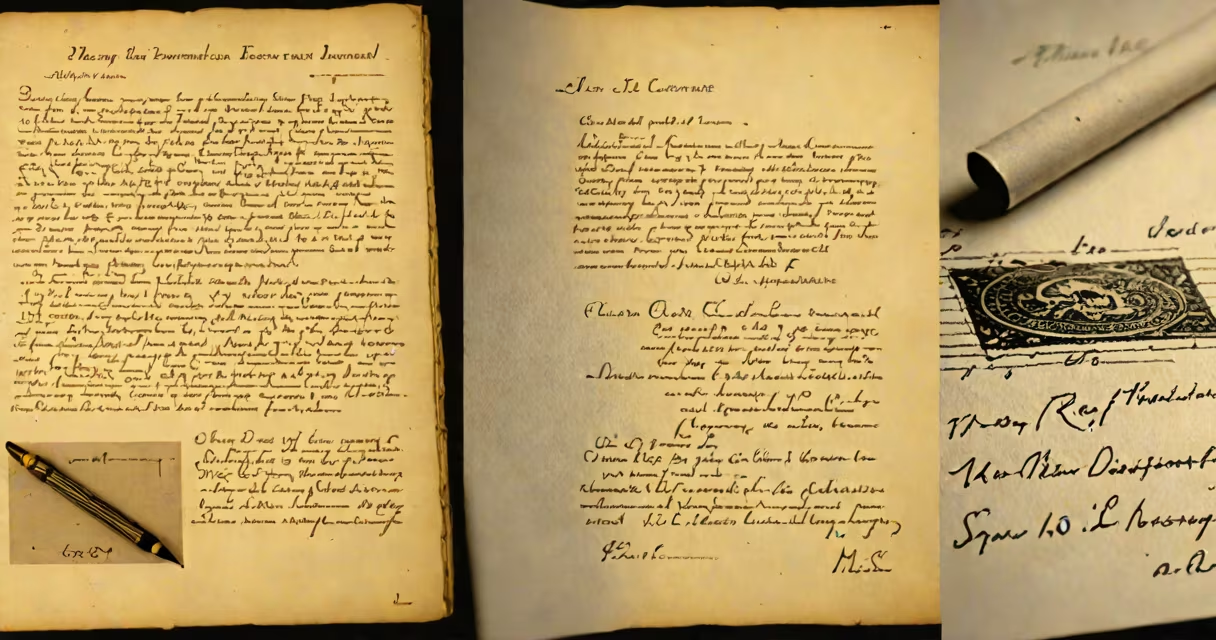
A primary source in research is an original document or physical artifact produced during the time period being studied. It offers direct, firsthand evidence about a subject, event, or phenomenon. Unlike secondary interpretations, primary sources were created by individuals who experienced or witnessed the events they describe.
These sources include diaries, letters, photographs, interviews, government records, scientific data, speeches, artworks, and original research publications. For example, a World War II soldier's diary entry describing a battle is a primary source. So is the original manuscript of a novel written in the 1800s. In science, raw experimental data collected during a study counts as a primary source.
Primary sources differ from secondary sources, which analyze, interpret, or summarize primary material. A history textbook discussing the causes of the Civil War is secondary. The same applies to documentaries, biographies, and scholarly reviews. While both types are valuable, primary sources are foundational for rigorous research because they allow scholars to draw conclusions based on unfiltered evidence.
When researchers use primary sources, they engage directly with the original context of a topic. This minimizes interpretation bias and enables deeper understanding. For instance, studying a 1963 speech by Martin Luther King Jr. in its original form-complete with pauses, tone, and audience reactions-reveals nuances lost in summaries.
Academic disciplines rely on different kinds of primary sources. In history, these may include census records, court transcripts, or personal correspondence. In the sciences, peer-reviewed journal articles reporting new findings serve as primary sources. In literature, the original text of a play or poem is primary. In social sciences, survey results or interview transcripts from fieldwork qualify.
Using primary sources strengthens argumentation. Instead of citing a scholar's opinion about a policy, a researcher can cite the actual policy draft, meeting minutes, or legislative debates. This shifts focus from interpretation to evidence, increasing credibility and transparency.
Primary sources vary widely by field and medium. Below is a breakdown of common categories and their applications:
| Type | Examples | Common Use Cases |
|---|---|---|
| Written Documents | Diaries, letters, official reports, birth certificates | Historical analysis, genealogy, legal research |
| Audiovisual Materials | Interviews, news footage, recordings, oral histories | Sociological studies, cultural analysis, media research |
| Artifacts and Objects | Tools, clothing, pottery, archaeological finds | Anthropology, archaeology, museum studies |
| Scientific Data | Lab notebooks, raw datasets, experiment logs | Medical research, environmental science, physics |
| Published Works | Original novels, poems, plays, early editions | Literature, comparative religion, textual criticism |
For example, a student analyzing the impact of the 1918 influenza pandemic might use newspaper articles from October 1918, city health department reports, and personal letters describing symptoms and quarantine experiences. These materials offer insight into public perception, medical response, and daily life during the crisis.
Not all original materials are automatically primary sources. A 2020 biography of Marie Curie is secondary. But a 1903 paper she co-authored on radioactivity-published in the journal *Comptes Rendus de l'Académie des Sciences*-is primary. The key distinction lies in authorship: if the creator was present during the event or activity described, the work qualifies.
Many assume that anything old is a primary source. That's incorrect. A 1990s textbook summarizing the French Revolution is secondary, even if it discusses original documents. The age of a source doesn't determine its classification-it's the origin and intent that do.
Another misconception is that primary sources are always trustworthy. A diary entry from a wartime soldier may reflect personal bias, emotion, or incomplete memory. Researchers must evaluate authenticity, context, and potential bias, just as they would with any evidence.
Even digital content can be primary. A tweet from a protest organizer during the 2020 Black Lives Matter demonstrations serves as a primary source for studying public sentiment and movement coordination. Similarly, a GitHub repository containing code developed during a software project is a primary source in computer science research.
One non-obvious point: some primary sources are not preserved in their original form. A 1945 letter from Winston Churchill may exist only as a photocopy in an archive. The copy is still considered a primary source because it represents the original document. The physical condition doesn't change the evidentiary value.
Consider a student writing a paper on the U.S. Civil Rights Movement. They find a 1963 photograph taken by Ernest C. Withers showing peaceful protesters in Selma, Alabama, facing police lines. The photo was published in *Jet* magazine and later archived at the Library of Congress.
This image is a primary source because it captures a real event as it happened. The student can analyze the composition-how people are positioned, the expressions on faces, the presence of police equipment-to argue that the protest was organized and nonviolent. They can compare it to newsreel footage from the same day to assess media framing.
They can also cross-reference the photo with contemporaneous newspaper articles and federal government memos to understand how authorities responded. This multi-source approach strengthens the argument and demonstrates critical engagement with original materials.
I once used a 1952 handwritten letter from a female scientist at NASA's Langley Research Center to examine gender dynamics in early space programs. The letter discussed her role in wind tunnel testing and noted that she had to ask permission to attend meetings. This detail, buried in a personal note, revealed institutional barriers not mentioned in official reports.
Libraries, archives, and digital repositories host vast collections of primary materials. The National Archives holds U.S. government records dating back to 1775. The British Library's online catalog includes millions of digitized manuscripts and maps. University libraries often have special collections focused on regional or disciplinary topics.
Databases for research such as ProQuest Historical Newspapers, JSTOR's Archive Collections, and the Digital Public Library of America provide access to scanned primary documents. These tools allow users to search by date, location, or keyword, making it easier to locate relevant materials.
Always verify the provenance of a source. A website claiming to host "original 1930s labor strike photos" may be selling replicas. Trusted institutions like university libraries or national archives maintain metadata and chain-of-custody records that confirm authenticity.
Understanding what is a primary source in research is essential for academic integrity and analytical rigor. These materials are the bedrock of evidence-based inquiry across disciplines. Whether analyzing a 17th-century treaty or a 2023 climate model, researchers must distinguish between firsthand accounts and later interpretations.
By prioritizing original documents and artifacts, scholars avoid relying solely on summaries or opinions. This practice leads to more accurate, transparent, and defensible conclusions. Always ask: Was this created by someone who lived through the event? If yes, it's likely a primary source.