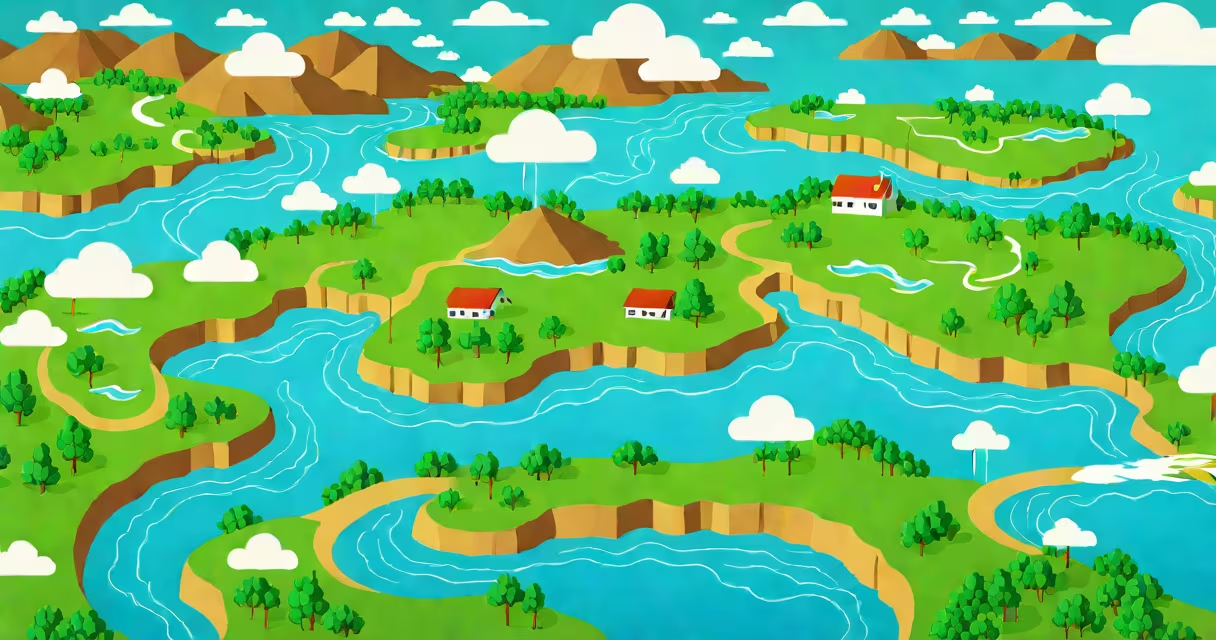
The water cycle is the continuous movement of water between Earth's surface, atmosphere, and subsurface reservoirs. It involves evaporation, condensation, precipitation, infiltration, runoff, and transpiration. This process sustains ecosystems, replenishes freshwater supplies, and regulates climate patterns globally.
Water begins its process when solar energy heats liquid water from oceans, lakes, rivers, and soil. This causes evaporation-the phase change from liquid to vapor. Over 86% of global evaporation occurs from oceans, according to the U.S. Geological Survey. As water vapor rises, it cools and undergoes condensation, forming tiny droplets in the atmosphere. These droplets cluster around microscopic particles like dust or salt, creating visible clouds.
When cloud droplets grow large enough, gravity pulls them down as precipitation-rain, snow, sleet, or hail. The form depends on atmospheric temperature. In temperate zones, winter storms often produce snowfall, while tropical regions see frequent rain. After falling, water follows several paths: some infiltrates the ground, some becomes runoff over land, and some is absorbed by plants through roots.
Transpiration is the release of water vapor from plant leaves. Together with evaporation, it forms evapotranspiration-a major component of the water cycle. A single mature oak tree can release up to 400 gallons of water annually through transpiration, according to the National Oceanic and Atmospheric Administration (NOAA).
| Stage | Process | Example |
|---|---|---|
| Evaporation | Surface water turns to vapor | Water from a lake vanishing under sunlight |
| Condensation | Vapor cools and forms droplets | Fog forming over a mountain valley |
| Precipitation | Droplets fall as rain or snow | Thunderstorm dumping 1.5 inches of rain in 30 minutes |
| Infiltration | Water seeps into soil | Rain soaking into sandy soil near a forest edge |
| Runoff | Water flows over land | Stormwater rushing down a city street after heavy rain |
| Transpiration | Plants release moisture | A cornfield releasing vapor on a hot afternoon |
Confusion often arises between evaporation and transpiration. Both move water from liquid to vapor, but evaporation comes from surfaces, while transpiration is biological. Evaporation accounts for about 60% of total evapotranspiration globally, with the rest from plant activity. This distinction matters in climate modeling and drought forecasting.
Another common misunderstanding is that the water cycle is a closed loop with no loss. While water is conserved, human activities disrupt timing and distribution. Urbanization increases runoff due to impermeable surfaces like asphalt. In Los Angeles, stormwater runoff contributes to 40% of annual river flow, despite low rainfall-this runoff carries pollutants into coastal waters.
During a field study in the Sierra Nevada mountains, I observed a small stream drying up in late summer. Soil samples showed high infiltration rates, yet the stream remained low. Further analysis revealed that prolonged drought had reduced groundwater recharge. Without consistent precipitation, infiltration couldn't sustain baseflow. This demonstrated how disruption at one stage affects the entire cycle.
Understanding the full sequence helps manage water resources. For example, knowing that infiltration reduces runoff can inform urban planning. Cities like Portland have implemented green roofs and permeable pavements to increase infiltration and reduce flood risk. These designs mimic natural processes in the water cycle.