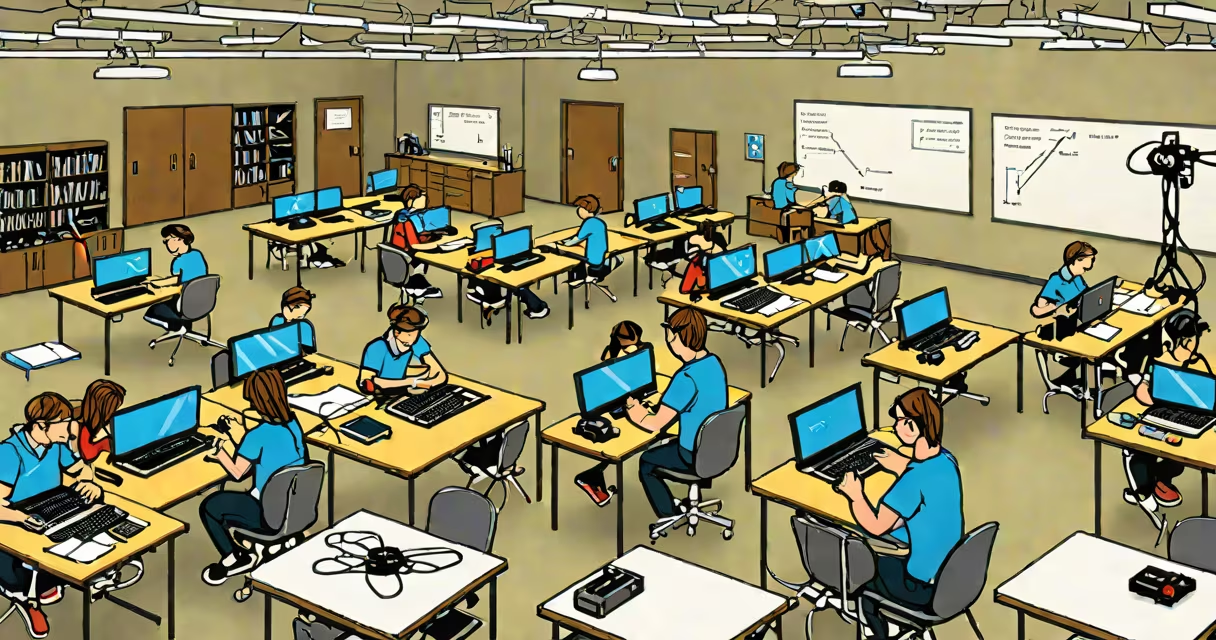
Lindbergh Stem Academy is a public magnet school within the Lindbergh School District in Missouri, designed for students in grades 6 through 12 who demonstrate strong interest and aptitude in science, technology, engineering, and mathematics. It provides a focused, inquiry-based curriculum emphasizing real-world problem solving, project-based learning, and early exposure to advanced STEM disciplines.
The program operates under the district's selective admission model, requiring application and assessment based on academic performance, teacher recommendations, and demonstrated passion for STEM fields. Students attend full-time at the school's dedicated campus, which features lab spaces, maker stations, and access to industry-standard software and hardware.
Unlike general STEM enrichment offered in traditional schools, Lindbergh Stem Academy functions as a standalone academic pathway. It integrates core subjects like math and science with applied engineering and computer science, preparing students for college-level STEM programs and careers in tech-driven industries.
Admission to Lindbergh Stem Academy is competitive and requires formal application during designated windows each year. Applicants must submit transcripts, standardized test scores (typically MAP or state assessments), and letters of recommendation. A selection committee evaluates candidates based on academic readiness, engagement in STEM activities, and personal essays outlining their goals.
Once admitted, students follow a modified district curriculum with enhanced rigor. Core courses in algebra, biology, and physics include extended labs, research components, and interdisciplinary projects. For example, a 7th-grade science unit on ecosystems includes designing sustainable urban gardens using hydroponic systems and data analysis tools.
Students also participate in weekly STEM electives such as robotics, coding bootcamps, and engineering design challenges. These are taught by certified educators with industry experience, often including guest lectures from local engineers and university researchers.
The curriculum is structured around four pillars: scientific inquiry, computational thinking, engineering design, and ethical innovation. Each pillar is reinforced through cross-disciplinary units and annual capstone projects.
| Grade Level | Core STEM Focus | Sample Project |
|---|---|---|
| 6-7 | Foundations in Systems & Design | Build a solar-powered vehicle using LEGO Mindstorms and test efficiency on inclined ramps. |
| 8-9 | Programming & Data Analysis | Use Python to analyze climate data from NOAA and create visualizations showing temperature trends. |
| 10-11 | Advanced Robotics & AI Concepts | Design a robot that identifies and sorts recyclable materials using machine learning models trained on labeled datasets. |
| 12 | Capstone Research & Innovation | Develop a prototype for a low-cost water filtration system targeting underserved communities. |
A non-obvious distinction: while many schools offer STEM clubs or after-school programs, Lindbergh Stem Academy embeds rigorous STEM content into the daily schedule. This means students spend approximately 60% of instructional time engaged in hands-on, project-based work-far exceeding typical classroom averages.
For example, in spring 2023, a group of 10th graders collaborated with a local environmental nonprofit to monitor stream health in the Meramec River watershed. They collected water samples, measured pH and dissolved oxygen levels, and used GIS mapping software to identify pollution hotspots. Their findings were presented at a regional science fair and later cited in a city planning report.
Lindbergh Stem Academy is sometimes mistaken for a private charter school or a virtual program. It is neither. It is a publicly funded, district-operated school located on the campus of Lindbergh High School. All students receive free transportation, meals, and access to district-wide resources like libraries and counseling services.
Another common error is assuming the school only serves students interested in becoming engineers. While engineering is a major focus, the curriculum supports diverse career paths. A 2022 cohort included students pursuing biomedical research, environmental policy, game development, and data science-all supported by tailored coursework and mentorship opportunities.
Some parents assume the program is only for high-achieving students. While academic strength is required, the school values curiosity, resilience, and collaboration. A student with average grades but strong persistence in troubleshooting failed experiments may be prioritized over one with higher GPAs but limited engagement.
In 2023, 87% of Lindbergh Stem Academy seniors applied to STEM-focused colleges, and 73% were accepted into institutions ranked in the top 100 nationally. Of those, 42% received merit-based scholarships averaging $12,000 per year.
One firsthand experience: during a summer internship program, a 10th grader named Maya developed a mobile app prototype to track mental health symptoms among teens. She presented her work at a national youth innovation conference and later partnered with a nonprofit to pilot the tool in three school districts. Her project was later featured in a Science News article on youth-led health technology.
Lindbergh Stem Academy exemplifies how targeted, immersive education can prepare young learners for complex global challenges. Its blend of academic rigor, practical experience, and community integration sets a benchmark for effective STEM programming in public education.