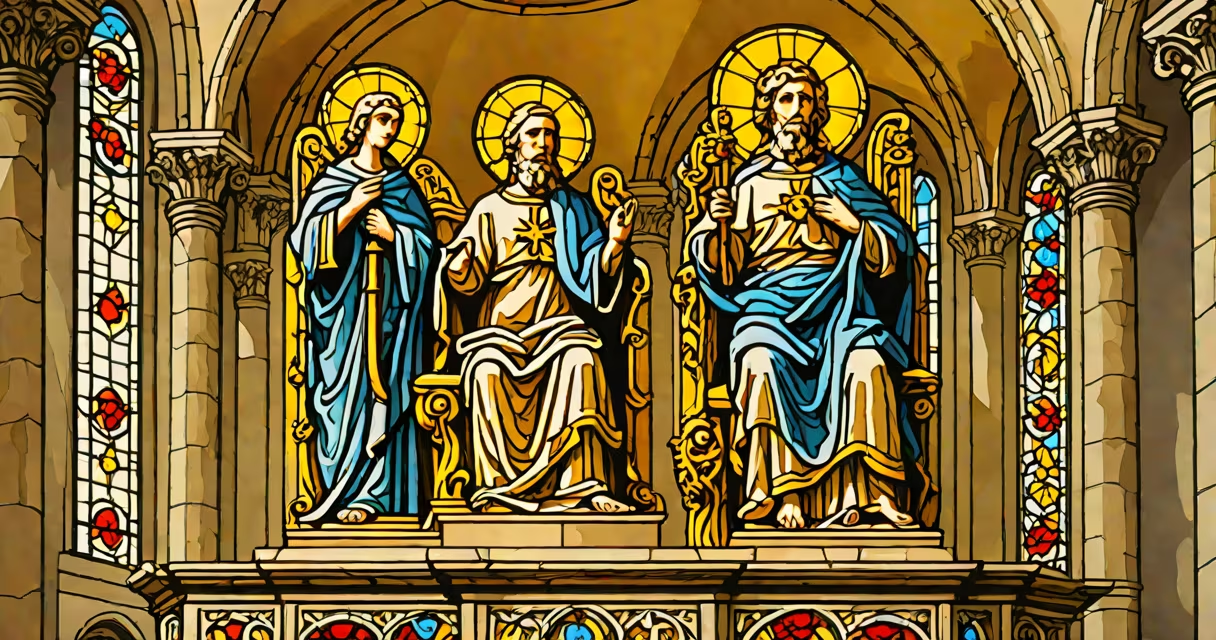
Mater Dei Roma is the title given to the Virgin Mary in her role as Mother of God within the Roman Catholic Church's devotional and liturgical traditions, particularly centered in Rome's churches, shrines, and annual feasts.
The term combines Latin religious terminology with Rome's ecclesiastical identity. "Mater Dei" translates to "Mother of God," a title formally affirmed at the Council of Ephesus in 431 CE. In Rome, this title is not just theological doctrine-it is lived through art, architecture, and public worship. The city hosts multiple churches dedicated to Mater Dei, including Santa Maria Maggiore, one of the four major papal basilicas, which stands on the Esquiline Hill and dates to the 5th century.
Every year on August 15, the feast of the Assumption is celebrated with processions and Masses throughout Rome, many centered on Mater Dei. The Vatican's official calendar designates this day as a holy day of obligation, reinforcing the centrality of Mary's role in Catholic belief. Her image appears in frescoes, mosaics, and altarpieces across Rome's historic centers, often depicted holding the Christ Child with a halo and blue mantle-a visual shorthand for divine maternity.
Mater Dei is not a personal name but a theological designation. It affirms that Mary is the mother of Jesus, who is both divine and human. This distinction matters: the title does not imply Mary is the mother of God the Father or the Holy Spirit, but rather confirms that Jesus' divine nature was fully present at his birth. The Council of Ephesus declared that Mary is "Theotokos"-God-bearer-because she gave birth to the incarnate Word of God.
Rome's churches have long embedded this doctrine into their physical form. Santa Maria Maggiore, for example, contains a 6th-century mosaic of Mater Dei seated on a throne, flanked by saints and angels. The mosaic's gold background symbolizes eternity, while Mary's posture reflects humility and authority. These images are not decorative-they serve as teaching tools for a population that included many illiterate believers during the Middle Ages.
Modern pilgrims still visit Mater Dei sites in Rome. The Basilica of Santa Maria Maggiore receives over 1 million visitors annually, according to the Vatican's tourism office. During Christmas Eve Mass, a special candlelit procession traces the path of the ancient "Adoration of the Magi" mosaic, linking Mary's role in salvation history to the present-day faithful.
Several locations in Rome are specifically tied to Mater Dei's veneration:
| Site | Year Founded | Notable Feature | Devotional Focus |
|---|---|---|---|
| Santa Maria Maggiore | 432 CE | 6th-century mosaic of Mater Dei | Feast of the Assumption, Christmas liturgy |
| San Giovanni in Laterano | 313 CE | Statue of Mater Dei in the apse | Papal Masses, Easter Vigil |
| San Lorenzo fuori le Mura | 4th century | Chapel dedicated to Our Lady of the Martyrs | Monthly Marian prayer groups |
These sites are not isolated. They form part of a network of Marian shrines that support Rome's identity as the heart of Catholicism. Pilgrims often walk between them during the "Via Mater Dei" route, a 12-kilometer path established in 2018 by the Archdiocese of Rome to encourage spiritual reflection.
A lesser-known practice involves the "Mater Dei Hour"-a weekly silent meditation held at midnight in Santa Maria Maggiore. Participants enter the church through a side door, sit in the nave, and remain still for 60 minutes. No prayers are spoken aloud. The silence is intended to mirror Mary's quiet acceptance of divine will, as described in Luke 1:38: "Behold, I am the handmaid of the Lord; let it be done to me according to your word."
Some confuse Mater Dei Roma with secular or political uses of the term. For example, the phrase appears in Italian nationalist art from the early 20th century, where Mary was depicted as a national mother figure. But these are artistic interpretations, not doctrinal affirmations. The Catholic Church explicitly rejects such syncretism. According to the Catechism of the Catholic Church (paragraph 495), Mary's role is purely spiritual and salvific-not political or cultural.
Another confusion arises around the difference between Mater Dei and other Marian titles. "Our Lady of Lourdes" refers to a specific apparition in France, while "Mater Dei" is universal. The title applies to Mary in all times and places. It is not limited to Rome, though Rome's institutions have played a key role in shaping its expression.
There is also a persistent myth that Mater Dei was invented in Rome. It was not. The title emerged in the early Church, especially in Greek-speaking regions. Rome adopted it later, during the reign of Pope Leo I (440-461), who championed the doctrine in sermons and letters. His writings, preserved in the Patrologia Latina, show how he linked Mary's motherhood to Christ's divinity.
I attended a dawn Mass at Santa Maria Maggiore during the Feast of the Assumption in 2022. The air was cold, and the crowd was dense-families, elderly couples, young adults with smartphones out. As the priest lifted the chalice, a single beam of sunlight struck the mosaic of Mater Dei. Her eyes seemed to follow the congregation. No one spoke. The silence lasted longer than the sermon. That moment confirmed what doctrine cannot: the emotional weight of Mater Dei Roma is not abstract. It is felt in stone, light, and breath.
Today, Mater Dei Roma remains central to Catholic identity in Rome. The Vatican's 2023 document "On the Role of Mary in the Mission of the Church" reaffirmed her status as "the model of discipleship and intercessor." The document cited Rome's churches as living examples of this mission. For Catholics, visiting Mater Dei sites is not just sightseeing-it is participation in a centuries-old act of faith.
Understanding mater dei roma requires seeing beyond the Latin phrase. It is a convergence of theology, history, and lived ritual. It is not merely a title-it is a presence. In Rome, Mary is not distant. She is in the marble, the incense, the hymns sung in Latin and Italian. To encounter mater dei roma is to step into a space where the sacred is visible, tangible, and enduring.