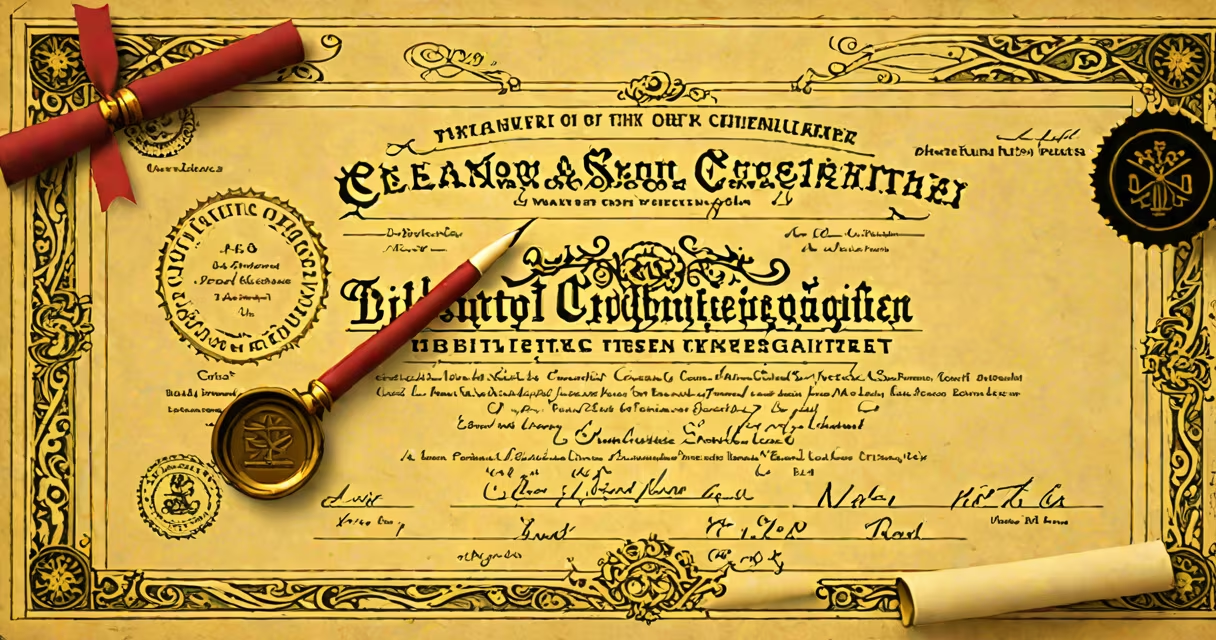
Stock certificates are physical documents issued by a company to confirm ownership of shares. They feature printed details such as the shareholder's name, number of shares, stock symbol, and official signatures. These documents serve as legal proof of equity ownership and may include embossing, watermarks, or security threads.
Modern stock certificates often resemble high-quality paper documents with corporate branding. They list the issuing company's name, the class of stock (e.g., common or preferred), the number of shares, and the date of issuance. Signature lines appear for authorized officers, and many include a unique certificate number. Some older or historically significant certificates have hand-drawn borders, decorative elements, and wax seals.
The U.S. Securities and Exchange Commission (SEC) defines a stock certificate as "a document evidencing ownership of a specified number of shares in a corporation." According to the SEC's Regulation S-K, issuers must maintain accurate records of share ownership, which includes the format and content of physical certificates when issued. The Financial Industry Regulatory Authority (FINRA) confirms that while most trades now settle electronically, physical certificates remain valid legal instruments under federal securities law.
Stock certificates typically include several standardized features. The top section displays the company's name, logo, and stock symbol. Below that, the shareholder's name appears in bold, followed by the number of shares owned. The certificate number-often a serial sequence-is listed in the corner.
Signature lines for the company's president, treasurer, and transfer agent are standard. These signatures authenticate the document. In older certificates, signatures were handwritten and sometimes varied in ink color or style. Modern versions may use printed or digital signature fields, especially in electronic book-entry systems.
Security features prevent forgery. Many certificates include watermarked paper, microprinting, or embedded fibers. Some use raised ink or embossed seals. For example, a 1920s General Electric stock certificate shows a detailed border with the company's name in ornate script and a red wax seal stamped across the bottom.
While all stock certificates serve the same purpose, their form varies based on issuance era, company policy, and jurisdiction. The following table outlines major categories:
| Type | Appearance | Common Use Cases |
|---|---|---|
| Physical Paper Certificate | Printed on thick, textured paper with embossing, security threads, and official signatures | Historical issuance, estate transfers, private placements |
| Book-Entry Certificate | No physical document; ownership recorded electronically via DTC | Standard public trading, brokerage accounts |
| Bearer Certificate | Unregistered; transferable by delivery, no owner name listed | Rare today; mostly obsolete due to fraud risks |
| Restricted Certificate | Includes legends stating "Restricted" and limitations on resale | Private company shares, early-stage startups |
Bearer certificates were once common but are now largely phased out. The IRS warns that unregistered securities carry higher risk of theft and loss. Today, most investors hold shares through brokerage accounts using electronic book-entry systems managed by the Depository Trust Company (DTC).
Many assume that all stock certificates are large, ornate documents with gold borders. This is false. While historic certificates from the 19th and early 20th centuries often had elaborate designs, modern ones are usually plain, printed on standard bond paper. A 2021 study by the American Numismatic Society found that over 80% of current stock certificates issued by Fortune 500 companies are single-page, black-and-white prints with minimal decoration.
Another misconception is that physical certificates are still widely used for daily trading. In reality, the SEC reports that less than 3% of U.S. stock transactions involve physical certificates. Most share transfers occur electronically through central depositories. However, physical certificates remain legally valid and are still issued for certain events, such as inheritance, mergers, or direct transfers between individuals.
I once handled a 1946 IBM stock certificate during a family estate review. It was printed on thin, slightly yellowed paper with a blue ink stamp of the company's seal. The signature of the vice president was in cursive, and the certificate number was hand-written in pencil. Despite its age, it was accepted by a brokerage firm for conversion into digital shares.
A legitimate stock certificate includes several verification points. The company's legal name must match its registration with the state and the SEC. The stock symbol should align with the ticker on financial exchanges. The signature of the transfer agent-usually a bank or trust company-must be authentic.
For authenticity checks, compare the certificate to the issuer's investor relations website. Public companies often publish sample templates. For example, Apple Inc.'s investor site provides a downloadable PDF of a typical stock certificate format. If discrepancies exist-such as mismatched names, incorrect symbols, or missing signatures-the document is likely fraudulent.
When transferring ownership, the recipient must sign a stock power form. This document authorizes the transfer and is filed with the company's transfer agent. The process can take 5 to 10 business days, depending on the issuer's procedures.
Today, most investors interact with shares through digital platforms. But when physical stock certificates do appear, they retain the same core design principles: clarity, authentication, and permanence. Whether issued in 1890 or 2024, a valid stock certificate remains a tangible record of ownership in the global capital markets.