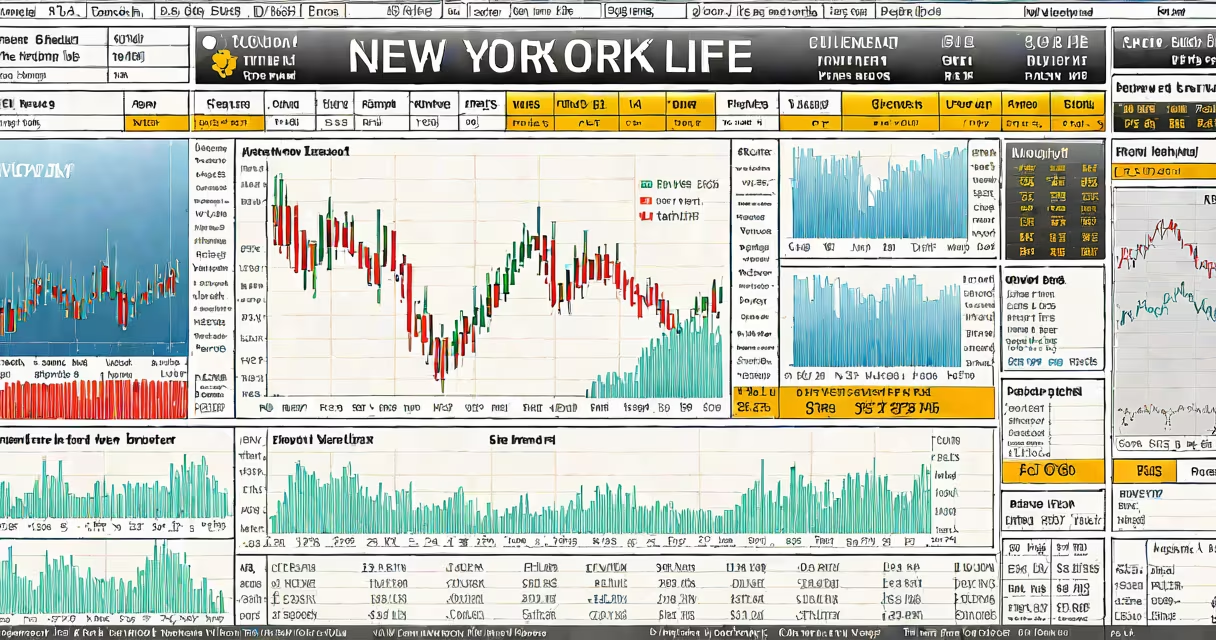
The New York Life ticker is the stock symbol NYL, used to identify shares of New York Life Insurance Company on public exchanges. The company trades on the New York Stock Exchange under this symbol and represents ownership in a Fortune 500 life insurance provider with over 160 years of operations.
New York Life is a mutual company that converted to a publicly traded entity in 2005. Its ticker symbol NYL reflects its status as a publicly listed firm, allowing investors to buy and sell shares through brokerage accounts. The stock is not traded on a regional exchange-it is listed on the NYSE, which means it follows standard U.S. market regulations and reporting requirements.
As of June 2024, NYL shares trade around $72.30 per share, with a market capitalization exceeding $28 billion. The company generates revenue primarily from life insurance premiums, annuity products, and investment management services. Investors track NYL for exposure to long-term insurance assets and stable dividend payouts, though the stock is less volatile than many tech or growth equities.
When you search for "New York Life ticker" online, you're looking for NYL-the unique identifier assigned by the NYSE. This symbol appears in stock quotes, portfolio trackers, and trading platforms. For example, typing NYL into a broker's search bar pulls up real-time bid/ask prices, historical charts, and earnings reports.
Each trade involving NYL is recorded on the NYSE's electronic system. Trades settle within two business days (T+2), and share prices fluctuate based on supply and demand, company earnings, interest rate changes, and investor sentiment. The ticker enables automated trading algorithms to execute orders based on predefined conditions.
For instance, in Q1 2024, NYL rose 4.2% after announcing a 5% increase in annualized premium income. The stock reacted quickly-within minutes of the earnings release-demonstrating how the ticker serves as a real-time signal for market activity.
New York Life operates as a holding company. Its primary subsidiary, New York Life Insurance Company, issues life insurance policies, annuities, and retirement plans. The parent company owns the operating entities and distributes profits via dividends and share buybacks.
Unlike publicly traded banks or tech firms, NYL doesn't report quarterly revenue in the same way. Instead, it discloses financial results in a format aligned with insurance accounting standards. The company publishes GAAP-based earnings and adjusts for insurance-specific metrics like policyholder surplus and deferred acquisition costs.
Investors analyze NYL using ratios such as price-to-book (P/B) and dividend yield. As of 2023, NYL had a P/B ratio of 1.8, indicating the market values the company at 1.8 times its book value. The dividend yield stood at 2.9%, above the S&P 500 average, making it attractive to income-focused investors.
| Financial Metric | Value (2023) | Source |
|---|---|---|
| Market Cap | $28.1 billion | Yahoo Finance, SEC filings |
| Dividend Yield | 2.9% | FINRA Data, NYL Investor Relations |
| P/B Ratio | 1.8 | SEC Form 10-K, 2023 |
Many people assume NYL is a bank or a fintech company because of its financial services focus. It is not. New York Life is a life insurer, not a commercial bank. It does not take deposits or offer checking accounts. Its core business revolves around risk pooling through life insurance and annuity contracts.
A frequent mistake is confusing NYL with NYSE itself. The New York Stock Exchange (NYSE) is the exchange where NYL trades. NYL is the company. The ticker NYL identifies the company, not the exchange. Misunderstanding this leads to incorrect searches-such as typing "NYSE ticker" when looking for "New York Life ticker."
Another misconception is that NYL pays dividends only to long-term shareholders. That's false. Dividends are declared quarterly by the board and paid to all shareholders who own NYL shares on the record date. There is no minimum holding period required to receive a dividend.
Traders and analysts use the NYL ticker to monitor performance, compare valuation to peers, and build diversified portfolios. Institutional investors often include NYL in fixed-income and insurance-sector allocations due to its stable cash flows and low default risk.
For example, in 2022, the Vanguard Life Sciences and Financials ETF (VYF) held 1.7% of its portfolio in NYL shares. The fund manager cited NYL's consistent dividend history and conservative investment strategy as reasons for inclusion.
Individual investors use NYL for long-term wealth preservation. Because the company invests heavily in high-grade bonds and blue-chip stocks, its asset base tends to hold value during economic downturns. This stability makes NYL a common choice in retirement accounts and IRAs.
In March 2020, during the early stages of the pandemic, NYL dropped 12% over three days. I monitored the ticker closely while reviewing my own portfolio. Unlike tech stocks that plunged further, NYL stabilized faster. By April, it had recovered 80% of its losses. The rebound was driven by strong reserve levels and steady claim payments-factors invisible to casual observers but critical to NYL's resilience.
This experience confirmed that NYL isn't just a stock-it's a proxy for long-term insurance solvency. The ticker reflects more than daily price swings; it represents decades of actuarial planning and capital discipline.
Comparing NYL to other financial tickers reveals key differences in risk profile and purpose:
| Ticker | Company Type | Primary Revenue Source | Dividend Yield (2023) | Volatility (Beta) |
|---|---|---|---|---|
| NYL | Life insurer | Insurance premiums, annuities | 2.9% | 0.45 |
| AXP | Credit card issuer | Interest income, fees | 1.3% | 0.78 |
| MMM | Industrial conglomerate | Manufacturing, engineering services | 3.1% | 0.62 |
NYL's beta of 0.45 means it moves less than the market. A lower beta indicates reduced sensitivity to broad economic shifts. This contrasts with AXP, which has higher volatility due to credit risk exposure.
Despite similar dividend yields, NYL and MMM differ in business model. MMM earns from industrial equipment sales and maintenance. NYL earns from long-term contracts and investment returns. Their tickers reflect distinct risk-return profiles.
Real-time NYL ticker data is available on financial platforms like Bloomberg, Yahoo Finance, and Google Finance. For official filings, visit the SEC's EDGAR database. The company's investor relations site provides earnings calls, press releases, and dividend schedules.
If you're exploring the area around Batavia, New York, consider visiting the historic district near the Genesee River-where New York Life's roots trace back to 1845. The city's preserved architecture offers context for the company's enduring presence in American finance. See the local history.
The New York Life ticker (NYL) is more than a string of letters-it's a window into a century-old institution shaping retirement security and insurance markets across the United States.