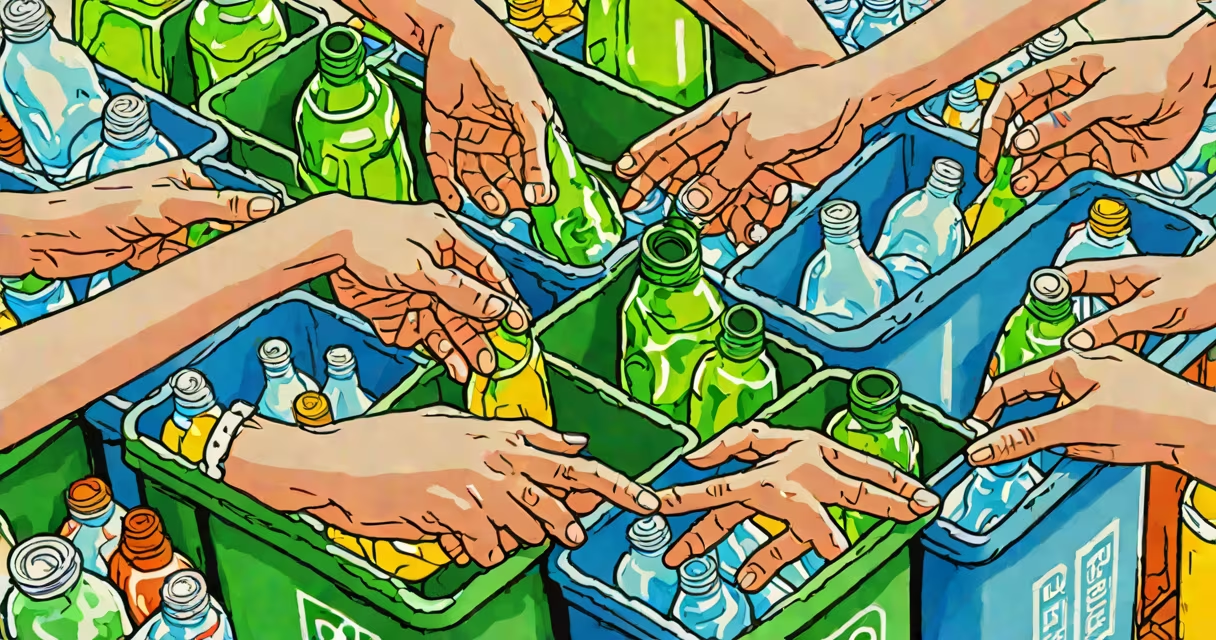
Recycle meaning and examples refers to the process of converting waste materials into new products, reducing the need for raw resource extraction and minimizing landfill use. This practice supports sustainability by conserving energy, lowering greenhouse gas emissions, and extending the life cycle of materials.
The core idea behind recycle meaning and examples lies in material recovery. Instead of discarding used items, they're collected, processed, and transformed into inputs for manufacturing. For example, aluminum cans are melted down and reshaped into new cans or automotive parts. This reduces the energy required compared to producing aluminum from bauxite ore-up to 95% less energy, according to the U.S. Environmental Protection Agency (EPA).
Recycling isn't limited to single materials. Mixed streams include paper, glass, metals, and plastics sorted at Material Recovery Facilities (MRFs). These facilities use optical scanners, magnets, and air classifiers to separate materials. A 2022 EPA report noted that 32.1% of municipal solid waste was recycled in the United States, totaling 94 million tons annually.
Recycling begins with collection. Curbside programs, drop-off centers, and buy-back stations gather recyclables. Once collected, materials travel to MRFs where they're sorted by type. Plastics are categorized by resin codes (1-7), with PET (code 1) and HDPE (code 2) being the most commonly recycled.
After sorting, materials undergo processing. Paper is pulped and de-inked. Glass is crushed and cleaned. Metals are shredded and melted. The resulting raw materials-called feedstock-are sold to manufacturers. For instance, recycled plastic flakes are used to make synthetic fibers for clothing or outdoor furniture.
A real-world example: in 2023, the city of San Francisco diverted 80% of its waste from landfills through mandatory recycling and composting laws. The program processes over 600 tons of recyclables daily, with a focus on high-value materials like aluminum and mixed paper. This system reduces methane emissions from decomposing waste and cuts transportation costs by reusing local infrastructure.
Recycling falls into three main categories: primary, secondary, and tertiary. Primary recycling involves reprocessing materials without altering their chemical structure-like melting aluminum cans into new ones. Secondary recycling transforms materials into different forms, such as turning old newspapers into cardboard. Tertiary recycling breaks materials down chemically, as with pyrolysis of plastics into oil.
| Type | Material Example | Process | Energy Saved (vs. virgin production) |
|---|---|---|---|
| Primary | Aluminum cans | Melted and cast into new cans | 95% |
| Secondary | Newspaper | Pulped and formed into new paper | 60% |
| Tertiary | Plastic #6 (PS) | Pyrolyzed into fuel oil | 40% |
Many people assume all plastics are recyclable, but only certain types are. Plastic #1 (PET) and #2 (HDPE) are widely accepted. However, #3 (PVC), #4 (LDPE), and #5 (PP) often face contamination issues and may not be processed in standard municipal systems. According to the National Association for PET Container Resources, only 29% of PET bottles were recycled in 2022-down from 30% in 2021 due to inconsistent state policies.
Recycle meaning and examples is frequently misunderstood as synonymous with "reuse" or "reduce." While all three support sustainability, they differ. Reuse means using an item again in its original form-like returning a glass jar to a store for refilling. Reduce means cutting consumption-such as buying fewer plastic-wrapped snacks. Recycling is the transformation of waste into new materials.
A common error is placing contaminated items in recycling bins. Grease-stained pizza boxes, wet paper towels, or food-soiled containers can ruin entire batches. The EPA reports that contamination rates in U.S. recycling streams average 25%, leading to higher processing costs and increased landfill disposal.
Another misconception is that recycling is always environmentally beneficial. While it reduces emissions, the global trade in recyclables can create carbon footprints. For example, China's 2018 ban on imported waste forced many Western countries to reevaluate export logistics. Some U.S. cities now process more domestic recycling, though capacity remains limited-only 14% of U.S. plastic waste is recycled domestically, per the American Chemistry Council.
Consider a plastic water bottle made from PET (resin code 1). After use, it's placed in a blue bin. Collected by a municipal truck, it arrives at a MRF. Optical sorters identify PET based on infrared signatures. The material is washed, ground into flakes, and shipped to a factory. There, the flakes are melted and extruded into pellets. These pellets are then used to manufacture new bottles or fiber for fleece jackets.
This closed-loop model saves resources. Producing one ton of recycled PET uses 75% less energy than virgin PET. Over 10 years, a single recycling plant processing 100,000 tons annually can prevent 1.2 million metric tons of CO₂ equivalent emissions, according to the European Environment Agency.
I once observed a pilot project in Portland, Oregon, where residents received smart bins that weighed and logged their recyclables. Data showed that households with feedback reduced contamination by 37%. This demonstrates that education and transparency improve recycling outcomes-something often overlooked in public campaigns.