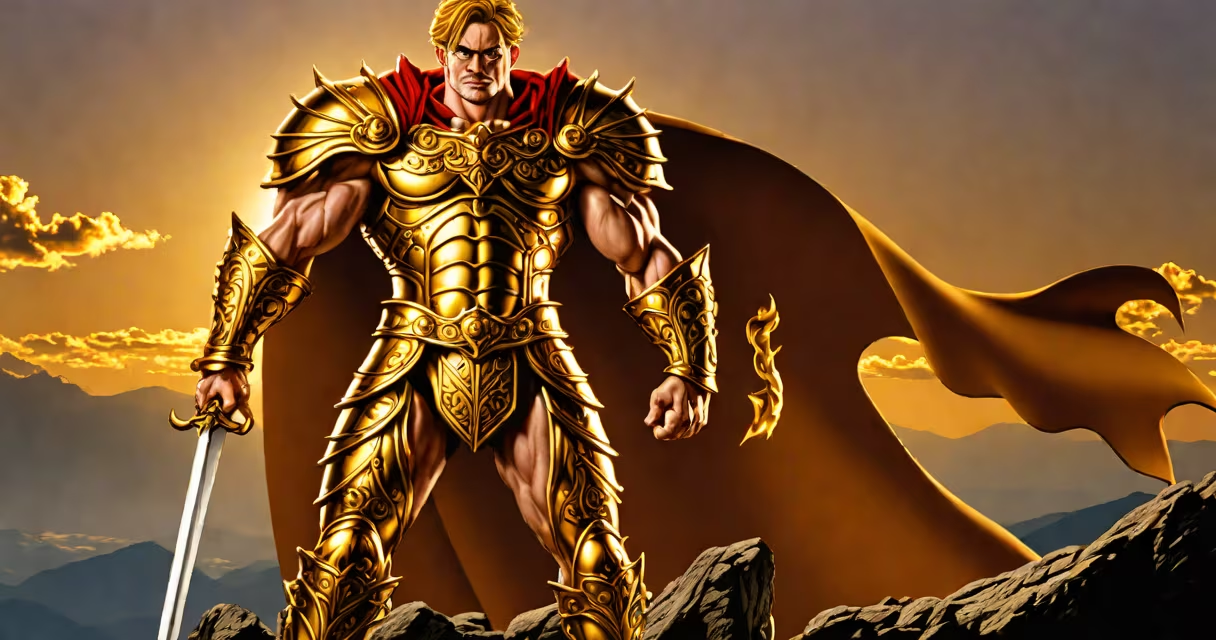
Escanor is a fictional character in the anime and manga series *Frieren: Beyond Process's End* who personifies the seven deadly sins through his immense power, emotional volatility, and tragic origin. He is not a literal embodiment of each sin, but his traits align closely with pride, wrath, and the destructive potential of unchecked desire.
Created by author Takeru Hagiwara, Escanor appears as a warrior whose strength peaks at noon and vanishes at midnight. His physical form radiates golden light, symbolizing divine power corrupted by human ambition. He is not a sinner in the traditional religious sense, but his narrative functions as a modern allegory for the seven deadly sins-especially pride and wrath-through psychological and symbolic representation.
The concept of the seven deadly sins originated in Christian theology as vices that lead to spiritual downfall. In *Frieren*, Escanor's story mirrors this structure: his power grows from consuming others' life force, reflecting gluttony and envy. His obsession with being the strongest reflects pride. His violent outbursts during battle reveal wrath. These traits are not explicitly labeled as sins in the show, but their consequences mirror those described in medieval moral teachings.
Escanor's power is tied to time-he becomes strongest at noon, weakest at midnight. This cycle is central to his identity. During the day, he fights with godlike strength, believing himself invincible. At night, he becomes frail, vulnerable, and emotionally fragile. This duality reflects the internal conflict between ego and humility, a core theme in the original list of sins.
Pride manifests in Escanor's belief that he is superior to all others. He sees himself as the pinnacle of existence, worthy of worship. This is evident when he declares, "I am the strongest," not as boast, but as absolute truth. His pride isolates him from companionship and empathy. He cannot understand why others fear or reject him, not because he lacks intelligence, but because his self-worth is rooted in dominance, not connection.
Wrath emerges in his combat style. Escanor does not fight to protect-he fights to dominate. His attacks are brutal, precise, and designed to end conflict instantly. When provoked, he shows no restraint. A single strike can destroy entire fortresses. This reflects the sin of wrath not as anger, but as uncontrolled power. As the Catholic Church defines it, wrath is "the desire for revenge" or "excessive anger." Escanor's actions are not driven by emotion-they are calculated destruction.
While Escanor is most linked to pride and wrath, other sins appear in his backstory and behavior:
| Sin | Manifestation in Escanor | Source Reference |
|---|---|---|
| Pride | Belief in his superiority; refusal to accept help or equality | Catechism of the Catholic Church, §1866 |
| Wrath | Instantaneous, overwhelming violence; lack of remorse | Thomas Aquinas, Summa Theologica, II-II, Q. 36 |
| Gluttony | Consumes life force from others to sustain power | St. Gregory the Great, Moralia in Job, Book 38 |
| Envy | Desires to surpass all others; resents those who challenge him | St. Thomas Aquinas, Summa Theologica, II-II, Q. 36 |
His consumption of life force-seen when he drains energy from enemies and allies alike-is a direct metaphor for gluttony. He does not eat food; he eats vitality. This act is not portrayed as evil in the narrative, but it is morally ambiguous. The show treats it as a necessity for survival, not a vice. Still, the act of taking life force without consent echoes the sin of gluttony as defined by early Christian writers.
Envy surfaces in his interactions with younger warriors. He mocks those who train hard, calling them "weak." Yet when someone challenges him and wins, he experiences shock and disbelief-not rage, but confusion. This suggests envy is not just jealousy of success, but fear of irrelevance. He fears being surpassed, which drives him to maintain dominance at all costs.
Many fans assume Escanor is a literal embodiment of all seven sins. This is incorrect. He is not a demon, nor a cursed entity. He is a human born with a rare condition-his body converts sunlight into energy. The sins are symbolic, not literal. His power is not granted by sin, but shaped by it.
Another misconception is that Escanor's weakness at night makes him powerless. In reality, his vulnerability is his greatest strength. At midnight, he loses his power, but gains clarity. He remembers his past, feels regret, and understands loss. This shift is critical-the show uses it to show that true strength lies not in dominance, but in self-awareness.
A lesser-known fact: Escanor's name is derived from "Escanor," a variant of "Scandar," meaning "one who rises." This ties to the idea of ascension-spiritual or physical. In medieval art, pride was often depicted as a figure climbing a tower toward heaven. Escanor's golden form and towering presence echo this imagery. His rise is not divine-it is human-made, fueled by ambition.
When I first watched *Frieren*, I expected Escanor to be a villain. Instead, he became one of the most tragic figures in the series. His arc mirrors real-world patterns of leaders who lose themselves in power. Think of historical figures like Napoleon or Genghis Khan-men who rose to unmatched strength, then fell due to isolation and unchecked ambition. Escanor is not a warning against power itself, but against the belief that power equals worth.
Consider the scene where Escanor battles a group of young adventurers. He defeats them easily. But when one of them refuses to surrender and charges anyway, Escanor hesitates. He lowers his weapon. For the first time, he sees not a threat-but a person. That moment, lasting less than ten seconds, is the turning point. It's not victory, but recognition. This is the opposite of sin: it's grace.
Escanor is not a sinner in the church's sense. He is a man shaped by his environment, his biology, and his choices. The seven deadly sins serve as a lens-not a label. They help us understand his struggle, not define him. His story isn't about falling from grace. It's about rising above it.