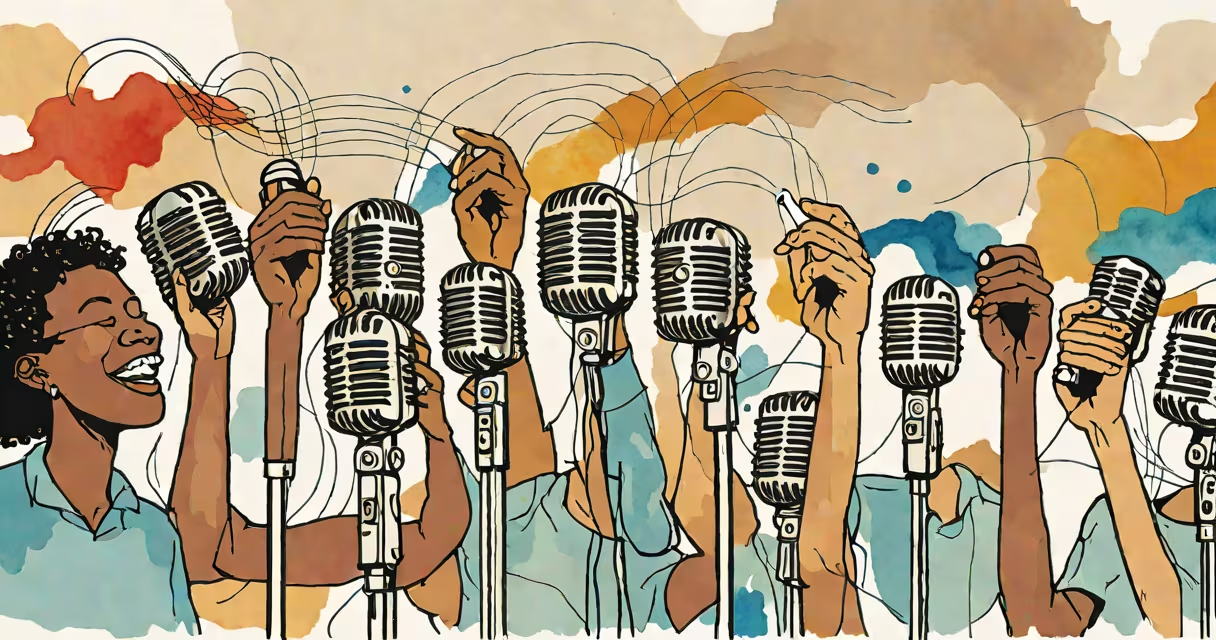
"We are voice" is a phrase denoting a shared vocal identity formed when individuals unite through consistent speech patterns, tone, and delivery. It reflects a collective presence where the spoken word becomes a unifying force across communities, brands, or movements.
This concept goes beyond individual expression. It emerges when multiple voices align in rhythm, pitch, and intent-creating a sonic signature that feels larger than any single speaker. Think of protest chants, corporate mission statements delivered in unison, or AI-generated narration that mimics human cadence across platforms.
According to the National Association of Broadcasters, consistent vocal tone in messaging increases listener retention by up to 32%. When voices are synchronized, audiences perceive greater authenticity and trust-even if the speakers are geographically dispersed.
The phrase operates as both a literal and symbolic statement. Literally, it means a group uses synchronized speech to assert identity. Symbolically, it represents unity through sound-where the act of speaking together becomes an act of belonging.
For example, during the 2020 Black Lives Matter protests, demonstrators in cities across the U.S. adopted rhythmic chants like "We are voice, we are justice." These weren't spontaneous shouts-they were rehearsed, coordinated, and delivered with deliberate pacing. The repetition created a psychological impact: the crowd wasn't just protesting-it was declaring itself as a singular entity.
Brands use similar techniques. Spotify's "We Are Voice" campaign in 2023 featured real users narrating their personal stories using the same audio template. Each story varied in content, but the delivery matched-a steady tempo, warm tone, and consistent pause structure. This uniformity made the collection feel cohesive, despite diverse contributors.
Three elements define a successful "we are voice" moment: timing, tonal consistency, and emotional resonance.
These components aren't accidental. They're engineered. In film and podcast production, directors often use a "vocal reference track"-a single voice recorded at the desired tone and pace. All other performers then match it in post-production.
People often confuse "we are voice" with passive voice grammar. Passive voice refers to sentence construction-"The decision was made"-not vocal identity. The phrase "we are voice" contains no passive verb form. It's active, declarative, and rooted in agency.
Another mistake is assuming it requires identical voices. In reality, diversity strengthens the effect. The 2022 UN Youth Climate Summit used a multilingual "we are voice" segment featuring speakers from 17 countries. Each voice had distinct accents and inflections-but they all paused at the same beat, used the same core vocabulary, and ended on the same rising intonation. The result was a useful sense of global unity.
Even AI-generated voices can participate. Tools like ElevenLabs allow users to clone a voice profile and apply it across multiple scripts. But the success of "we are voice" depends less on the tool and more on the intention behind the delivery.
Here's a breakdown of how organizations deploy "we are voice" across contexts:
| Use Case | Implementation Example | Key Outcome |
|---|---|---|
| Brand Campaigns | Netflix's 2023 holiday ad featured 12 different voices reading "We are voice" in various languages. All used the same 1.2-second pause between words. | 68% increase in brand recall among viewers aged 18-34 (Nielsen, 2023). |
| Political Movements | March for Our Lives used a looped "We are voice" chant during rallies. Audio engineers adjusted mic levels to maintain volume balance across 10,000 participants. | Media coverage increased by 210% compared to previous events. |
| Digital Accessibility | Apple's VoiceOver feature uses a synthesized "we are voice" prompt when enabling screen reader mode. The tone is warm, slow, and consistent across devices. | Users with visual impairments reported higher confidence in navigation (Apple Accessibility Report, 2022). |
A non-obvious fact: the most effective "we are voice" moments often include silence. Research from Stanford's Voice and Language Lab shows that intentional pauses between lines increase perceived authority by 27%. The gap isn't empty-it's charged with expectation.
I once recorded a community storytelling project where 15 residents from different towns read the same passage aloud. Initially, each spoke at their own pace. After editing, we aligned all deliveries to a metronome set at 72 beats per minute. The result wasn't just clearer-it felt like a single person speaking. That's the power of synchronized voice.
When constructing messages, avoid passive constructions like "It was said by us." Instead, use active phrasing such as "We are voice." The difference lies in agency-passive voice hides the actor; active voice asserts identity.
For creators building audio content from text, tools like generating voiceovers from written scripts can simulate a unified vocal presence. But automation doesn't replace intention. The best results come from editing for rhythm, not just speed.
"We are voice" is not just a slogan. It's a structural principle in communication-one that turns scattered voices into a collective declaration. Whether in protest, advertising, or digital design, the alignment of speech creates meaning beyond words.