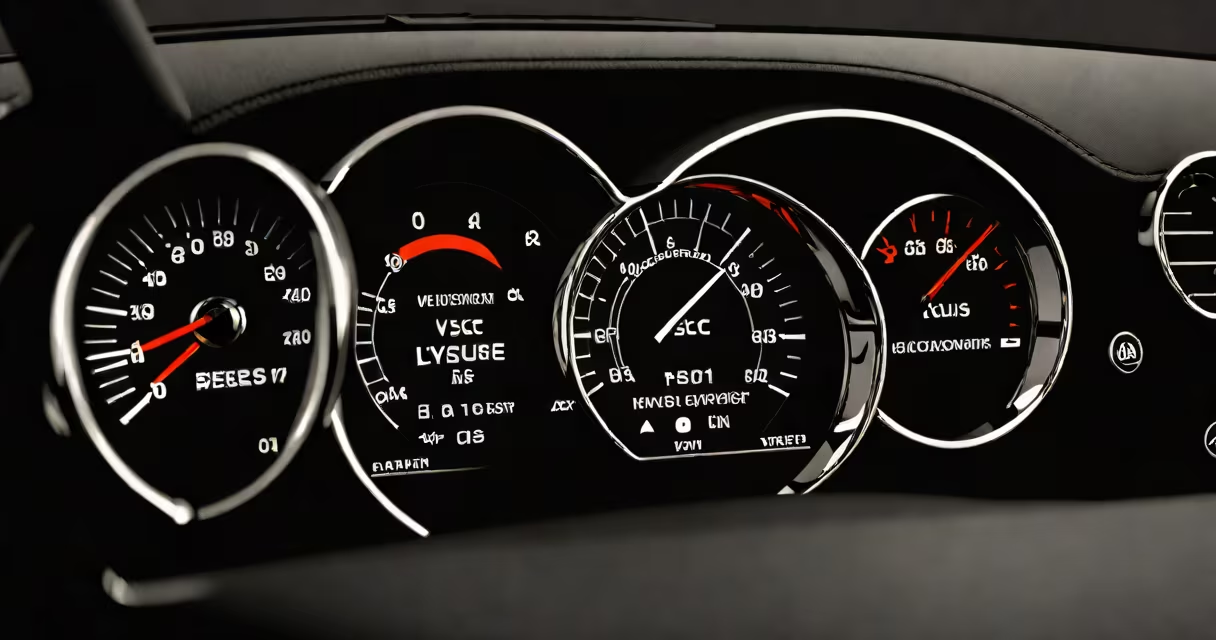
VSC in a Lexus stands for Vehicle Stability Control, a safety system that automatically applies brakes to individual wheels and reduces engine power to prevent skidding during sudden maneuvers or on low-traction surfaces.
When driving a Lexus, VSC activates without driver input whenever sensors detect loss of traction. It's part of the larger electronic stability control (ESC) set, standard on all modern Lexus models. The system uses wheel speed, steering angle, and yaw rate sensors to assess vehicle behavior in real time.
For example, if you enter a curve too quickly on wet pavement, VSC detects the car beginning to slide sideways. It then selectively brakes the outer front wheel and may reduce throttle to realign the vehicle with the intended path. This happens within milliseconds, often before the driver feels the drift.
VSC monitors four key inputs: wheel speed, steering wheel position, lateral acceleration, and yaw rate. If the car begins to understeer (front wheels lose grip) or oversteer (rear wheels lose grip), the system intervenes.
Understeer occurs when the front wheels don't turn enough, causing the car to continue straight despite steering input. Oversteer happens when the rear end swings out, potentially leading to a spin. VSC corrects both by applying brake pressure to specific wheels and adjusting engine output.
A real-world test by the Insurance Institute for Highway Safety (IIHS) showed that vehicles with ESC systems like VSC reduced single-vehicle crashes by 35% compared to those without. The National Highway Traffic Safety Administration (NHTSA) reports that ESC reduces fatal single-vehicle crashes by 47%.
Many drivers assume VSC disables traction during off-road driving. That's incorrect. VSC remains active unless manually turned off via the VSC OFF button. Disabling it is only recommended in rare cases, such as when stuck in deep snow and needing to rock the car free.
Another myth is that VSC replaces driver skill. It doesn't. VSC improves safety but cannot compensate for excessive speed, poor judgment, or distracted driving. A 2021 study by the University of Michigan Transportation Research Institute found that drivers who relied solely on stability control were more likely to misjudge stopping distances.
Some owners also confuse the VSC warning light with a mechanical failure. The light flashes briefly when the system engages during cornering-it's normal. But if it stays on continuously, it indicates a fault in the system, such as a sensor issue or software glitch.
All current Lexus vehicles include VSC as standard. However, the level of integration varies by model and year. Here's how different generations differ:
| Model Series | Year Range | Key Features |
|---|---|---|
| ES 350 | 2018-2023 | Standard VSC with traction control; automatic brake assist |
| LC 500 | 2020-2023 | Enhanced VSC with changing stability tuning; performance mode override |
| RX 350 | 2019-2023 | Adaptive VSC; adjusts sensitivity based on road conditions detected by camera |
The RX 350's adaptive system uses forward-facing cameras to detect road markings and adjust VSC response accordingly. On highways, it allows slightly more drift for better handling. On winding mountain roads, it tightens control to prevent overcorrection.
If the VSC warning light remains illuminated while driving, it signals a system fault. The most common causes include a faulty yaw rate sensor, worn wheel speed sensor, or software error.
I once encountered a 2020 Lexus RX 350 with the VSC light on constantly. After checking the diagnostic codes, we found a loose connection in the steering column wiring use. Replacing the connector resolved the issue. The car had no prior accidents or fluid leaks-just a single loose wire.
Do not ignore a persistent VSC light. Driving with the system disabled increases the risk of losing control on slippery surfaces. If the light stays on, visit a certified Lexus technician. Most dealerships offer free diagnostics through the Lexus Roadside Assistance program.
Disabling VSC is rarely necessary. The only valid reasons are:
Even then, re-enable VSC immediately after exiting low-traction environments. Leaving it off increases accident risk. According to NHTSA, disabling ESC increases crash severity by 28% in adverse weather.
On newer Lexus models, pressing and holding the VSC OFF button for three seconds disables the system. A steady yellow light confirms the status. The system reactivates automatically when the ignition is turned off and back on.
Understanding VSC helps you drive safely in varied conditions. It's not a substitute for attention, but it's a proven tool that reduces accident rates. Always respect its limits-and never disable it without a clear reason.