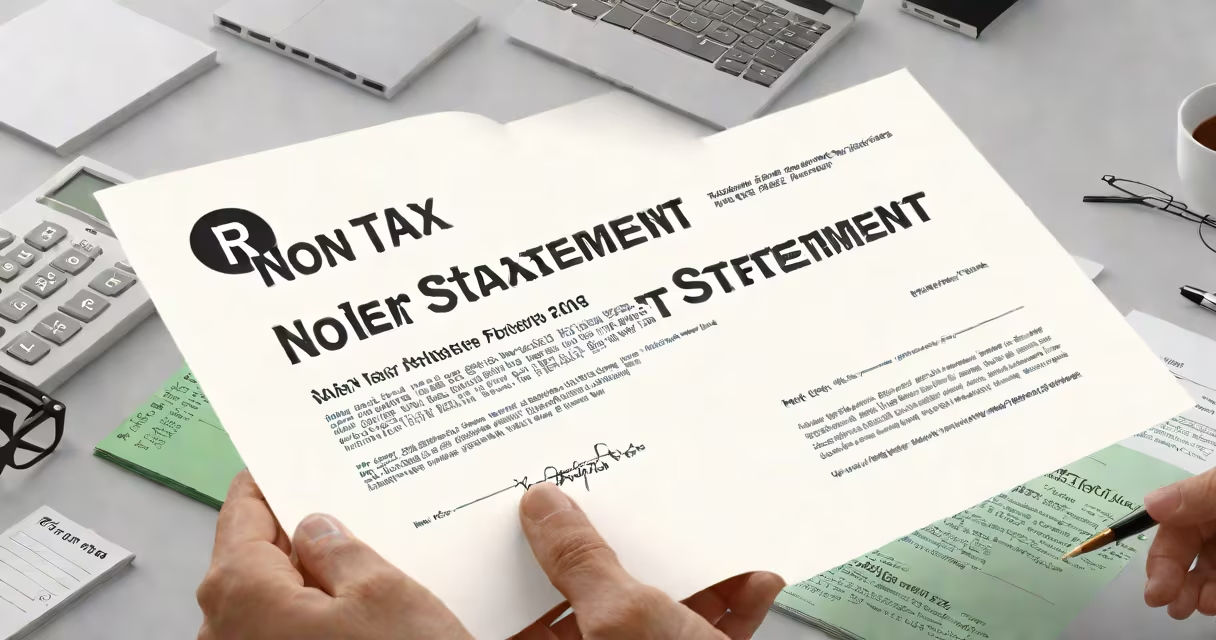
A non tax filer statement is a document that verifies an individual or entity does not have a federal income tax filing requirement due to low or no taxable income. It serves as proof for institutions, employers, or government agencies that the person is not obligated to file a federal income tax return.
The IRS defines non filers as individuals whose gross income falls below the threshold for mandatory filing. For 2023, this threshold was $13,850 for single filers under age 65. If income stays below this level, no return is required, and a non tax filer statement may be issued to confirm that status.
These statements are not forms filed with the IRS. Instead, they are created by the individual or a third party such as a payroll processor, financial institution, or nonprofit organization. They are used in contexts like student loan deferment, benefit applications, or employer verification.
A non tax filer statement functions as a self-certification. It states that the person's annual income did not exceed the IRS threshold for mandatory filing. The statement typically includes the name, Social Security Number, date of birth, and a declaration of income level.
For example, a college student earning $8,000 in part-time work during the year would not need to file a federal tax return. A school administrator might request a non tax filer statement to verify eligibility for a tuition deferment program. The student provides the statement, which the school uses to approve the deferral.
Some organizations require a signed, dated statement. Others accept a digital version with a secure signature. The IRS does not issue or authenticate these documents. They are not official tax forms and do not replace Form 1040 or Form 1040-SR.
Common users include students, retirees on fixed incomes, low-wage workers, and dependents. These groups often earn below the filing threshold and may need to prove their non-filing status to access benefits or services.
Examples of usage:
According to the IRS Publication 501, "If your gross income is less than the standard deduction amount, you generally don't have to file a return." This rule applies to most non filers. However, even if not required, some people choose to file to claim refundable credits like the Earned Income Tax Credit (EITC).
There is no standardized template for a non tax filer statement. Institutions may create their own formats. The document usually contains:
Confusion often arises between a non tax filer statement and actual IRS forms. A non tax filer statement is not a substitute for Form 1040. It cannot be used to claim refunds or credits. It only confirms that filing is not required.
Another misconception is that being a non filer means avoiding taxes entirely. That's false. Non filers still pay payroll taxes (FICA), sales taxes, property taxes, and excise taxes. They may also owe self-employment tax if they earned income through freelance work.
For example, a retiree receiving $22,000 annually from Social Security and a pension may still be exempt from federal income tax filing. But they still pay Medicare premiums and state taxes. A non tax filer statement only addresses federal income tax obligations.
"Non filer" refers to someone who does not file a return because income is below the threshold. "Non filing status" is a term used in IRS systems to describe accounts that haven't submitted returns. These are different concepts.
IRS records track non filers for enforcement purposes. If someone fails to file when required, they may face penalties. But if income is truly below the threshold, no penalty applies. A non tax filer statement helps clarify this distinction when needed.
For instance, a 2022 IRS report found that 31 million taxpayers had adjusted gross income below $10,000. Of those, 24 million were not required to file. A non tax filer statement can help verify this status during audits or benefit applications.
In 2023, a single mother working two part-time jobs earned $12,500. Her income was below the $13,850 threshold. She did not file a tax return. When applying for a subsidized childcare program, she was asked to provide documentation proving her income was too low to require filing.
She drafted a non tax filer statement stating:
I, Jane Doe, SSN XXX-XX-XXXX, certify that my gross income for 2023 was $12,500. This amount is below the IRS threshold for mandatory federal income tax filing. I am not required to file a federal income tax return for 2023. I understand this statement is for verification purposes only.
Signature: ___________________ Date: January 15, 2024
The childcare agency accepted the statement and approved her application. No IRS form was involved. The document served as proof of non-filing status.
One non-obvious fact: Even if you're a non filer, you may still be eligible for certain tax benefits. The IRS allows individuals with low income to claim the EITC, Child Tax Credit, and additional child tax credit-even if they don't file a return. But to receive the credit, you must file a return.
This creates a paradox: You're not required to file, but you may lose money if you don't. A non tax filer statement does not resolve this. It only confirms non-filing status. To claim benefits, you must file.
Another key point: Non tax filer statements are not auditable by the IRS. They are not recorded in IRS databases. If challenged, the recipient must provide supporting evidence such as pay stubs, bank statements, or tax transcripts.
When in doubt, consult IRS Publication 501 or speak with a tax professional. If you're managing a program that accepts these statements, ensure they meet basic criteria: clear identification, accurate income reporting, and a signed declaration.
Understanding what a non tax filer statement is-and what it isn't-helps avoid confusion and ensures proper use in real-world scenarios.