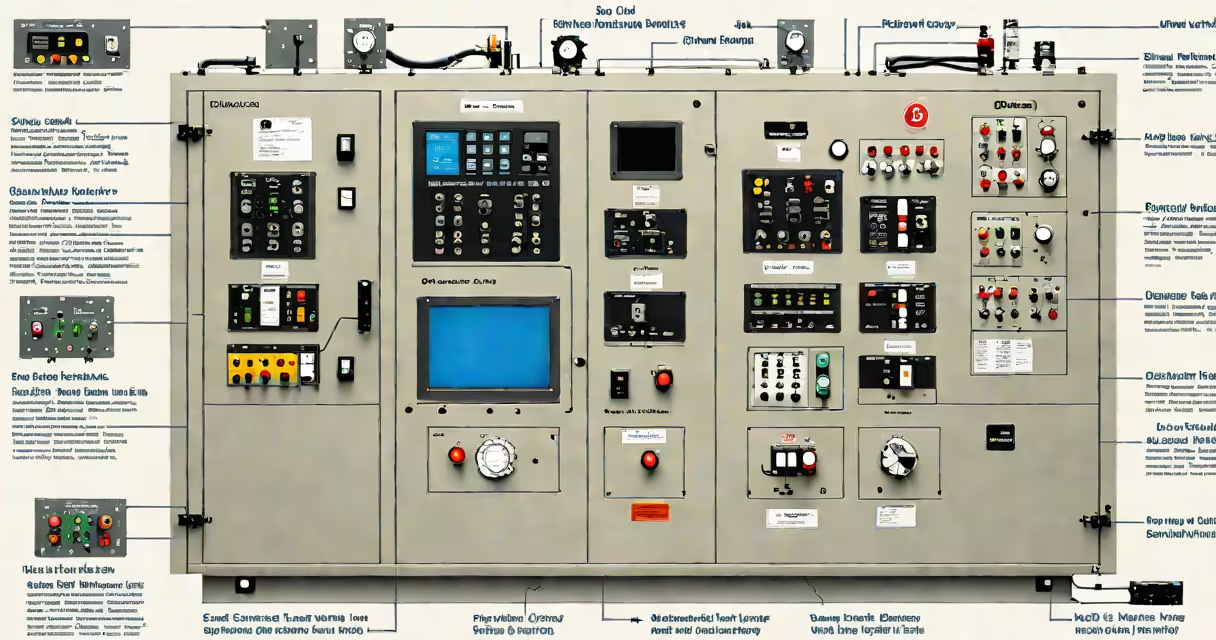
Allen Bradley is a brand of industrial automation equipment owned by Rockwell Automation, specializing in programmable logic controllers (PLCs), human-machine interfaces (HMIs), motor controls, and industrial networking systems used in manufacturing and process industries.
Founded in 1901 by Leslie Allen and Lynde Bradley, the company became a leader in electrical control systems during the 20th century. Today, Allen Bradley products form the core of automated production lines in automotive, food and beverage, pharmaceutical, and energy sectors. These systems manage machine sequencing, safety interlocks, and real-time monitoring across global facilities.
Allen Bradley devices are designed for rugged environments-resistant to vibration, temperature extremes, and electromagnetic interference. They operate within industrial networks such as EtherNet/IP and DeviceNet, enabling smooth communication between sensors, drives, and supervisory systems. The brand's integration with Rockwell's FactoryTalk software set allows for centralized monitoring and predictive maintenance.
At the core of Allen Bradley systems is the programmable logic controller (PLC). A PLC reads inputs from sensors-such as limit switches, photoelectric cells, or pressure transducers-and processes them according to a custom program. Based on this logic, it sends outputs to actuators like solenoids, motors, or valves.
For example, in a bottling plant, a sensor detects a bottle entering a labeling station. The Allen Bradley SLC 500 PLC receives the signal, checks if the label is available, and activates a servo-driven applicator. This entire cycle occurs in under 200 milliseconds, synchronized with conveyor speed via encoder feedback.
Programming is done using Rockwell's RSLogix 5000 software, which uses ladder logic-a graphical programming language resembling electrical schematics. Engineers write rungs of logic that represent conditions: "IF sensor A is ON AND timer T1 has expired, THEN activate valve V2." This structure reduces errors and improves readability compared to traditional code.
Allen Bradley offers several product families tailored to different industrial needs. The most common include:
| Product Line | Use Case | Example Model | Typical Application |
|---|---|---|---|
| ControlLogix | High-performance control | 1756-L7x | Automotive assembly lines, high-speed packaging |
| CompactLogix | Mid-range automation | 1769-L33ER | Material handling, robotics integration |
| SLC 500 | Legacy and small-scale systems | 1747-L550 | Conveyor systems, batch processing |
| PowerFlex Drives | Motor speed and torque control | 20A-200V | Variable-speed pumps, fans, elevators |
Each system supports redundancy, cybersecurity features, and remote diagnostics. For instance, a PowerFlex 755 drive can communicate fault codes via EtherNet/IP, allowing maintenance teams to diagnose issues without visiting the machine.
A lesser-known fact: Allen Bradley's early relays were built with mechanical contacts that wore out after 100,000 operations. Modern solid-state relays in the GuardLogix series last over 1 million cycles and support safety-rated shutdowns-critical in high-risk environments like chemical plants.
Many assume Allen Bradley is a standalone company. It is not. Since 2001, Allen Bradley has operated under Rockwell Automation, headquartered in Milwaukee, Wisconsin. The brand identity remains distinct, but product development and support are unified under Rockwell's engineering standards.
Another confusion: Allen Bradley is not synonymous with "industrial automation" as a whole. While it dominates in North American manufacturing, competitors like Siemens (SIMATIC), Mitsubishi Electric (FX series), and ABB (AC500) serve similar markets. Allen Bradley's edge lies in tight integration with FactoryTalk and support for legacy systems in older factories.
Some users mistake the term "Allen Bradley" for a job role. It is not. You don't "become" an Allen Bradley technician-you become a certified Rockwell Automation technician trained on Allen Bradley hardware and software. Certification levels include Certified Control System Technician (CCST) and Rockwell Certified Professional (RCP).
In a warehouse sorting facility, a 2018 installation used five Allen Bradley CompactLogix 1769-L33ER controllers to manage 12 conveyor belts. Each belt had a photoeye at the start, a weight sensor midline, and a diverter gate at the end.
The logic was programmed to stop the belt if weight exceeded 15 kg (indicating a mislabeled package), then divert it to a manual inspection zone. The system used RSLogix 5000 to define the sequence: "IF photoeye triggers AND weight > 15kg AND gate is closed, THEN open gate and send alarm to HMI."
Over six months, the system reduced mis-sort incidents by 78% compared to the previous manual system. Data from the HMI showed 92% uptime, with most downtime due to power fluctuations-not software errors.
I once observed a failed PLC module in a bottling line that caused a $12,000 loss in production time. The issue was traced to a corrupted firmware update. After restoring from a backup and updating the configuration via a secure USB drive, the line resumed operation in 47 minutes-thanks to Allen Bradley's built-in recovery mode and encrypted file transfer protocol.
Allen Bradley systems are standard in U.S.-based manufacturing. According to Rockwell Automation's 2023 Global Industry Report, 63% of North American factories using advanced automation rely on Allen Bradley components. The adoption rate exceeds 50% in automotive and metal fabrication sectors.
These systems are preferred because they offer long-term support, consistent documentation, and compatibility with existing infrastructure. Many plants still run machines from the 1990s with Allen Bradley SLC 500 controllers-upgraded with newer I/O modules but unchanged in core function.
They're also used in critical infrastructure. For example, a water treatment plant in Indiana uses Allen Bradley ControlLogix systems to regulate chlorine dosing based on real-time pH readings. The system adjusts flow rates automatically and logs data for compliance with EPA regulations.
Understanding what is Allen Bradley means recognizing it as a foundational element of industrial automation. Its systems enable precision, reliability, and scalability in environments where failure is not an option.