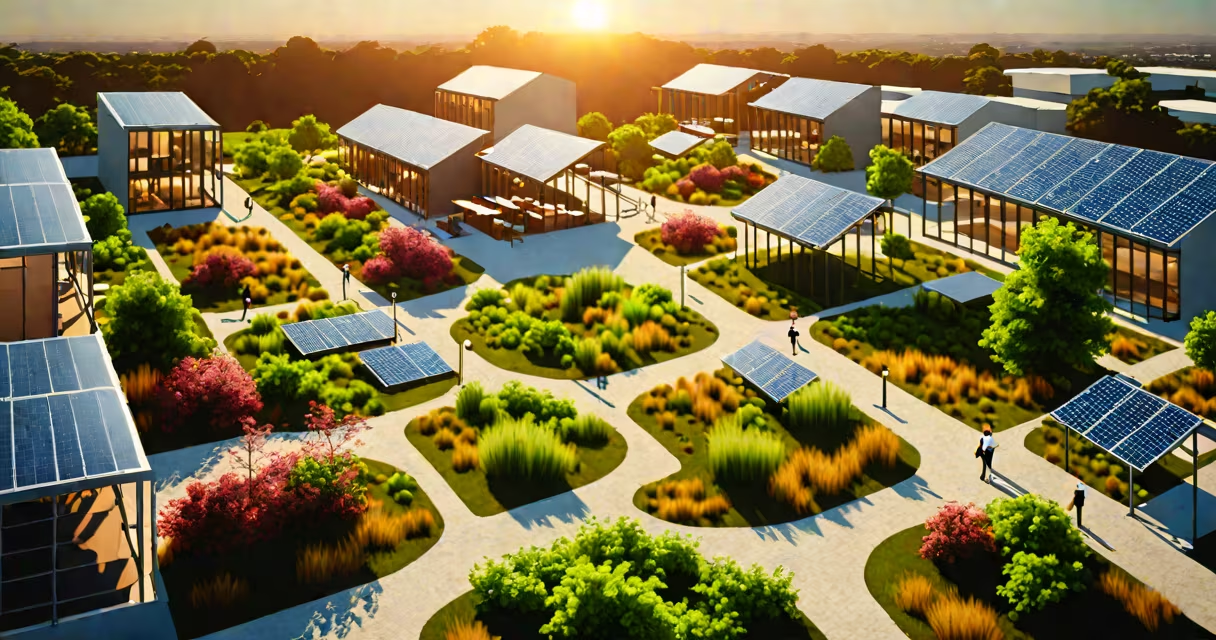
Sustainability refers to meeting present human needs without compromising the ability of future generations to meet their own. It balances environmental protection, economic development, and social well-being across time. This concept underpins global efforts to address climate change, resource depletion, and inequality.
The idea emerged from the 1987 Brundtland Report, which defined sustainability as "development that meets the needs of the present without compromising the ability of future generations to meet their own needs." This definition remains central to policy and practice worldwide. The United Nations Sustainable Development Goals (SDGs) build on it, setting measurable targets for poverty reduction, clean energy, responsible consumption, and biodiversity conservation.
Sustainability is not a single action or outcome. It's a structure applied across sectors-urban planning, agriculture, manufacturing, and education. A city that reduces emissions while expanding public transit, a farm that rotates crops to preserve soil health, or a company that uses recycled materials in production all embody sustainability. These actions aim for long-term resilience, not just immediate results.
Sustainability operates through interconnected systems. Environmental sustainability focuses on maintaining ecosystems and reducing pollution. Economic sustainability ensures resources are used efficiently and fairly. Social sustainability promotes equity, access to education, healthcare, and fair labor practices. All three must align to prevent trade-offs that undermine progress.
For example, a factory producing electric vehicles may reduce carbon emissions (environmental), create jobs (economic), and improve air quality in nearby communities (social). But if it sources cobalt from mines with child labor, the social pillar fails. True sustainability requires auditing each stage of a product's lifecycle.
Life cycle assessment (LCA) tools quantify environmental impacts from raw material extraction to disposal. A 2020 study by the European Environment Agency found that 60% of global greenhouse gas emissions come from just 100 companies. This highlights how sustainability isn't just individual behavior-it demands systemic change in corporate and government decision-making.
Sustainability is often broken into three pillars: environmental, economic, and social. These are sometimes called the "three Es": environment, economy, and equity. Some models include a fourth-governance or ethics-but the core triad remains standard.
| Pillar | Focus Area | Concrete Example |
|---|---|---|
| Environmental | Resource conservation, emissions reduction | Using renewable energy to power factories |
| Economic | Long-term profitability, fair wages | Payroll systems that ensure living wages across supply chains |
| Social | Health, safety, inclusion | Providing mental health support for employees in high-stress roles |
Some organizations adopt circular economy models, where waste becomes input. The Ellen MacArthur Foundation reports that transitioning to circular systems could reduce global CO₂ emissions by 39% by 2050. This shows how sustainability isn't just about less harm-it's about designing systems that regenerate.
Sustainability is frequently misunderstood as synonymous with "green" or "eco-friendly." But a product labeled "biodegradable" may still require high water use or contribute to deforestation. True sustainability considers full impact, not just one metric.
Greenwashing is a major issue. In 2021, the Federal Trade Commission issued guidance clarifying that companies cannot claim "sustainable" unless they have evidence. For example, a clothing brand advertising "sustainable cotton" must prove it sourced from farms using less water and fewer pesticides. Without verification, such claims mislead consumers.
A lesser-known distinction: sustainability is not the same as resilience. Resilience means enduring shocks-like a drought or supply chain disruption. Sustainability means thriving over time within planetary boundaries. A community might survive a flood (resilient), but if it rebuilds using non-renewable materials and increases pollution, it's not sustainable.
In 2018, the city of Copenhagen set a goal to become carbon neutral by 2025. They achieved this through integrated policies: district heating powered by waste-to-energy plants, expansion of cycling infrastructure, and retrofitting buildings for energy efficiency. By 2023, 42% of the city's energy came from renewables, and emissions dropped 42% since 2005.
This success wasn't accidental. The city used data-driven planning, engaged citizens in design workshops, and tied funding to measurable outcomes. For example, every new housing project had to achieve a minimum energy performance rating. These standards ensured sustainability was embedded in implementation, not just aspiration.
I observed this process firsthand during a 2022 visit. At a community center in Nørrebro, residents reviewed quarterly sustainability reports. One resident noted, "We're not just saving money-we're building trust in our leaders." That sense of ownership is critical. Sustainability fails when imposed top-down without local input.
Sustainability is not solely about protecting forests or reducing plastic. It's about justice. Climate change disproportionately affects low-income populations and marginalized regions. The World Bank estimates that 132 million people could fall into extreme poverty by 2030 due to climate-related disruptions. Addressing this requires sustainable development that includes adaptation and equity.
Even food systems reflect this. Industrial agriculture produces high yields but degrades soil and relies on synthetic fertilizers. In contrast, agroecology-using natural processes like crop rotation and polyculture-can maintain productivity while restoring soil health. A 2022 study in *Nature Sustainability* found that agroecological farms in sub-Saharan Africa increased yields by 20% over five years while improving biodiversity.
These examples show that sustainability isn't a vague ideal. It's a set of actionable strategies grounded in science and ethics. It requires transparency, accountability, and continuous improvement. As the Intergovernmental Panel on Climate Change (IPCC) states, "Limiting warming to 1.5°C requires rapid, far-reaching, and new changes in all aspects of society." That's the scale of commitment sustainability demands.