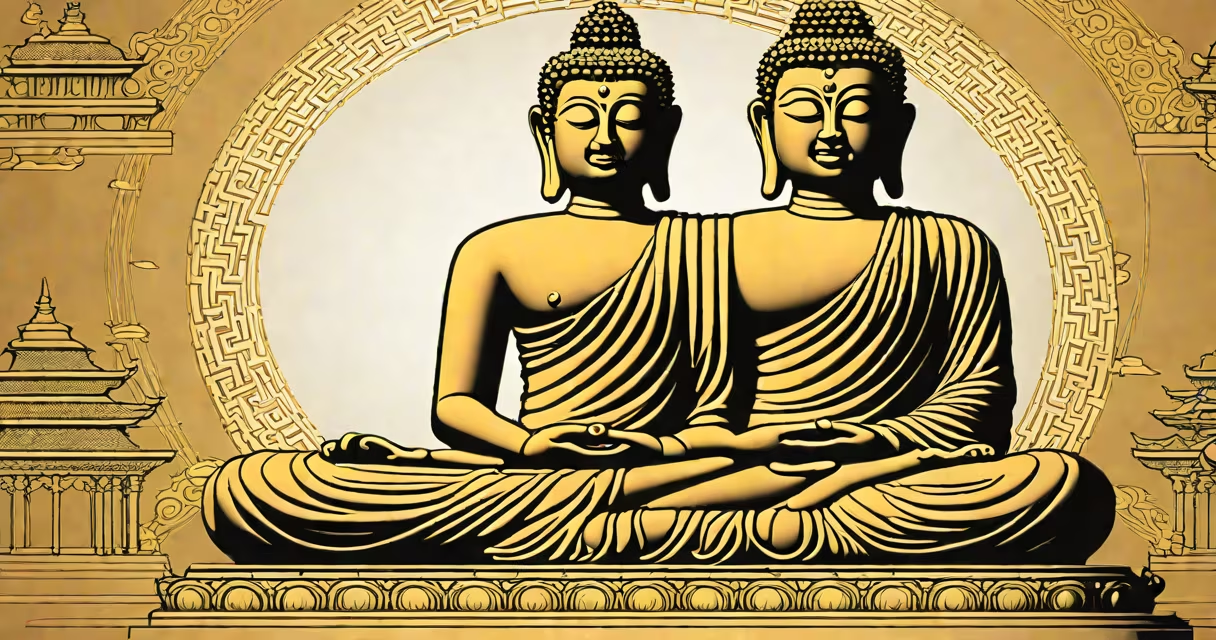
The name Buddha means "awakened one" or "enlightened one," derived from the Sanskrit root *bodh*, meaning "to awaken" or "to understand." It refers to someone who has achieved full enlightenment (*bodhi*) and transcended suffering through insight into the nature of reality.
Buddha is not a personal name but a title. It denotes a state of consciousness rather than a specific individual. The most historically recognized figure bearing this title is Siddhartha Gautama, born in the 5th-6th century BCE in Lumbini, present-day Nepal. He attained enlightenment under the Bodhi tree in Bodh Gaya, India, and spent the rest of his life teaching the path to liberation from suffering.
According to the Pali Canon, one of the earliest collections of Buddhist texts, the term *Buddha* applies to anyone who independently discovers the Four Noble Truths and the Eightfold Path. This includes past and future enlightened beings. The historical Buddha is often called Shakyamuni, meaning "Sage of the Shakya clan," to distinguish him from others who have attained Buddhahood.
The word *Buddha* comes from the Sanskrit verb *budh*, meaning "to wake up" or "to become aware." It is related to the concept of *bodhi*, which translates to "awakening" or "enlightenment." In Pali, the liturgical language of Theravāda Buddhism, the term is spelled *Buddha* and pronounced similarly.
When Siddhartha Gautama reached enlightenment, he was described as having "woken up" to the true nature of existence-impermanence, suffering, and non-self. This awakening was not supernatural but a result of deep meditation, ethical living, and direct insight. The title Buddha reflects this transformation from ignorance to wisdom.
Modern scholars such as Donald S. Lopez Jr., author of *Buddhism: A Very Short Introduction*, confirm that the term *Buddha* originally referred to a person who had achieved full awakening. It was later adopted as a proper noun for the founder of Buddhism, though the title remains applicable to any being who attains complete enlightenment.
Buddhist traditions recognize different categories of Buddhas based on their role and level of attainment. These distinctions reflect evolving interpretations across schools of thought.
| Type | Description | Examples |
|---|---|---|
| Samyak-sambuddha | A fully awakened Buddha who discovers the Dharma independently and teaches it to others. | Siddhartha Gautama (Shakyamuni) |
| Pratyekabuddha | An enlightened being who achieves awakening alone but does not teach the Dharma. | Individuals who realize truth through solitary practice, not public teaching. |
| Arhat | A disciple who has attained liberation but has not fully awakened to universal truth. | Disciples of the historical Buddha who reached Nirvana but did not become Buddhas. |
In Mahāyāna Buddhism, the idea of multiple Buddhas across time and space expands the concept. Figures like Amitābha Buddha (associated with Pure Land Buddhism) and Maitreya (the future Buddha) represent different aspects of enlightenment. These are not literal people but symbolic representations of compassion, wisdom, and the potential for awakening in all beings.
One non-obvious distinction: the term *Buddha* is not used in early Buddhist texts to refer to a divine being or deity. It describes a human who achieved enlightenment through disciplined practice. This contrasts sharply with later religious developments where some Buddhas were deified and worshipped as saviors.
Many assume that "Buddha" is a religion or a god. It is neither. Buddha is a title, not a name. The religion founded by Siddhartha Gautama is called Buddhism, but the term itself does not include the word "Buddha" in its core identity.
Another common error is equating "Buddha" with peace or passivity. While compassion and nonviolence are central tenets, the teachings emphasize active engagement with reality. The Buddha taught that understanding suffering requires confronting it directly-not avoiding it.
For example, in the *Dhammapada*, a collection of verses attributed to the Buddha, he says: "All that we are is the result of what we have thought. The mind is everything. What we think, we become." This shows that enlightenment involves mental discipline, not mere stillness.
The name Buddha continues to influence culture, psychology, and personal development. In Western contexts, "Buddha" is often used metaphorically to describe someone who embodies calm, clarity, and presence. Mindfulness practices rooted in Buddhist meditation are now widely adopted in corporate wellness programs and clinical therapy.
Consider a 2022 study published in *JAMA Internal Medicine* analyzing mindfulness-based stress reduction (MBSR) programs. Researchers found that participants who completed eight weeks of training reported a 30% reduction in anxiety symptoms. The program's foundation lies in techniques developed by the historical Buddha over 2,500 years ago.
I once attended a silent retreat in rural Oregon where participants practiced Vipassanā meditation-direct observation of bodily sensations and thoughts. After seven days, I experienced a shift in perception: thoughts no longer felt like commands. They were simply events passing through awareness. That moment mirrored the Buddha's own realization under the Bodhi tree-seeing things as they truly are.
Names with similar roots appear across languages. For instance, the name *Abigail* (from Hebrew *Avigayil*) means "my father is joy," while *Genevieve* (from Old French *Genoveva*) means "woman of the tribe" or "born of the tribe." These names carry cultural weight but differ in origin and meaning from *Buddha*.
Still, the spiritual intent behind naming varies. In some cultures, children are named after virtues or ideals. A child named *Bodhi* in modern India may be chosen to symbolize the aspiration for wisdom and awakening. Similarly, parents in the West sometimes choose names like *Siddhartha* or *Ananda* (meaning "bliss") to reflect philosophical values.
The name Buddha signifies not a person, but a state-a recognition that awakening is possible for anyone willing to see. Its meaning persists not in ritual, but in practice: observing, questioning, and releasing attachment to fixed ideas.