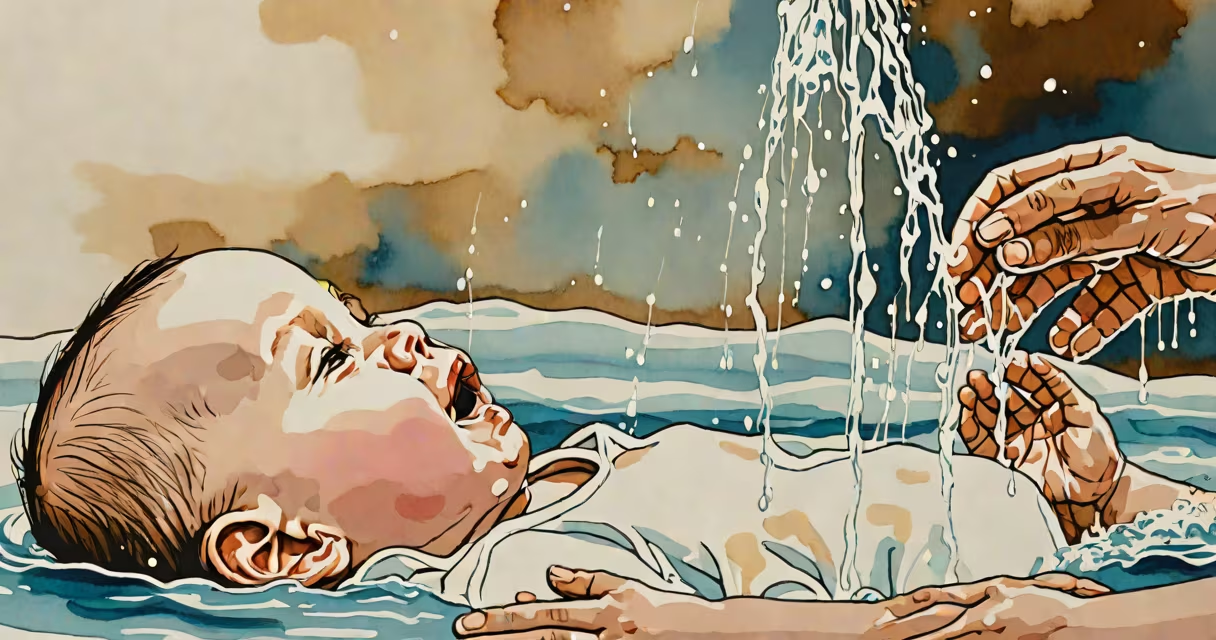
Baptism is a Christian sacrament marking spiritual rebirth, cleansing from original sin, and formal entry into the faith community. It involves immersion, pouring, or sprinkling of water, often accompanied by a declaration of faith.
Baptism is not merely symbolic-it is a foundational act in most Christian traditions. It signifies the believer's union with Christ in death and resurrection, as described in Romans 6:4: "We were therefore buried with him through baptism into death..." The act represents dying to sin and rising to new life in Christ.
The practice varies widely across denominations. Catholics, Orthodox Christians, and many Protestants view baptism as essential for salvation. In contrast, some evangelical groups emphasize believer's baptism-administered only after personal faith confession. These differences reflect deeper theological distinctions about grace, free will, and church authority.
Baptism typically follows a structured sequence: the candidate (infant or adult) is presented before the congregation, a prayer is offered, water is applied, and a blessing is pronounced. The water is not just a physical element-it is understood as a conduit of divine grace.
In Catholic theology, baptism imparts sanctifying grace and removes original sin. According to the Catechism of the Catholic Church, "Baptism is the basis of the whole Christian life, the gateway to life in the Spirit..." This doctrine positions baptism as the first step in becoming a member of the Church, the Body of Christ.
For many Protestant denominations, such as Baptists, baptism is a public profession of faith. It is not seen as conferring grace automatically but as a visible testimony of inner conversion. As stated in Acts 2:38, Peter says, "Repent and be baptized, every one of you, in the name of Jesus Christ for the forgiveness of your sins." This highlights baptism as an act of obedience following belief.
The method of water application reflects theological emphasis. The three primary forms are immersion, affusion (pouring), and aspersion (sprinkling).
| Type | Method | Common Denominations | Symbolic Focus |
|---|---|---|---|
| Immersion | Full submersion in water | Baptist, Churches of Christ, some Pentecostals | Dying and rising with Christ; complete cleansing |
| Affusion | Pouring water over the head | Catholic, Anglican, Lutheran | Grace received through ritual; continuity with ancient practice |
| Aspersion | Sprinkling water on the head | Some Reformed, Methodist, and Orthodox churches | Accessibility in limited space or medical conditions |
Immersion is the oldest form, supported by early Christian art and writings. The Didache, a first-century Christian document, instructs: "Baptize in living water... If you have no living water, baptize in other water." This shows flexibility based on context.
Non-immersion methods are not less valid in many traditions. The Catholic Church permits affusion and aspersion when immersion is impractical. The United States Conference of Catholic Bishops notes that "the essential elements of the rite remain unchanged regardless of the mode of baptism."
Baptism remains central in Christian worship. Over 2.4 billion people identify as Christian globally, and nearly all denominations perform the rite. In the U.S., about 60% of Christians report being baptized, according to Pew Research Center (2023).
Adult baptisms occur in contexts like mission work, prison outreach, or personal conversions. A 2021 study by the Pew Research Center found that 37% of U.S. adults who converted to Christianity reported being baptized after their conversion. This underscores baptism's function as both a spiritual milestone and a social marker.
Baptism is not a magic ritual that guarantees salvation. Some assume that being baptized ensures eternal life, but Christian doctrine emphasizes faith alongside the rite. The Apostle Paul writes in Ephesians 2:8-9: "For it is by grace you have been saved, through faith-and this is not from yourselves, it is the gift of God-not by works, so that no one can boast."
Another misconception is that baptism erases all past sins. While it cleanses original sin in Catholic and Orthodox teaching, personal sins committed after baptism require ongoing repentance and confession. The sacrament initiates grace but does not eliminate the need for continued spiritual growth.
There is also confusion between baptism and christening. In many English-speaking countries, "christening" refers specifically to the naming and blessing of infants, while "baptism" is the broader term encompassing all ages and rites. In practice, they often refer to the same event-but the distinction matters in liturgical settings.
In 2022, a family in Portland, Oregon, chose immersion baptism for their 3-year-old daughter. The parents had recently joined a Baptist church after moving from a secular background. They selected a local river for the ceremony due to its symbolic connection to biblical rivers like the Jordan.
The service included a 15-minute sermon on John 3:5: "Very truly I tell you, no one can enter the kingdom of God unless they are born of water and the Spirit." The child was baptized by a pastor using full immersion. Afterward, the family hosted a small reception with photos, a cake shaped like a dove, and a certificate stating the date and location of the baptism.
This example illustrates how baptism functions as both a religious act and a cultural milestone. The family later reported feeling a stronger sense of belonging to their church community. The child's godmother, who had previously served as a volunteer at youth camp, took on increased responsibility in her spiritual development.
Baptism is not a one-time event with no lasting effect. It marks the beginning of a lifelong process of discipleship. For many, it is the first step in a series of faith commitments-including confirmation, communion, and service.
The significance of baptism lies in its dual nature: it is both a personal transformation and a communal affirmation. Whether performed in a cathedral, a community center, or a riverbank, it continues to shape lives across generations.