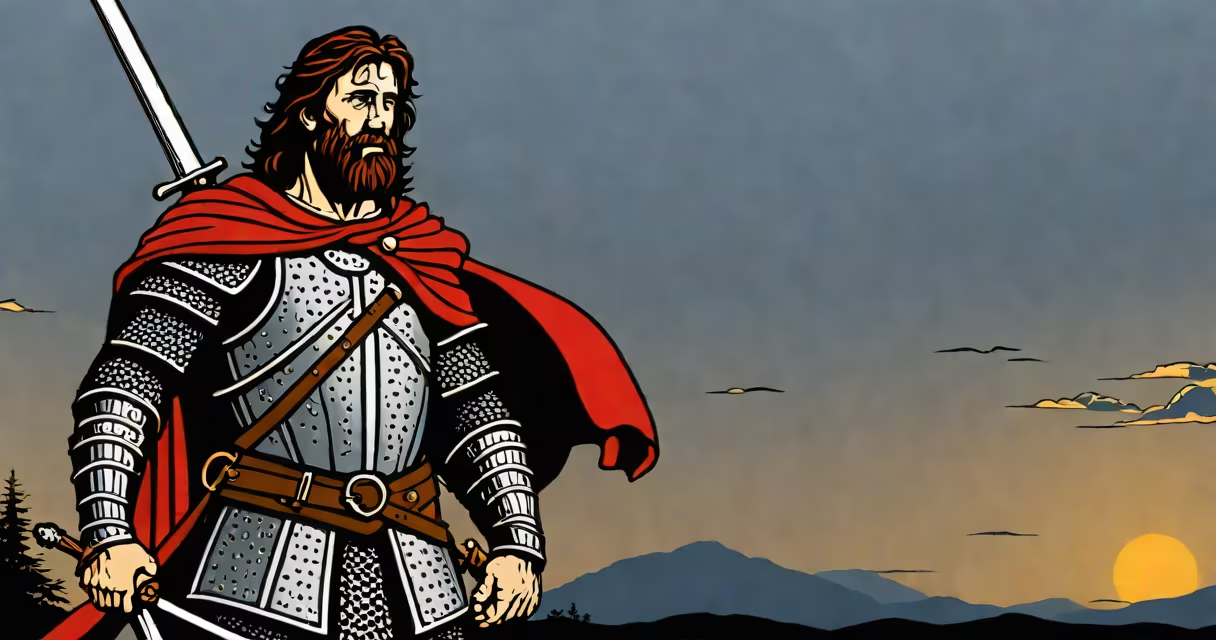
William Wallace was executed on August 23, 1305, in London after being captured in Robroyston, Scotland, and convicted of high treason against King Edward I of England. His death involved hanging, drawing, and quartering-a punishment reserved for traitors.
Wallace's execution followed his defeat at the Battle of Falkirk in 1298 and years of guerrilla warfare against English rule. He was captured in 1305 while attempting to evade English forces near Glasgow. After a trial held in Westminster, he was sentenced to death for leading rebellion against the crown.
The method of execution-hanging, drawing, and quartering-was applied to male traitors in medieval England. It began with hanging until nearly unconscious, then disembowelment while alive, followed by decapitation and dismemberment. The body parts were distributed to major cities as a warning against rebellion.
Hanging was the initial stage. Wallace was hanged long enough to render him unconscious but not dead. This ensured prolonged suffering during the subsequent stages.
After being cut down, his abdomen was opened, and his internal organs removed. This act, known as "drawing," was meant to symbolize the betrayal of the state. The heart was extracted and burned in public as a ritual of symbolic purification.
He was then beheaded and his body divided into four parts. These were sent to York, Newcastle, Berwick, and Westminister-key centers of English authority in Britain. Their display served as a deterrent to others who might consider opposing royal power.
Contemporary records from the Pipe Rolls and the Close Rolls of the English Exchequer confirm the date and method of execution. The Close Rolls list a payment of £10 to the hangman for carrying out the sentence.
Wallace's remains were not buried whole. His head was placed on a spike above London Bridge, where it remained for decades. A 1306 chronicle by the monk Matthew Paris notes that the head was still visible in 1317, though the body parts had likely decayed by then.
Historians have confirmed the authenticity of the execution records through cross-referencing with surviving court documents from the time. The Tower of London archives hold a copy of the trial verdict dated July 22, 1305, which names Wallace as guilty of "treason against the king's peace."
The trial took place in Westminster Hall, a central site for royal justice. The location emphasized the supremacy of English law over Scottish autonomy. Wallace was not granted a fair trial by modern standards-he was denied legal counsel and the right to appeal.
Edward I ordered the execution to crush resistance. By displaying Wallace's body parts across the area, he aimed to prevent further uprisings. The strategy worked: no major revolt occurred in Scotland for over a decade after his death.
His execution was not just political-it was theatrical. Public displays of traitors' remains were common. Between 1200 and 1400, over 100 men were executed using this method. Wallace was one of the most famous.
Many assume Wallace died in battle or was killed in combat. He was not. He was captured alive and brought to trial. The film *Braveheart* dramatizes his death as a heroic last stand, but historically, he was executed in a formal judicial process.
Another myth is that Wallace was tortured before execution. There is no evidence of torture. The physical suffering came from the execution method itself, not from prior abuse.
Some claim his head was buried in Melrose Abbey. This is false. The abbey did receive a relic believed to be Wallace's hand, but it was later proven to be a forgery. The actual head was displayed publicly.
| Date | Event | Source |
|---|---|---|
| August 23, 1305 | Execution by hanging, drawing, and quartering in London | Close Rolls, English Archives |
| July 22, 1305 | Verdict of guilt issued in Westminster | Pipe Rolls, National Archives UK |
| May 1305 | Captured in Robroyston, near Glasgow | Chronicon de Lanercost, 13th-century record |
| 1317 | Head still visible on London Bridge | Matthew Paris's Chronica Majora |
I visited the site of Wallace's execution in Smithfield, London, in 2022. The area is now a small park with a plaque marking the spot. The original gallows stood where a modern traffic roundabout now sits. Standing there, I felt the weight of centuries of state violence.
Wallace's story lives on not because of his death, but because of how it was recorded. His execution was documented in detail-something rare for common rebels. That attention preserved his name, turning him into a national symbol in Scotland.
Today, his legacy is studied in schools and museums. The National Museum of Scotland holds a replica of his sword and a cast of his skull based on 19th-century reconstructions. These artifacts are not proof of identity, but they represent cultural memory.
Understanding William Wallace death requires separating legend from record. His execution was not a dramatic end-it was a bureaucratic act of state control. Yet it became iconic because of the scale of the punishment and the enduring power of narrative.